Your Trusted Houston Commercial Real Estate Brokerage
Viking Enterprise LLC is part of eXp Commercial, an agent-led, cloud-based commercial real estate brokerage with agents across the globe.
Email: [email protected]
Call: (281) 222-0433

Your Trusted Katy / Fulshear & Houston Commercial Real Estate Brokerage
Viking Enterprise LLC is part of eXp Commercial, an agent-led, cloud-based commercial real estate brokerage with agents across the globe.
Looking to invest, buy, sell or lease? We can help.
Looking to invest, buy, sell or lease? We can help.
FEATURED PROPERTIES



OUR FEATURED TENANTS & CLIENTS
eXp Commercial - Viking Enterprise Team's real estate network provides unparalleled commercial real estate services to Tenants and Landlords around the Katy- Houston area. Our knowledge, experience, and reputation sets us apart from many firms.
A commercial property owner might have various plans that would necessitate the services of a commercial real estate broker. Some of the common scenarios include:
1. Selling the Property: If the owner decides it’s time to sell the property, a commercial real estate broker can help determine the market value, market the property effectively, and negotiate with potential buyers to get the best possible price.
2. Leasing Space: For property owners looking to lease out part or all of their commercial space, a broker can help find suitable tenants, negotiate lease terms, and ensure the lease agreements meet all legal requirements and serve the owner’s best interests.
3. Acquiring More Properties: Owners looking to expand their portfolio would benefit from a broker's knowledge of the market, access to listings, and negotiation skills to secure additional properties at favorable terms.
4. Property Management: While not all brokers offer this service, some commercial real estate brokers or their affiliates offer property management services. This can be particularly appealing for owners who prefer a hands-off approach or are managing properties from a distance.
5. Market Analysis: Owners considering future developments, renovations, or rebranding of their property might engage a broker for a comprehensive market analysis. This helps in understanding current market trends, the demand for different types of spaces, and potential returns on investment for various strategies.
6. Refinancing: In situations where a property owner is looking to refinance their property, a commercial real estate broker can provide valuable insights into the property’s current market value, assist in gathering necessary documentation, and even help in finding the best financing options.
7. Partnership or Investment Opportunities: Owners interested in exploring partnerships, joint ventures, or seeking investors for expansion or development projects might use a broker to find and vet potential partners or investors.
8. Consulting on Zoning and Use Changes: When contemplating a change in the use of the property or dealing with zoning issues, a broker with experience in local regulations and the specific property type can provide guidance and strategic planning assistance.
9. Exit Strategy Planning: For owners looking to plan an exit strategy from their investment, whether it’s through a strategic sale or a gradual winding down of operations, brokers can provide market insights, timing advice, and valuation services to optimize the exit process.
In any of these scenarios, the expertise and services provided by a commercial real estate broker can save the property owner time and money, while also providing access to a wider network of potential buyers, tenants, and industry professionals. Give us a call today!
Reviews
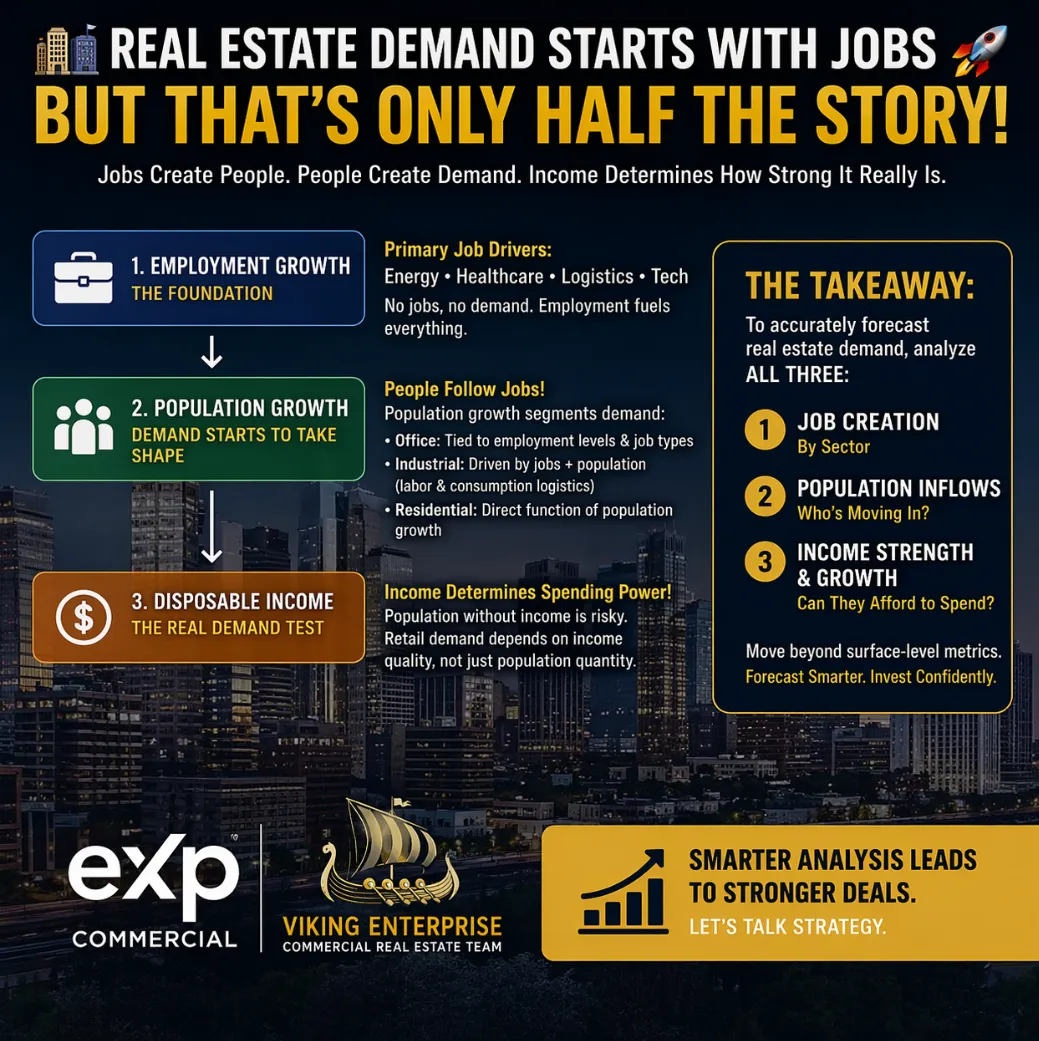
🚀 Real Estate Demand Starts With Jobs—But Income Is the Real Driver 💰
🚀 Real Estate Demand Starts With Jobs—But Income Is the Real Driver 💰
📊 Why Jobs Alone Don’t Predict CRE Demand (The Missing Income Layer) 🏢
Real Estate Demand Starts With Jobs—But That’s Only Half the Story
Most investors stop their analysis at job growth.
That’s where mistakes begin.
If you’re underwriting deals based only on employment trends, you’re missing the full demand equation—and exposing yourself to flawed assumptions that can quietly kill returns.
The Real Demand Model (What Actually Drives CRE Performance)
Real estate demand is not a single-variable equation. It’s layered:
Jobs → Population → Income → Demand Strength
Each layer builds on the one before it.
Miss one—and your deal doesn’t pencil the way you thought it would.
1. Employment: The Foundation of All Demand
Every real estate cycle starts with jobs.
In markets like Houston, primary job drivers include:
·Energy
·Healthcare
·Logistics
·Technology
These sectors create base employment, which fuels broader economic activity.
No jobs = no demand.
But here’s the problem:
Jobs tell you IF demand exists—not WHERE or HOW it shows up.
2. Population Growth: Where Demand Takes Shape
People follow jobs.
When employment expands, population inflows follow—and this is where demand begins to segment across asset classes:
·Office → Tied to job growth and job type (white-collar vs blue-collar)
·Industrial → Driven by both labor availability and consumer demand
·Residential → Direct function of population growth
This is where most investors feel confident.
They see rooftops going up—and assume everything else works.
That’s where deals go sideways.
3. Disposable Income: The Layer Most Investors Miss
Population growth alone does NOT equal strong demand.
Income quality determines demand strength.
This is where retail—and even parts of multifamily—can quietly fail.
You can have:
·Growing population
·Increasing employment
·Rising occupancy
…but still have weak retail performance if income levels don’t support spending.
Retail doesn’t follow rooftops.
Retail follows spending power.
Why This Matters for CRE Investors
If you’re analyzing deals using only job growth or population data, you’re making surface-level decisions.
Strong underwriting requires analyzing all three:
✔️ Job Creation (by sector) – What types of jobs are being created?
✔️ Population Inflows – Who is moving in, and why?
✔️ Income Strength – Can they actually afford to spend?
This is how you:
·Avoid overpaying for assets
·Identify early-stage growth markets
·Understand which asset classes will outperform
Houston Case Study: Why This Model Matters
In Houston, you’re seeing:
·Strong job growth in energy, healthcare, and logistics
·Continued population inflows into areas like Katy and Fulshear
·But income segmentation varies significantly by submarket
That means:
·Industrial continues to outperform (jobs + consumption)
·Retail is highly location-dependent (income-driven)
·Office demand is split based on job types
Same city. Different outcomes.
That’s the difference between surface-level analysis—and real underwriting.
The Investor Takeaway
If you remember one thing, it’s this:
Jobs create people.
People create demand.
Income determines how strong that demand really is.
This is the difference between:
·Buying based on headlines
·And investing based on fundamentals
Final Thought: Structure Beats Assumptions
Most bad deals don’t fail because of the market.
They fail because the investor misunderstood demand.
If you want to stay ahead:
·Think like a lender
·Underwrite beyond the headline numbers
·And always follow the full demand chain
That’s where the real opportunities are.
https://www.houstonrealestatebrokerage.com/
https://www.houstonrealestatebrokerage.com/houston-cre-navigator
https://www.commercialexchange.com/agent/653bf5593e3a3e1dcec275a6
http://expressoffers.com/[email protected]
https://app.bullpenre.com/profile/1742476177701x437444415125976000
https://author.billrapponline.com/
https://www.amazon.com/dp/B0F32Z5BH2
https://veed.cello.so/FOmzTty6oi9
https://buymeacoffee.com/vikingente3
https://creplaybookseries.billrapponline.com
https://creplaybook.billrapponline.com/
© 2023-2024 Bill Rapp, Broker Associate, eXp Commercial Viking Enterprise Team

eXp Commercial - Viking Enterprise team real estate network provides unparalleled commercial real estate services to Tenants and Landlords around the greater Katy & Houston MSA area. Our knowledge, experience, and reputation sets us apart from many firms.
A commercial property owner might have various plans that would necessitate the services of a commercial real estate broker. Some of the common scenarios include:
1. Selling the Property: If the owner decides it’s time to sell the property, a commercial real estate broker can help determine the market value, market the property effectively, and negotiate with potential buyers to get the best possible price.
2. Leasing Space: For property owners looking to lease out part or all of their commercial space, a broker can help find suitable tenants, negotiate lease terms, and ensure the lease agreements meet all legal requirements and serve the owner’s best interests.
3. Acquiring More Properties: Owners looking to expand their portfolio would benefit from a broker's knowledge of the market, access to listings, and negotiation skills to secure additional properties at favorable terms.
4. Property Management: While not all brokers offer this service, some commercial real estate brokers or their affiliates offer property management services. This can be particularly appealing for owners who prefer a hands-off approach or are managing properties from a distance.
5. Market Analysis: Owners considering future developments, renovations, or rebranding of their property might engage a broker for a comprehensive market analysis. This helps in understanding current market trends, the demand for different types of spaces, and potential returns on investment for various strategies.
6. Refinancing: In situations where a property owner is looking to refinance their property, a commercial real estate broker can provide valuable insights into the property’s current market value, assist in gathering necessary documentation, and even help in finding the best financing options.
7. Partnership or Investment Opportunities: Owners interested in exploring partnerships, joint ventures, or seeking investors for expansion or development projects might use a broker to find and vet potential partners or investors.
8. Consulting on Zoning and Use Changes: When contemplating a change in the use of the property or dealing with zoning issues, a broker with experience in local regulations and the specific property type can provide guidance and strategic planning assistance.
9. Exit Strategy Planning: For owners looking to plan an exit strategy from their investment, whether it’s through a strategic sale or a gradual winding down of operations, brokers can provide market insights, timing advice, and valuation services to optimize the exit process.
In any of these scenarios, the expertise and services provided by a commercial real estate broker can save the property owner time and money, while also providing access to a wider network of potential buyers, tenants, and industry professionals. Give us a call today!

Find the perfect location for your business.
Let us help your business succeed.
🚀 Real Estate Demand Starts With Jobs—But Income Is the Real Driver 💰
🚀 Real Estate Demand Starts With Jobs—But Income Is the Real Driver 💰
📊 Why Jobs Alone Don’t Predict CRE Demand (The Missing Income Layer) 🏢
Real Estate Demand Starts With Jobs—But That’s Only Half the Story
Most investors stop their analysis at job growth.
That’s where mistakes begin.
If you’re underwriting deals based only on employment trends, you’re missing the full demand equation—and exposing yourself to flawed assumptions that can quietly kill returns.
The Real Demand Model (What Actually Drives CRE Performance)
Real estate demand is not a single-variable equation. It’s layered:
Jobs → Population → Income → Demand Strength
Each layer builds on the one before it.
Miss one—and your deal doesn’t pencil the way you thought it would.
1. Employment: The Foundation of All Demand
Every real estate cycle starts with jobs.
In markets like Houston, primary job drivers include:
·Energy
·Healthcare
·Logistics
·Technology
These sectors create base employment, which fuels broader economic activity.
No jobs = no demand.
But here’s the problem:
Jobs tell you IF demand exists—not WHERE or HOW it shows up.
2. Population Growth: Where Demand Takes Shape
People follow jobs.
When employment expands, population inflows follow—and this is where demand begins to segment across asset classes:
·Office → Tied to job growth and job type (white-collar vs blue-collar)
·Industrial → Driven by both labor availability and consumer demand
·Residential → Direct function of population growth
This is where most investors feel confident.
They see rooftops going up—and assume everything else works.
That’s where deals go sideways.
3. Disposable Income: The Layer Most Investors Miss
Population growth alone does NOT equal strong demand.
Income quality determines demand strength.
This is where retail—and even parts of multifamily—can quietly fail.
You can have:
·Growing population
·Increasing employment
·Rising occupancy
…but still have weak retail performance if income levels don’t support spending.
Retail doesn’t follow rooftops.
Retail follows spending power.
Why This Matters for CRE Investors
If you’re analyzing deals using only job growth or population data, you’re making surface-level decisions.
Strong underwriting requires analyzing all three:
✔️ Job Creation (by sector) – What types of jobs are being created?
✔️ Population Inflows – Who is moving in, and why?
✔️ Income Strength – Can they actually afford to spend?
This is how you:
·Avoid overpaying for assets
·Identify early-stage growth markets
·Understand which asset classes will outperform
Houston Case Study: Why This Model Matters
In Houston, you’re seeing:
·Strong job growth in energy, healthcare, and logistics
·Continued population inflows into areas like Katy and Fulshear
·But income segmentation varies significantly by submarket
That means:
·Industrial continues to outperform (jobs + consumption)
·Retail is highly location-dependent (income-driven)
·Office demand is split based on job types
Same city. Different outcomes.
That’s the difference between surface-level analysis—and real underwriting.
The Investor Takeaway
If you remember one thing, it’s this:
Jobs create people.
People create demand.
Income determines how strong that demand really is.
This is the difference between:
·Buying based on headlines
·And investing based on fundamentals
Final Thought: Structure Beats Assumptions
Most bad deals don’t fail because of the market.
They fail because the investor misunderstood demand.
If you want to stay ahead:
·Think like a lender
·Underwrite beyond the headline numbers
·And always follow the full demand chain
That’s where the real opportunities are.
https://www.houstonrealestatebrokerage.com/
https://www.houstonrealestatebrokerage.com/houston-cre-navigator
https://www.commercialexchange.com/agent/653bf5593e3a3e1dcec275a6
http://expressoffers.com/[email protected]
https://app.bullpenre.com/profile/1742476177701x437444415125976000
https://author.billrapponline.com/
https://www.amazon.com/dp/B0F32Z5BH2
https://veed.cello.so/FOmzTty6oi9
https://buymeacoffee.com/vikingente3
https://creplaybookseries.billrapponline.com
https://creplaybook.billrapponline.com/
© 2023-2024 Bill Rapp, Broker Associate, eXp Commercial Viking Enterprise Team
Find the perfect location for your business.
Let us help your business succeed.
Sign up to receive the latest news on property investment and commercial real estate listings.
9600 Great Hills Trail, Suite 150w Austin, TX 78759 |
855.450.0324 xx255
Texas Real Estate Commission Consumer Protection Notice Texas Real Estate Commission
Information About Brokerage Services eXp Commercial LLC #9010212
Viking Enterprise LLC #9009614

Sign up to receive the latest news on property investment and commercial real estate listings.


Contact Us
901 S Mopac Expwy, Bldg 2, Suite 350 Austin, TX 78746 | 512.474.5557Texas Real Estate Commission
Consumer Protection Notice Texas Real Estate Commission Information About Brokerage Services Reliance Retail, LLC #603091
Texas RS, LLC #9003193 | RESOLUT RE Is Licensed In Louisiana #0995694083
Facebook
Instagram
X
LinkedIn
Youtube
TikTok