Your Trusted Houston Commercial Real Estate Brokerage
Viking Enterprise LLC is part of eXp Commercial, an agent-led, cloud-based commercial real estate brokerage with agents across the globe.
Email: [email protected]
Call: (281) 222-0433
Your Trusted Katy / Fulshear & Houston Commercial Real Estate Brokerage
Viking Enterprise LLC is part of eXp Commercial, an agent-led, cloud-based commercial real estate brokerage with agents across the globe.
Looking to invest, buy, sell or lease? We can help.
Looking to invest, buy, sell or lease? We can help.
FEATURED PROPERTIES



OUR FEATURED TENANTS & CLIENTS
eXp Commercial - Viking Enterprise Team's real estate network provides unparalleled commercial real estate services to Tenants and Landlords around the Katy- Houston area. Our knowledge, experience, and reputation sets us apart from many firms.
A commercial property owner might have various plans that would necessitate the services of a commercial real estate broker. Some of the common scenarios include:
1. Selling the Property: If the owner decides it’s time to sell the property, a commercial real estate broker can help determine the market value, market the property effectively, and negotiate with potential buyers to get the best possible price.
2. Leasing Space: For property owners looking to lease out part or all of their commercial space, a broker can help find suitable tenants, negotiate lease terms, and ensure the lease agreements meet all legal requirements and serve the owner’s best interests.
3. Acquiring More Properties: Owners looking to expand their portfolio would benefit from a broker's knowledge of the market, access to listings, and negotiation skills to secure additional properties at favorable terms.
4. Property Management: While not all brokers offer this service, some commercial real estate brokers or their affiliates offer property management services. This can be particularly appealing for owners who prefer a hands-off approach or are managing properties from a distance.
5. Market Analysis: Owners considering future developments, renovations, or rebranding of their property might engage a broker for a comprehensive market analysis. This helps in understanding current market trends, the demand for different types of spaces, and potential returns on investment for various strategies.
6. Refinancing: In situations where a property owner is looking to refinance their property, a commercial real estate broker can provide valuable insights into the property’s current market value, assist in gathering necessary documentation, and even help in finding the best financing options.
7. Partnership or Investment Opportunities: Owners interested in exploring partnerships, joint ventures, or seeking investors for expansion or development projects might use a broker to find and vet potential partners or investors.
8. Consulting on Zoning and Use Changes: When contemplating a change in the use of the property or dealing with zoning issues, a broker with experience in local regulations and the specific property type can provide guidance and strategic planning assistance.
9. Exit Strategy Planning: For owners looking to plan an exit strategy from their investment, whether it’s through a strategic sale or a gradual winding down of operations, brokers can provide market insights, timing advice, and valuation services to optimize the exit process.
In any of these scenarios, the expertise and services provided by a commercial real estate broker can save the property owner time and money, while also providing access to a wider network of potential buyers, tenants, and industry professionals. Give us a call today!
Reviews
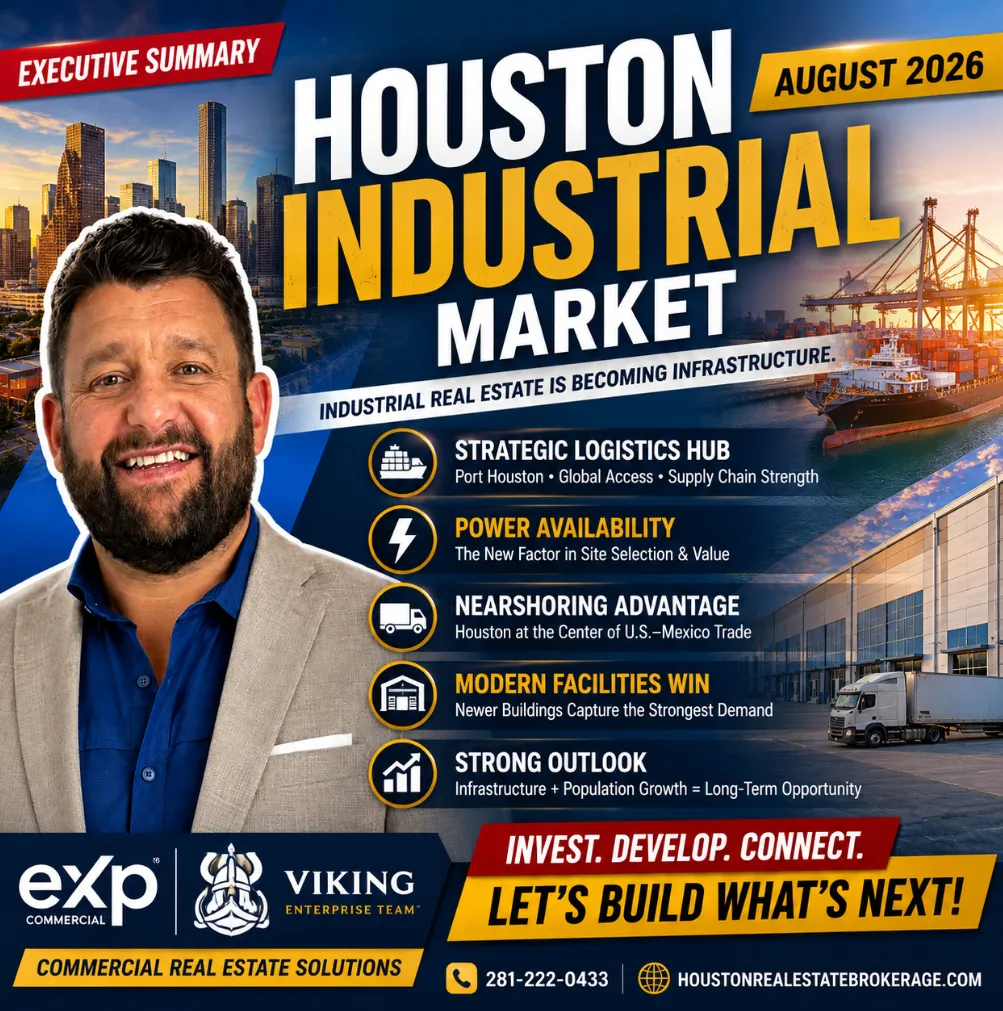
🏭 Houston Industrial Real Estate 2026: Why Logistics, Power & Nearshoring Are Reshaping the Market 🚢
🏭 Houston Industrial Real Estate 2026: Why Logistics, Power & Nearshoring Are Reshaping the Market 🚢
⚡ Houston Industrial Market Outlook: The Infrastructure Trends Driving the Next Wave of CRE Growth 📈
Houston Industrial Market Executive Summary — August 2026
Houston's industrial real estate market is entering a new phase.
The extraordinary post-pandemic industrial expansion has normalized nationally, but Houston continues to benefit from a combination few U.S. markets can replicate: Port Houston, the Houston Ship Channel, extensive interstate and rail infrastructure, a massive energy ecosystem, population growth, manufacturing capacity, and strategic access to Mexico.
Houston's industrial distribution market recorded approximately 12.8 million square feet of net absorption through the first half of 2026, with 15.3 million square feet of deliveries. Q2 leasing activity reached approximately 7.4 million square feet, up 21.2% from Q1.
But the next generation of industrial investment may require a different approach.
The competitive advantage is increasingly about more than warehouse space.
It's about infrastructure.
Global Supply-Chain Risk Strengthens Houston's Strategic Position
Recent global events have reinforced just how vulnerable international supply chains can be.
Approximately 30 major global trade chokepoints have been identified where disruption could create significant cascading effects across international commerce. Routes such as the Strait of Malacca, Taiwan Strait, Suez Canal and Panama Canal illustrate the risks associated with concentrating global supply chains around a relatively small number of critical corridors.
For Houston industrial real estate, this matters.
Companies seeking greater supply-chain resilience may increasingly prioritize domestic inventory, alternative distribution channels, U.S. manufacturing and nearshoring through Mexico.
Houston sits at the intersection of those strategies.
Port Houston Remains a Powerful Industrial Demand Engine
At the center of Houston's logistics infrastructure is Port Houston.
Port Houston's public terminals handled a record 4.3 million TEUs during 2025, while the Southeast Houston industrial submarket totaled approximately 86.3 million square feet as of Q2 2026. Port-related logistics, manufacturing and distribution activity continues to support demand throughout the corridor.
The broader Houston Ship Channel region also continues to demonstrate its importance. Through May 2026, total trade increased 17%, driven in part by a 23% increase in exports.
For investors, this supports continued attention to properties serving:
·Distribution and logistics
·Manufacturing and assembly
·Warehousing and transload operations
·Truck terminals and industrial outdoor storage
·Supplier facilities
·Port-related industrial users
Corpus Christi Could Strengthen the Texas–Mexico Industrial Corridor
Houston investors should also watch developments farther down the Texas Gulf Coast.
DP World announced in June that it had entered exclusive negotiations for a long-term lease to develop and operate a container terminal at the Port of Corpus Christi.
Rather than viewing additional Gulf Coast container capacity strictly as competition for Houston, investors should consider the potential for a broader Houston–Corpus Christi–Laredo–Monterrey industrial corridor.
That network could become increasingly important as companies combine Mexican manufacturing with Texas logistics, distribution and supplier operations.
Houston could capture secondary demand from businesses providing components, equipment, warehousing, transportation and professional services to those manufacturing networks.
Power Availability Is Becoming a CRE Due-Diligence Issue
One of the most important changes affecting Texas industrial development may have little to do with the warehouse itself.
It is electricity.
Texas was recently confronting an estimated 474 GW of large-load interconnection requests, prompting increased scrutiny of data-center projects and their potential impact on grid capacity.
That changes the industrial site-selection conversation.
Traditionally, developers and occupiers focused heavily on:
Location + Access + Labor + Land + Building Specifications
Increasingly, another variable belongs near the beginning of the analysis:
Power availability.
For advanced manufacturing, cold storage, data centers and other power-intensive uses, investors need to understand not simply whether electricity is nearby, but how much capacity is available and when it can actually be delivered.
Houston-area developments already illustrate the scale of this issue. A proposed AWS data-center campus in Wharton County, for example, could represent a multibillion-dollar investment requiring substantial infrastructure.
Behind-the-Meter Power Could Become a Competitive Advantage
The power constraint also creates opportunities.
Industrial occupiers are increasingly evaluating on-site generation, microgrids and behind-the-meter energy strategies to improve reliability and potentially accelerate project timelines.
Houston possesses an unusual competitive advantage here: it combines industrial real estate expertise with one of the deepest energy ecosystems in the world.
Properties capable of bringing together land + industrial infrastructure + scalable power could command increasing attention from sophisticated occupiers.
For developers evaluating industrial land, utility capacity should therefore become part of early-stage due diligence alongside drainage, detention, environmental conditions, access and entitlement risk.
Nearshoring Strengthens Houston's Long-Term Industrial Thesis
Nearshoring remains another important structural driver.
Companies attempting to reduce reliance on distant supply chains can shift portions of manufacturing and supplier operations closer to the U.S. consumer.
Mexico is particularly important to that equation.
Houston offers Gulf Coast port access while highway and rail networks provide connectivity toward South Texas, Laredo and Mexican manufacturing centers.
That creates opportunities beyond traditional warehousing.
Manufacturing growth can generate demand for suppliers, equipment companies, 3PLs, trucking operations, assembly facilities and industrial service companies.
A midyear Houston industrial outlook similarly points to onshoring and distribution outsourcing as factors supporting bulk industrial leasing.
Modern Industrial Buildings Are Capturing Demand
Not every industrial property will benefit equally.
The market is increasingly separating modern, functional facilities from older commodity inventory.
National industrial research has found that positive absorption has been concentrated in buildings delivered since 2020, while older properties are taking longer to lease.
Houston is demonstrating a similar pattern.
Newmark reported that Houston's five largest Q1 industrial transactions occurred in buildings completed since 2023, reinforcing occupier preference for modern product.
Houston's Q2 market data also indicates that modern rear-load and front-load buildings are commanding the strongest asking rents, while cross-dock facilities remain highly desirable among major logistics occupiers.
For investors, the takeaway is important:
A warehouse is no longer just a warehouse.
Clear height, loading configuration, truck courts, trailer parking, power, energy efficiency, location and throughput capability can increasingly influence rent growth, tenant retention and long-term liquidity.
What Houston Industrial Investors Should Be Evaluating
Industrial acquisitions should therefore be analyzed through a broader framework than simply cap rate and price per square foot.
Investors should evaluate:
Transportation: How quickly can the property connect to ports, highways, rail and airports?
Power: Is sufficient electrical capacity available for the property's current and future tenant base?
Building functionality: Does the asset meet the specifications modern occupiers actually require?
Labor: Can tenants efficiently access the workforce necessary to operate the facility?
Supply chains: Does the location benefit from reshoring, nearshoring, port activity or population-driven distribution?
Future liquidity: Will institutional buyers and sophisticated owner-users still want this building five or ten years from now?
These questions may increasingly separate outperforming industrial investments from commodity assets.
Houston Industrial Market Outlook for the Second Half of 2026
Houston's fundamentals remain compelling.
Q2 2026 leasing reached 7.4 million square feet, and developers have become somewhat more disciplined. New construction starts declined to approximately 5 million square feet during Q2, while aggregate preleasing improved from 12.6% to 18%.
There are still near-term risks.
New supply can create pockets of elevated vacancy, particularly where speculative development has been concentrated. Southeast Houston, for example, reported 11.3% direct vacancy during Q2 as recently completed projects entered lease-up.
That means investors need to distinguish between temporary supply-driven vacancy and structural weakness.
Over the longer term, Houston retains several advantages that are extremely difficult for competing markets to recreate simultaneously: a global port, the Houston Ship Channel, energy infrastructure, highway and rail connectivity, manufacturing capacity, proximity to Mexico and one of America's largest population centers.
Industrial Real Estate Is Becoming Infrastructure
That may be the most important investment theme heading into Houston's next industrial cycle.
The highest-value industrial properties may increasingly be those capable of connecting companies efficiently to five critical resources:
Transportation. Power. Labor. Ports. Supply chains.
In that environment, industrial real estate becomes more than four walls and a roof.
Industrial real estate becomes infrastructure.
And Houston is exceptionally well positioned to compete in that world.
For investors, developers and business owners considering industrial acquisitions, dispositions, leasing, development or financing in Greater Houston, evaluating these infrastructure variables early could make the difference between acquiring yesterday's warehouse and positioning for tomorrow's demand.
Connect With Viking Enterprise Team
📍 eXp Commercial & eXp Realty
📍 Houston | Katy | Fulshear | West Houston
📅 Calendly.com/VikingEnterprise
📞 281-222-0433
📞 Bill Rapp, CCIM
eXp Commercial | Viking Enterprise Team
Commercial Real Estate & Capital Advisory
🌐 https://houstonrealestatebrokerage.com
https://www.houstonrealestatebrokerage.com/
https://www.houstonrealestatebrokerage.com/houston-cre-navigator
https://www.commercialexchange.com/agent/653bf5593e3a3e1dcec275a6
http://expressoffers.com/[email protected]
https://app.bullpenre.com/profile/1742476177701x437444415125976000
https://author.billrapponline.com/
https://www.amazon.com/dp/B0F32Z5BH2
https://veed.cello.so/FOmzTty6oi9
https://buymeacoffee.com/vikingente3
https://creplaybookseries.billrapponline.com
https://creplaybook.billrapponline.com/
© Bill Rapp, Broker Associate, eXp Commercial Viking Enterprise Team

Commercial Real Estate Advisors Serving Katy, Fulshear & Greater Houston
Helping Property Owners, Investors & Businesses Make Smarter Commercial Real Estate Decisions
Whether you're buying, selling, leasing, investing, or financing commercial real estate, having the right advisor can make all the difference.
At eXp Commercial – Viking Enterprise Team, we provide comprehensive commercial real estate brokerage and advisory services for property owners, investors, developers, landlords, tenants, and business owners throughout Katy, Fulshear, Houston, and the surrounding Texas markets.
Our team combines local market expertise with commercial investment knowledge and capital markets experience to help clients maximize property value, identify new opportunities, reduce risk, and achieve long-term investment success.
From a single office building to a growing investment portfolio, we provide strategic guidance from acquisition through disposition.
Comprehensive Commercial Real Estate Services
Commercial Property Sales
Selling commercial real estate requires far more than placing a property on the market. We develop customized marketing strategies designed to maximize exposure while targeting qualified buyers locally, regionally, and nationally.
Our services include:
Property valuation and pricing strategy
Investment analysis
Professional marketing campaigns
Buyer qualification
Contract negotiation
Due diligence coordination
Transaction management through closing
Whether you're selling office, retail, industrial, multifamily, land, medical, mixed-use, or investment property, our objective is simple—maximize your property's value while creating a smooth transaction.
Commercial Leasing Services
Vacancies reduce cash flow and impact property performance.
We help landlords lease available space by creating effective marketing campaigns, identifying qualified tenants, negotiating favorable lease terms, and minimizing downtime.
Our leasing services include:
Office leasing
Retail leasing
Industrial leasing
Medical office leasing
Flex space leasing
Warehouse leasing
Landlord representation
Tenant representation
Lease renewals
Lease negotiations
Our goal is to keep your property occupied with quality tenants while protecting your long-term investment.
Commercial Property Acquisitions
Whether you're purchasing your first commercial property or expanding a large investment portfolio, we help identify opportunities that align with your investment objectives.
Our acquisition services include:
Market research
Property sourcing
Financial analysis
Cap rate evaluation
Cash flow analysis
Due diligence
Negotiation
Closing coordination
We help investors make informed decisions backed by market data and financial analysis—not emotion.
Investment Property Analysis
Every investment should begin with a thorough understanding of risk and return.
We assist investors by evaluating:
Net Operating Income (NOI)
Capitalization Rates
Cash-on-Cash Returns
Internal Rate of Return (IRR)
Market Rent Analysis
Occupancy Trends
Comparable Sales
Exit Strategies
Our investment analysis helps clients make data-driven decisions before committing capital.
Commercial Financing & Capital Advisory
One of the biggest advantages of working with Viking Enterprise Team is access to commercial financing expertise.
Through our capital markets relationships, we help clients evaluate financing options for acquisitions, refinancing, construction, bridge financing, SBA loans, investment properties, and owner-occupied commercial real estate.
We help clients:
Evaluate financing options
Analyze refinancing opportunities
Improve loan positioning
Understand lender requirements
Coordinate with commercial lenders
Structure financing strategies
Real estate and financing should work together—not independently.
Portfolio Growth & Investment Strategy
Building long-term wealth through commercial real estate requires strategic planning.
We work with investors to:
Expand investment portfolios
Identify off-market opportunities
Improve portfolio performance
Evaluate redevelopment opportunities
Reposition underperforming assets
Develop long-term acquisition strategies
Whether you're purchasing your second investment or your fiftieth, we help create a roadmap for continued growth.
Landlord Representation
Commercial property owners face constant challenges:
Tenant turnover
Lease negotiations
Rental rates
Market competition
Property positioning
We provide landlord representation focused on maximizing occupancy, improving lease terms, increasing property value, and strengthening long-term cash flow.
Tenant Representation
Businesses often outgrow their current space or need a location that better supports future growth.
We represent tenants throughout the site selection process, helping negotiate favorable lease terms while identifying properties that fit operational and financial objectives.
Our tenant services include:
Office space
Retail locations
Industrial facilities
Warehouse space
Medical offices
Flex properties
Build-to-suit opportunities
Market Analysis & Commercial Consulting
Successful commercial real estate decisions begin with accurate market intelligence.
Our advisory services include:
Market studies
Property positioning
Rent analysis
Development feasibility
Redevelopment analysis
Demographic research
Growth corridor identification
Competitive property analysis
Whether you're considering selling today or planning five years ahead, we help you understand where the market is headed.
Joint Ventures & Investment Partnerships
Many commercial opportunities require additional equity, strategic partners, or experienced investors.
We help facilitate introductions between qualified investors, developers, operators, and commercial property owners seeking partnership opportunities for acquisitions, development, redevelopment, or recapitalization.
Exit Planning & Wealth Preservation
Every commercial investment eventually reaches a transition point.
Whether you're considering:
Selling
Refinancing
Recapitalizing
Completing a 1031 Exchange
Passing assets to the next generation
Repositioning your portfolio
we help create an exit strategy that aligns with your financial goals while maximizing value and minimizing unnecessary risk.
Why Choose Viking Enterprise Team?
Commercial real estate is about more than buying and selling properties—it's about creating long-term value.
Our clients benefit from:
Local expertise throughout Katy, Fulshear, Houston, and surrounding markets
Experience representing investors, developers, business owners, landlords, and tenants
Comprehensive brokerage and advisory services
Commercial financing insight and capital markets knowledge
Investment-focused analysis
Strategic negotiation
Professional marketing
Personalized service from initial consultation through closing
We believe informed clients make better decisions, and our role is to provide the expertise, market intelligence, and guidance needed to help you succeed.
Let's Discuss Your Commercial Real Estate Goals
Whether you're buying, selling, leasing, investing, refinancing, or planning your next commercial real estate transaction, Viking Enterprise Team is ready to help.
Schedule a confidential consultation to discuss your objectives and discover how our experience, market knowledge, and strategic approach can help you maximize the value of your commercial real estate investments.
Contact eXp Commercial – Viking Enterprise Team today and let's build your commercial real estate strategy together.


Find the perfect location for your business.
Let us help your business succeed.
🏭 Houston Industrial Real Estate 2026: Why Logistics, Power & Nearshoring Are Reshaping the Market 🚢
🏭 Houston Industrial Real Estate 2026: Why Logistics, Power & Nearshoring Are Reshaping the Market 🚢
⚡ Houston Industrial Market Outlook: The Infrastructure Trends Driving the Next Wave of CRE Growth 📈
Houston Industrial Market Executive Summary — August 2026
Houston's industrial real estate market is entering a new phase.
The extraordinary post-pandemic industrial expansion has normalized nationally, but Houston continues to benefit from a combination few U.S. markets can replicate: Port Houston, the Houston Ship Channel, extensive interstate and rail infrastructure, a massive energy ecosystem, population growth, manufacturing capacity, and strategic access to Mexico.
Houston's industrial distribution market recorded approximately 12.8 million square feet of net absorption through the first half of 2026, with 15.3 million square feet of deliveries. Q2 leasing activity reached approximately 7.4 million square feet, up 21.2% from Q1.
But the next generation of industrial investment may require a different approach.
The competitive advantage is increasingly about more than warehouse space.
It's about infrastructure.
Global Supply-Chain Risk Strengthens Houston's Strategic Position
Recent global events have reinforced just how vulnerable international supply chains can be.
Approximately 30 major global trade chokepoints have been identified where disruption could create significant cascading effects across international commerce. Routes such as the Strait of Malacca, Taiwan Strait, Suez Canal and Panama Canal illustrate the risks associated with concentrating global supply chains around a relatively small number of critical corridors.
For Houston industrial real estate, this matters.
Companies seeking greater supply-chain resilience may increasingly prioritize domestic inventory, alternative distribution channels, U.S. manufacturing and nearshoring through Mexico.
Houston sits at the intersection of those strategies.
Port Houston Remains a Powerful Industrial Demand Engine
At the center of Houston's logistics infrastructure is Port Houston.
Port Houston's public terminals handled a record 4.3 million TEUs during 2025, while the Southeast Houston industrial submarket totaled approximately 86.3 million square feet as of Q2 2026. Port-related logistics, manufacturing and distribution activity continues to support demand throughout the corridor.
The broader Houston Ship Channel region also continues to demonstrate its importance. Through May 2026, total trade increased 17%, driven in part by a 23% increase in exports.
For investors, this supports continued attention to properties serving:
·Distribution and logistics
·Manufacturing and assembly
·Warehousing and transload operations
·Truck terminals and industrial outdoor storage
·Supplier facilities
·Port-related industrial users
Corpus Christi Could Strengthen the Texas–Mexico Industrial Corridor
Houston investors should also watch developments farther down the Texas Gulf Coast.
DP World announced in June that it had entered exclusive negotiations for a long-term lease to develop and operate a container terminal at the Port of Corpus Christi.
Rather than viewing additional Gulf Coast container capacity strictly as competition for Houston, investors should consider the potential for a broader Houston–Corpus Christi–Laredo–Monterrey industrial corridor.
That network could become increasingly important as companies combine Mexican manufacturing with Texas logistics, distribution and supplier operations.
Houston could capture secondary demand from businesses providing components, equipment, warehousing, transportation and professional services to those manufacturing networks.
Power Availability Is Becoming a CRE Due-Diligence Issue
One of the most important changes affecting Texas industrial development may have little to do with the warehouse itself.
It is electricity.
Texas was recently confronting an estimated 474 GW of large-load interconnection requests, prompting increased scrutiny of data-center projects and their potential impact on grid capacity.
That changes the industrial site-selection conversation.
Traditionally, developers and occupiers focused heavily on:
Location + Access + Labor + Land + Building Specifications
Increasingly, another variable belongs near the beginning of the analysis:
Power availability.
For advanced manufacturing, cold storage, data centers and other power-intensive uses, investors need to understand not simply whether electricity is nearby, but how much capacity is available and when it can actually be delivered.
Houston-area developments already illustrate the scale of this issue. A proposed AWS data-center campus in Wharton County, for example, could represent a multibillion-dollar investment requiring substantial infrastructure.
Behind-the-Meter Power Could Become a Competitive Advantage
The power constraint also creates opportunities.
Industrial occupiers are increasingly evaluating on-site generation, microgrids and behind-the-meter energy strategies to improve reliability and potentially accelerate project timelines.
Houston possesses an unusual competitive advantage here: it combines industrial real estate expertise with one of the deepest energy ecosystems in the world.
Properties capable of bringing together land + industrial infrastructure + scalable power could command increasing attention from sophisticated occupiers.
For developers evaluating industrial land, utility capacity should therefore become part of early-stage due diligence alongside drainage, detention, environmental conditions, access and entitlement risk.
Nearshoring Strengthens Houston's Long-Term Industrial Thesis
Nearshoring remains another important structural driver.
Companies attempting to reduce reliance on distant supply chains can shift portions of manufacturing and supplier operations closer to the U.S. consumer.
Mexico is particularly important to that equation.
Houston offers Gulf Coast port access while highway and rail networks provide connectivity toward South Texas, Laredo and Mexican manufacturing centers.
That creates opportunities beyond traditional warehousing.
Manufacturing growth can generate demand for suppliers, equipment companies, 3PLs, trucking operations, assembly facilities and industrial service companies.
A midyear Houston industrial outlook similarly points to onshoring and distribution outsourcing as factors supporting bulk industrial leasing.
Modern Industrial Buildings Are Capturing Demand
Not every industrial property will benefit equally.
The market is increasingly separating modern, functional facilities from older commodity inventory.
National industrial research has found that positive absorption has been concentrated in buildings delivered since 2020, while older properties are taking longer to lease.
Houston is demonstrating a similar pattern.
Newmark reported that Houston's five largest Q1 industrial transactions occurred in buildings completed since 2023, reinforcing occupier preference for modern product.
Houston's Q2 market data also indicates that modern rear-load and front-load buildings are commanding the strongest asking rents, while cross-dock facilities remain highly desirable among major logistics occupiers.
For investors, the takeaway is important:
A warehouse is no longer just a warehouse.
Clear height, loading configuration, truck courts, trailer parking, power, energy efficiency, location and throughput capability can increasingly influence rent growth, tenant retention and long-term liquidity.
What Houston Industrial Investors Should Be Evaluating
Industrial acquisitions should therefore be analyzed through a broader framework than simply cap rate and price per square foot.
Investors should evaluate:
Transportation: How quickly can the property connect to ports, highways, rail and airports?
Power: Is sufficient electrical capacity available for the property's current and future tenant base?
Building functionality: Does the asset meet the specifications modern occupiers actually require?
Labor: Can tenants efficiently access the workforce necessary to operate the facility?
Supply chains: Does the location benefit from reshoring, nearshoring, port activity or population-driven distribution?
Future liquidity: Will institutional buyers and sophisticated owner-users still want this building five or ten years from now?
These questions may increasingly separate outperforming industrial investments from commodity assets.
Houston Industrial Market Outlook for the Second Half of 2026
Houston's fundamentals remain compelling.
Q2 2026 leasing reached 7.4 million square feet, and developers have become somewhat more disciplined. New construction starts declined to approximately 5 million square feet during Q2, while aggregate preleasing improved from 12.6% to 18%.
There are still near-term risks.
New supply can create pockets of elevated vacancy, particularly where speculative development has been concentrated. Southeast Houston, for example, reported 11.3% direct vacancy during Q2 as recently completed projects entered lease-up.
That means investors need to distinguish between temporary supply-driven vacancy and structural weakness.
Over the longer term, Houston retains several advantages that are extremely difficult for competing markets to recreate simultaneously: a global port, the Houston Ship Channel, energy infrastructure, highway and rail connectivity, manufacturing capacity, proximity to Mexico and one of America's largest population centers.
Industrial Real Estate Is Becoming Infrastructure
That may be the most important investment theme heading into Houston's next industrial cycle.
The highest-value industrial properties may increasingly be those capable of connecting companies efficiently to five critical resources:
Transportation. Power. Labor. Ports. Supply chains.
In that environment, industrial real estate becomes more than four walls and a roof.
Industrial real estate becomes infrastructure.
And Houston is exceptionally well positioned to compete in that world.
For investors, developers and business owners considering industrial acquisitions, dispositions, leasing, development or financing in Greater Houston, evaluating these infrastructure variables early could make the difference between acquiring yesterday's warehouse and positioning for tomorrow's demand.
Connect With Viking Enterprise Team
📍 eXp Commercial & eXp Realty
📍 Houston | Katy | Fulshear | West Houston
📅 Calendly.com/VikingEnterprise
📞 281-222-0433
📞 Bill Rapp, CCIM
eXp Commercial | Viking Enterprise Team
Commercial Real Estate & Capital Advisory
🌐 https://houstonrealestatebrokerage.com
https://www.houstonrealestatebrokerage.com/
https://www.houstonrealestatebrokerage.com/houston-cre-navigator
https://www.commercialexchange.com/agent/653bf5593e3a3e1dcec275a6
http://expressoffers.com/[email protected]
https://app.bullpenre.com/profile/1742476177701x437444415125976000
https://author.billrapponline.com/
https://www.amazon.com/dp/B0F32Z5BH2
https://veed.cello.so/FOmzTty6oi9
https://buymeacoffee.com/vikingente3
https://creplaybookseries.billrapponline.com
https://creplaybook.billrapponline.com/
© Bill Rapp, Broker Associate, eXp Commercial Viking Enterprise Team
Find the perfect location for your business.
Let us help your business succeed.

Sign up to receive the latest news on property investment and commercial real estate listings.
9600 Great Hills Trail, Suite 150w Austin, TX 78759 |
855.450.0324 xx255
Texas Real Estate Commission Consumer Protection Notice Texas Real Estate Commission
Information About Brokerage Services eXp Commercial LLC #9010212
Viking Enterprise LLC #9009614

Sign up to receive the latest news on property investment and commercial real estate listings.


Contact Us
901 S Mopac Expwy, Bldg 2, Suite 350 Austin, TX 78746 | 512.474.5557Texas Real Estate Commission
Consumer Protection Notice Texas Real Estate Commission Information About Brokerage Services Reliance Retail, LLC #603091
Texas RS, LLC #9003193 | RESOLUT RE Is Licensed In Louisiana #0995694083
Facebook
Instagram
X
LinkedIn
Youtube
TikTok