Your Trusted Houston Commercial Real Estate Brokerage
Viking Enterprise LLC is part of eXp Commercial, an agent-led, cloud-based commercial real estate brokerage with agents across the globe.
Email: [email protected]
Call: (281) 222-0433

Your Trusted Katy / Fulshear & Houston Commercial Real Estate Brokerage
Viking Enterprise LLC is part of eXp Commercial, an agent-led, cloud-based commercial real estate brokerage with agents across the globe.
Looking to invest, buy, sell or lease? We can help.
Looking to invest, buy, sell or lease? We can help.
FEATURED PROPERTIES

OUR FEATURED TENANTS & CLIENTS
eXp Commercial - Viking Enterprise Team's real estate network provides unparalleled commercial real estate services to Tenants and Landlords around the Katy- Houston area. Our knowledge, experience, and reputation sets us apart from many firms.
A commercial property owner might have various plans that would necessitate the services of a commercial real estate broker. Some of the common scenarios include:
1. Selling the Property: If the owner decides it’s time to sell the property, a commercial real estate broker can help determine the market value, market the property effectively, and negotiate with potential buyers to get the best possible price.
2. Leasing Space: For property owners looking to lease out part or all of their commercial space, a broker can help find suitable tenants, negotiate lease terms, and ensure the lease agreements meet all legal requirements and serve the owner’s best interests.
3. Acquiring More Properties: Owners looking to expand their portfolio would benefit from a broker's knowledge of the market, access to listings, and negotiation skills to secure additional properties at favorable terms.
4. Property Management: While not all brokers offer this service, some commercial real estate brokers or their affiliates offer property management services. This can be particularly appealing for owners who prefer a hands-off approach or are managing properties from a distance.
5. Market Analysis: Owners considering future developments, renovations, or rebranding of their property might engage a broker for a comprehensive market analysis. This helps in understanding current market trends, the demand for different types of spaces, and potential returns on investment for various strategies.
6. Refinancing: In situations where a property owner is looking to refinance their property, a commercial real estate broker can provide valuable insights into the property’s current market value, assist in gathering necessary documentation, and even help in finding the best financing options.
7. Partnership or Investment Opportunities: Owners interested in exploring partnerships, joint ventures, or seeking investors for expansion or development projects might use a broker to find and vet potential partners or investors.
8. Consulting on Zoning and Use Changes: When contemplating a change in the use of the property or dealing with zoning issues, a broker with experience in local regulations and the specific property type can provide guidance and strategic planning assistance.
9. Exit Strategy Planning: For owners looking to plan an exit strategy from their investment, whether it’s through a strategic sale or a gradual winding down of operations, brokers can provide market insights, timing advice, and valuation services to optimize the exit process.
In any of these scenarios, the expertise and services provided by a commercial real estate broker can save the property owner time and money, while also providing access to a wider network of potential buyers, tenants, and industry professionals. Give us a call today!
Reviews
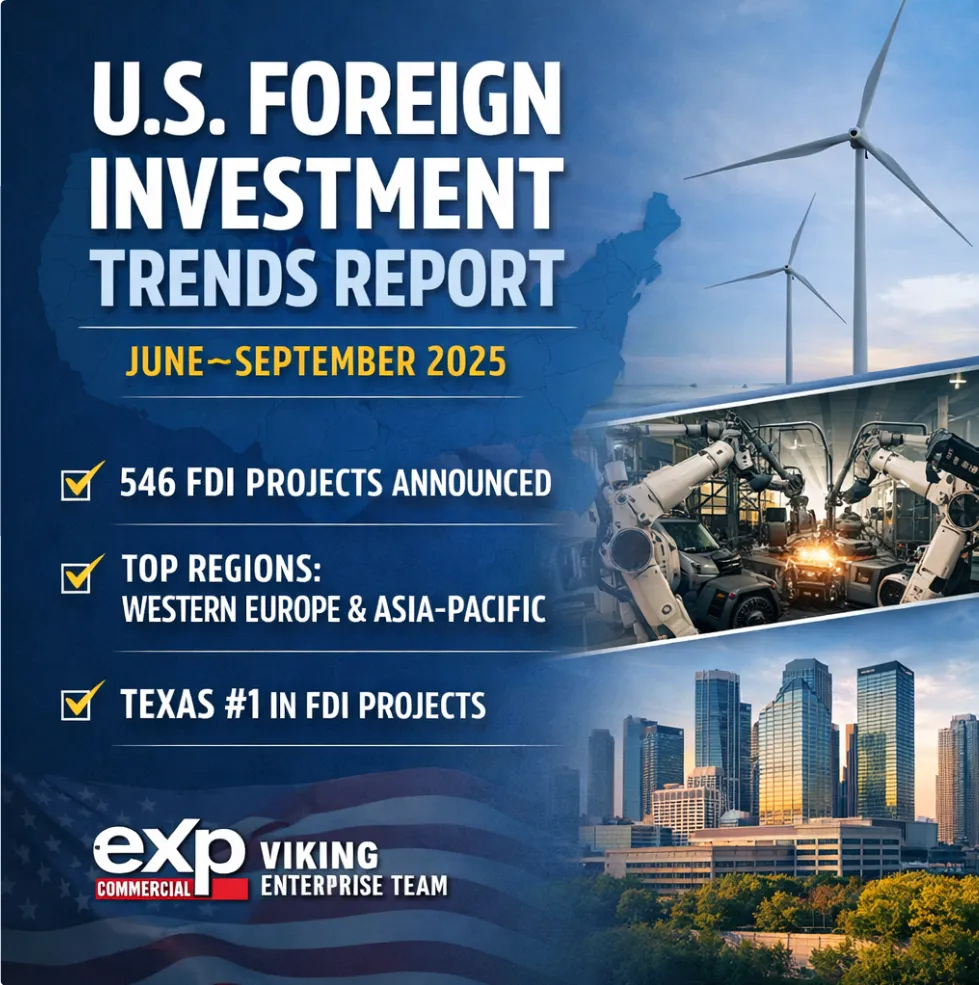
🌍 US Foreign Direct Investment Trends Report (June–September 2025): What Global Capital Means for CRE 📈
🌍 US Foreign Direct Investment Trends Report (June–September 2025): What Global Capital Means for CRE 📈
📊 Where Global Money Is Moving: US FDI Trends and CRE Implications (Mid-2025 Report) 🏗️
US Foreign Direct Investment (FDI) Trends Report
June–September 2025
Foreign direct investment (FDI) remains one of the most reliable indicators of long-term economic confidence, capital mobility, and regional competitiveness. While short-term market cycles fluctuate, global investors allocate capital where they see durable demand, infrastructure readiness, and scalable returns.
Between June and September 2025, US FDI activity softened year-over-year. However, the composition of those investments tells a far more constructive story—one that matters directly to commercial real estate investors, developers, and operators across the United States.
This report breaks down what the data actually signals and why CRE-focused markets—particularly those tied to energy transition, manufacturing, and real assets—continue to attract global capital.
Why FDI Matters for Commercial Real Estate
Foreign direct investment is not speculative capital. These are long-horizon commitments tied to physical assets, workforce development, and supply-chain strategy. For commercial real estate stakeholders, FDI trends influence:
• Industrial and logistics demand
• Manufacturing and life-sciences site selection
• Capital inflows into commercial real estate assets
• Job creation that fuels housing, retail, and services
• Long-term absorption and rent growth
Markets that attract FDI consistently outperform in asset stability and long-term valuation.
National FDI Snapshot: June–September 2025
Key US Metrics
• 546 FDI projects announced
• 26% decline year-over-year
• $35.2 billion in total capital investment
• 18% decline year-over-year
• 55,526 estimated jobs created
• 436 foreign companies invested
• The US captured 12% of all global FDI projects
Interpretation for Investors:
While headline volumes declined, the US remains one of the most attractive destinations globally—particularly for capital-intensive, strategic investments rather than short-cycle expansion projects.
This reflects investor selectivity, not capital flight.
Who Is Investing in the United States?
Top Investing Regions
• Western Europe: ~$15–16B invested
• Asia-Pacific: ~$15–16B invested
• Each region supported over 23,000 US jobs
These regions continue to anchor US-bound FDI due to regulatory stability, deep capital markets, and demand for real assets.
Top Countries Investing in the US
Country
Capital Investment
Projects
United Kingdom
$6.7B
77
South Korea
$6.4B
26
Japan
$4.0B
46
Canada
$2.1B
46
Germany
$2.0B
46
Key Insight:
South Korea’s investment profile stands out—fewer deals, but significantly larger capital commitments. This aligns with advanced manufacturing, battery production, and energy-transition infrastructure.
Where the Capital Is Going
Top US States by Capital Investment
State
Capital Investment
Projects
Pennsylvania
$6.7B
28
Texas
$5.2B
61
California
$1.5B
46
Georgia
$1.3B
21
Michigan
$1.3B
16
Why Texas Matters for CRE Investors:
Texas ranked #1 in project volume, reinforcing its position as a diversified, scalable, business-friendly market. This volume translates into sustained demand for:
• Industrial and flex properties
• Manufacturing facilities
• Workforce housing
• Retail and service assets
For CRE investors, velocity matters as much as headline capital totals.
Top Sectors Attracting Foreign Capital
Sector
Capital Investment
Projects
Renewable Energy
$3.6B
19
Real Estate
$3.0B
72
Pharmaceuticals
$3.0B
19
Food & Beverages
$2.1B
20
Industrial Equipment
$1.7B
60
What This Signals:
• Renewable energy deals are large, infrastructure-heavy, and long-term
• Real estate leads in project count, reflecting global demand for US assets
• Industrial equipment and pharma reinforce domestic manufacturing trends
These sectors directly support industrial, multifamily, medical office, and logistics demand.
Strategic Takeaways for CRE Investors & Operators
• Capital-intensive sectors remain active despite fewer total projects
• Energy transition and advanced manufacturing anchor global confidence
• Real estate remains a preferred hard-asset allocation for foreign capital
• Investor psychology has shifted toward fewer, larger, higher-quality deals
• Markets with infrastructure, labor, and entitlement readiness outperform
This environment rewards preparation, not speculation.
Closing Perspective
Although US FDI activity declined modestly year-over-year in mid-2025, the underlying investment composition reflects long-term strategic confidence—not retreat.
For commercial real estate investors and developers, the message is clear: global capital continues to favor US markets aligned with energy, manufacturing, logistics, and real assets. Regions that can support these sectors will remain on the radar for the next cycle of expansion.
https://www.houstonrealestatebrokerage.com/
https://www.houstonrealestatebrokerage.com/houston-cre-navigator
https://www.commercialexchange.com/agent/653bf5593e3a3e1dcec275a6
http://expressoffers.com/[email protected]
https://app.bullpenre.com/profile/1742476177701x437444415125976000
https://author.billrapponline.com/
https://www.amazon.com/dp/B0F32Z5BH2
https://veed.cello.so/FOmzTty6oi9
https://creplaybookseries.billrapponline.com
https://creplaybook.billrapponline.com/
© 2023-2024 Bill Rapp, Broker Associate, eXp Commercial Viking Enterprise Team

eXp Commercial - Viking Enterprise team real estate network provides unparalleled commercial real estate services to Tenants and Landlords around the greater Katy & Houston MSA area. Our knowledge, experience, and reputation sets us apart from many firms.
A commercial property owner might have various plans that would necessitate the services of a commercial real estate broker. Some of the common scenarios include:
1. Selling the Property: If the owner decides it’s time to sell the property, a commercial real estate broker can help determine the market value, market the property effectively, and negotiate with potential buyers to get the best possible price.
2. Leasing Space: For property owners looking to lease out part or all of their commercial space, a broker can help find suitable tenants, negotiate lease terms, and ensure the lease agreements meet all legal requirements and serve the owner’s best interests.
3. Acquiring More Properties: Owners looking to expand their portfolio would benefit from a broker's knowledge of the market, access to listings, and negotiation skills to secure additional properties at favorable terms.
4. Property Management: While not all brokers offer this service, some commercial real estate brokers or their affiliates offer property management services. This can be particularly appealing for owners who prefer a hands-off approach or are managing properties from a distance.
5. Market Analysis: Owners considering future developments, renovations, or rebranding of their property might engage a broker for a comprehensive market analysis. This helps in understanding current market trends, the demand for different types of spaces, and potential returns on investment for various strategies.
6. Refinancing: In situations where a property owner is looking to refinance their property, a commercial real estate broker can provide valuable insights into the property’s current market value, assist in gathering necessary documentation, and even help in finding the best financing options.
7. Partnership or Investment Opportunities: Owners interested in exploring partnerships, joint ventures, or seeking investors for expansion or development projects might use a broker to find and vet potential partners or investors.
8. Consulting on Zoning and Use Changes: When contemplating a change in the use of the property or dealing with zoning issues, a broker with experience in local regulations and the specific property type can provide guidance and strategic planning assistance.
9. Exit Strategy Planning: For owners looking to plan an exit strategy from their investment, whether it’s through a strategic sale or a gradual winding down of operations, brokers can provide market insights, timing advice, and valuation services to optimize the exit process.
In any of these scenarios, the expertise and services provided by a commercial real estate broker can save the property owner time and money, while also providing access to a wider network of potential buyers, tenants, and industry professionals. Give us a call today!
Find the perfect location for your business.
Let us help your business succeed.
🌍 US Foreign Direct Investment Trends Report (June–September 2025): What Global Capital Means for CRE 📈
🌍 US Foreign Direct Investment Trends Report (June–September 2025): What Global Capital Means for CRE 📈
📊 Where Global Money Is Moving: US FDI Trends and CRE Implications (Mid-2025 Report) 🏗️
US Foreign Direct Investment (FDI) Trends Report
June–September 2025
Foreign direct investment (FDI) remains one of the most reliable indicators of long-term economic confidence, capital mobility, and regional competitiveness. While short-term market cycles fluctuate, global investors allocate capital where they see durable demand, infrastructure readiness, and scalable returns.
Between June and September 2025, US FDI activity softened year-over-year. However, the composition of those investments tells a far more constructive story—one that matters directly to commercial real estate investors, developers, and operators across the United States.
This report breaks down what the data actually signals and why CRE-focused markets—particularly those tied to energy transition, manufacturing, and real assets—continue to attract global capital.
Why FDI Matters for Commercial Real Estate
Foreign direct investment is not speculative capital. These are long-horizon commitments tied to physical assets, workforce development, and supply-chain strategy. For commercial real estate stakeholders, FDI trends influence:
• Industrial and logistics demand
• Manufacturing and life-sciences site selection
• Capital inflows into commercial real estate assets
• Job creation that fuels housing, retail, and services
• Long-term absorption and rent growth
Markets that attract FDI consistently outperform in asset stability and long-term valuation.
National FDI Snapshot: June–September 2025
Key US Metrics
• 546 FDI projects announced
• 26% decline year-over-year
• $35.2 billion in total capital investment
• 18% decline year-over-year
• 55,526 estimated jobs created
• 436 foreign companies invested
• The US captured 12% of all global FDI projects
Interpretation for Investors:
While headline volumes declined, the US remains one of the most attractive destinations globally—particularly for capital-intensive, strategic investments rather than short-cycle expansion projects.
This reflects investor selectivity, not capital flight.
Who Is Investing in the United States?
Top Investing Regions
• Western Europe: ~$15–16B invested
• Asia-Pacific: ~$15–16B invested
• Each region supported over 23,000 US jobs
These regions continue to anchor US-bound FDI due to regulatory stability, deep capital markets, and demand for real assets.
Top Countries Investing in the US
Country
Capital Investment
Projects
United Kingdom
$6.7B
77
South Korea
$6.4B
26
Japan
$4.0B
46
Canada
$2.1B
46
Germany
$2.0B
46
Key Insight:
South Korea’s investment profile stands out—fewer deals, but significantly larger capital commitments. This aligns with advanced manufacturing, battery production, and energy-transition infrastructure.
Where the Capital Is Going
Top US States by Capital Investment
State
Capital Investment
Projects
Pennsylvania
$6.7B
28
Texas
$5.2B
61
California
$1.5B
46
Georgia
$1.3B
21
Michigan
$1.3B
16
Why Texas Matters for CRE Investors:
Texas ranked #1 in project volume, reinforcing its position as a diversified, scalable, business-friendly market. This volume translates into sustained demand for:
• Industrial and flex properties
• Manufacturing facilities
• Workforce housing
• Retail and service assets
For CRE investors, velocity matters as much as headline capital totals.
Top Sectors Attracting Foreign Capital
Sector
Capital Investment
Projects
Renewable Energy
$3.6B
19
Real Estate
$3.0B
72
Pharmaceuticals
$3.0B
19
Food & Beverages
$2.1B
20
Industrial Equipment
$1.7B
60
What This Signals:
• Renewable energy deals are large, infrastructure-heavy, and long-term
• Real estate leads in project count, reflecting global demand for US assets
• Industrial equipment and pharma reinforce domestic manufacturing trends
These sectors directly support industrial, multifamily, medical office, and logistics demand.
Strategic Takeaways for CRE Investors & Operators
• Capital-intensive sectors remain active despite fewer total projects
• Energy transition and advanced manufacturing anchor global confidence
• Real estate remains a preferred hard-asset allocation for foreign capital
• Investor psychology has shifted toward fewer, larger, higher-quality deals
• Markets with infrastructure, labor, and entitlement readiness outperform
This environment rewards preparation, not speculation.
Closing Perspective
Although US FDI activity declined modestly year-over-year in mid-2025, the underlying investment composition reflects long-term strategic confidence—not retreat.
For commercial real estate investors and developers, the message is clear: global capital continues to favor US markets aligned with energy, manufacturing, logistics, and real assets. Regions that can support these sectors will remain on the radar for the next cycle of expansion.
https://www.houstonrealestatebrokerage.com/
https://www.houstonrealestatebrokerage.com/houston-cre-navigator
https://www.commercialexchange.com/agent/653bf5593e3a3e1dcec275a6
http://expressoffers.com/[email protected]
https://app.bullpenre.com/profile/1742476177701x437444415125976000
https://author.billrapponline.com/
https://www.amazon.com/dp/B0F32Z5BH2
https://veed.cello.so/FOmzTty6oi9
https://creplaybookseries.billrapponline.com
https://creplaybook.billrapponline.com/
© 2023-2024 Bill Rapp, Broker Associate, eXp Commercial Viking Enterprise Team
Find the perfect location for your business.
Let us help your business succeed.
Sign up to receive the latest news on property investment and commercial real estate listings.
9600 Great Hills Trail, Suite 150w Austin, TX 78759 |
855.450.0324 xx255
Texas Real Estate Commission Consumer Protection Notice Texas Real Estate Commission
Information About Brokerage Services eXp Commercial LLC #9010212
Viking Enterprise LLC #9009614

Sign up to receive the latest news on property investment and commercial real estate listings.


Contact Us
901 S Mopac Expwy, Bldg 2, Suite 350 Austin, TX 78746 | 512.474.5557Texas Real Estate Commission
Consumer Protection Notice Texas Real Estate Commission Information About Brokerage Services Reliance Retail, LLC #603091
Texas RS, LLC #9003193 | RESOLUT RE Is Licensed In Louisiana #0995694083
Facebook
Instagram
X
LinkedIn
Youtube
TikTok