Your Trusted Houston Commercial Real Estate Brokerage
Viking Enterprise LLC is part of eXp Commercial, an agent-led, cloud-based commercial real estate brokerage with agents across the globe.
Email: [email protected]
Call: (281) 222-0433

Your Trusted Katy / Fulshear & Houston Commercial Real Estate Brokerage
Viking Enterprise LLC is part of eXp Commercial, an agent-led, cloud-based commercial real estate brokerage with agents across the globe.
Looking to invest, buy, sell or lease? We can help.
Looking to invest, buy, sell or lease? We can help.
FEATURED PROPERTIES




OUR FEATURED TENANTS & CLIENTS
eXp Commercial - Viking Enterprise Team's real estate network provides unparalleled commercial real estate services to Tenants and Landlords around the Katy- Houston area. Our knowledge, experience, and reputation sets us apart from many firms.
A commercial property owner might have various plans that would necessitate the services of a commercial real estate broker. Some of the common scenarios include:
1. Selling the Property: If the owner decides it’s time to sell the property, a commercial real estate broker can help determine the market value, market the property effectively, and negotiate with potential buyers to get the best possible price.
2. Leasing Space: For property owners looking to lease out part or all of their commercial space, a broker can help find suitable tenants, negotiate lease terms, and ensure the lease agreements meet all legal requirements and serve the owner’s best interests.
3. Acquiring More Properties: Owners looking to expand their portfolio would benefit from a broker's knowledge of the market, access to listings, and negotiation skills to secure additional properties at favorable terms.
4. Property Management: While not all brokers offer this service, some commercial real estate brokers or their affiliates offer property management services. This can be particularly appealing for owners who prefer a hands-off approach or are managing properties from a distance.
5. Market Analysis: Owners considering future developments, renovations, or rebranding of their property might engage a broker for a comprehensive market analysis. This helps in understanding current market trends, the demand for different types of spaces, and potential returns on investment for various strategies.
6. Refinancing: In situations where a property owner is looking to refinance their property, a commercial real estate broker can provide valuable insights into the property’s current market value, assist in gathering necessary documentation, and even help in finding the best financing options.
7. Partnership or Investment Opportunities: Owners interested in exploring partnerships, joint ventures, or seeking investors for expansion or development projects might use a broker to find and vet potential partners or investors.
8. Consulting on Zoning and Use Changes: When contemplating a change in the use of the property or dealing with zoning issues, a broker with experience in local regulations and the specific property type can provide guidance and strategic planning assistance.
9. Exit Strategy Planning: For owners looking to plan an exit strategy from their investment, whether it’s through a strategic sale or a gradual winding down of operations, brokers can provide market insights, timing advice, and valuation services to optimize the exit process.
In any of these scenarios, the expertise and services provided by a commercial real estate broker can save the property owner time and money, while also providing access to a wider network of potential buyers, tenants, and industry professionals. Give us a call today!
Reviews
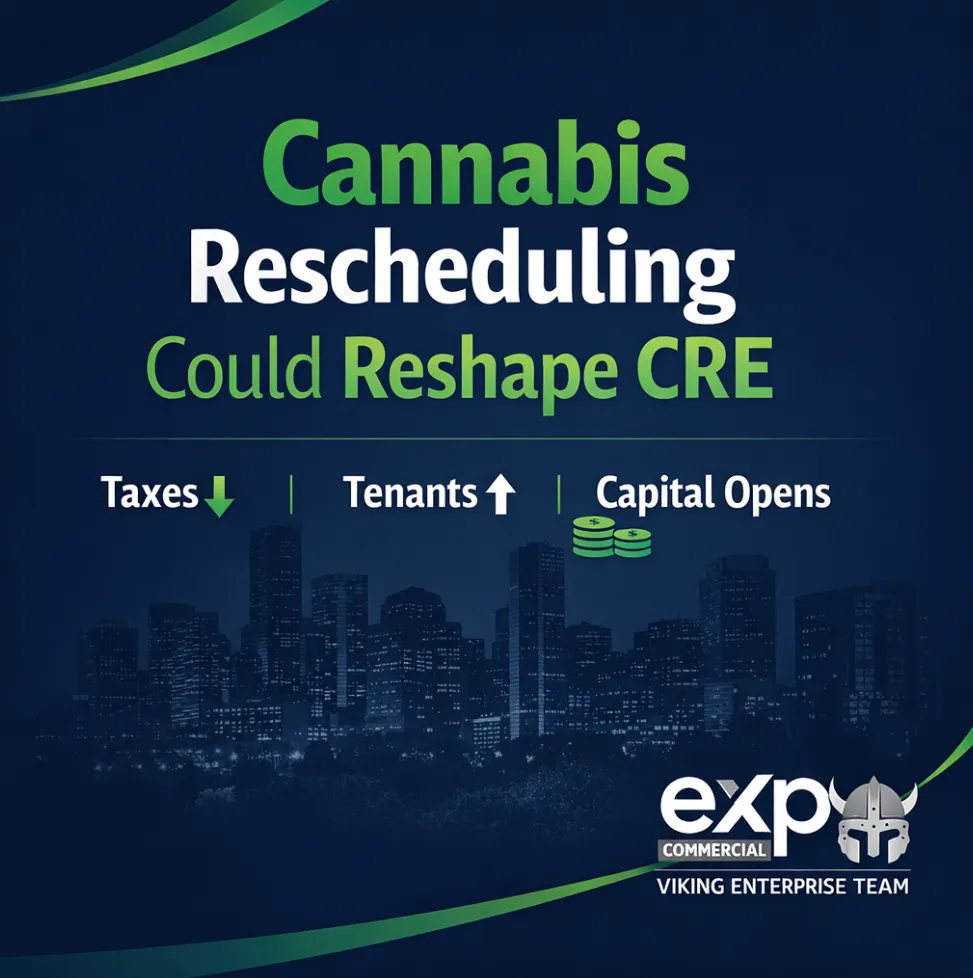
🌿 Trump’s Marijuana Policy Shift: What It Means for Hemp, Cannabis & Commercial Real Estate 🏢
🌿 Trump’s Marijuana Policy Shift: What It Means for Hemp, Cannabis & Commercial Real Estate 🏢
🏗️ Cannabis Rescheduling Could Unlock Billions for CRE: Hemp, Dispensaries & Industrial Space 🌿
What Trump’s Marijuana Policy Shift Means for the Legal Hemp Industry—and Commercial Real Estate
President Donald Trump has issued an executive order directing the reclassification of marijuana from a Schedule I drug to Schedule III. While this action does not federally legalize marijuana, it represents one of the most consequential federal drug policy shifts in decades—and it has direct implications for the legal hemp industry and commercial real estate.
For commercial property owners and investors, this move signals a potential inflection point in lending access, leasing risk, zoning flexibility, and tenant demand across retail, industrial, and specialized-use real estate.
Schedule III: Why This Matters
Moving marijuana to Schedule III places it alongside substances recognized as having accepted medical use. While interstate commerce and federal legalization remain off the table, rescheduling materially changes how the industry is treated from a tax and regulatory standpoint.
Most importantly, Schedule III eliminates the application of IRS Section 280E, which has long prevented cannabis operators from deducting ordinary business expenses such as rent, payroll, utilities, and insurance.
Immediate Impact: Tax Relief = Stronger Tenants
Under Section 280E, many cannabis operators paid effective tax rates exceeding 70%. With rescheduling, operators revert closer to the standard 21% corporate rate.
Industry research estimates cannabis companies paid more than $2.3 billion in excess federal taxes in 2024 alone. Removing that burden significantly improves:
·Tenant profitability
·Creditworthiness
·Ability to sign longer leases
·Capital reinvestment into facilities and expansion
For landlords, this translates into lower default risk and a more stable tenant base.
Commercial Real Estate Implications
1. Retail Leasing Expansion
Major operators such as Cresco Labs, Curaleaf, and Trulieve already operate hundreds of dispensaries nationwide. Improved margins and reduced regulatory stigma could accelerate:
·New retail site selection
·Conversion of underutilized strip centers
·Re-tenanting of formerly “non-bankable” spaces
As legal risk perception declines, more landlords—particularly those with institutional debt—may be willing to lease to cannabis tenants.
2. Industrial & Flex Space Demand
Beyond retail, rescheduling benefits cultivation, processing, testing, and distribution facilities. These uses favor:
·Industrial warehouses
·Flex/industrial campuses
·Specialized HVAC and power-intensive buildings
For hemp operators in particular—already federally legal under the 2018 Farm Bill—this policy shift further legitimizes adjacent cannabis infrastructure, increasing investor appetite for specialized industrial assets.
3. Lending & Capital Markets: A Slow but Meaningful Shift
While rescheduling alone does not force banks to lend, it opens the door for clearer guidance from the Treasury and Justice Departments. Until then, many traditional lenders remain cautious.
That said, the direction of travel is clear:
·More private credit participation
·Improved underwriting confidence
·Potential future bank entry
Once banks fully engage, cap rates, valuations, and transaction volume could reset meaningfully.
Zoning & Municipal Considerations
Municipal zoning restrictions—such as distance requirements from schools or churches—remain locally enforced. However, legal experts expect some jurisdictions to revisit restrictive policies now that marijuana is no longer categorized alongside heroin at the federal level.
This creates opportunities for:
·Adaptive reuse projects
·Rezoning plays
·Early-mover landlord advantages
Hemp Industry Spillover Effects
The legal hemp industry stands to benefit indirectly through:
·Normalized banking relationships
·Shared infrastructure investment
·Expanded research and product development
For commercial real estate investors, hemp processing, CBD manufacturing, and related logistics facilities may see increased institutional interest.
Industry Response
Trade groups like the National Cannabis Industry Association have called the move a foundational reform. Operators including Verano Holdings describe it as a necessary step toward normalized capital access, medical research expansion, and long-term industry stability.
What CRE Investors Should Watch Next
·Treasury and DOJ banking guidance
·State-level zoning changes
·Institutional lender policy shifts
·Sale-leaseback activity
·Industrial redevelopment demand
Bottom Line for Commercial Real Estate
Trump’s marijuana rescheduling order does not flip a switch overnight—but it meaningfully de-risks cannabis and hemp tenants. For commercial real estate investors, this is not a cultural issue; it is a capital markets and tenant-credit story.
As tax burdens fall and financing pathways slowly open, cannabis-adjacent real estate could move from fringe to mainstream—creating both opportunity and competition for well-located assets.
https://www.houstonrealestatebrokerage.com/
https://www.houstonrealestatebrokerage.com/houston-cre-navigator
https://www.commercialexchange.com/agent/653bf5593e3a3e1dcec275a6
http://expressoffers.com/[email protected]
https://app.bullpenre.com/profile/1742476177701x437444415125976000
https://author.billrapponline.com/
https://www.amazon.com/dp/B0F32Z5BH2
https://veed.cello.so/FOmzTty6oi9
https://creplaybookseries.billrapponline.com
https://creplaybook.billrapponline.com/
© 2023-2024 Bill Rapp, Broker Associate, eXp Commercial Viking Enterprise Team

eXp Commercial - Viking Enterprise team real estate network provides unparalleled commercial real estate services to Tenants and Landlords around the greater Katy & Houston MSA area. Our knowledge, experience, and reputation sets us apart from many firms.
A commercial property owner might have various plans that would necessitate the services of a commercial real estate broker. Some of the common scenarios include:
1. Selling the Property: If the owner decides it’s time to sell the property, a commercial real estate broker can help determine the market value, market the property effectively, and negotiate with potential buyers to get the best possible price.
2. Leasing Space: For property owners looking to lease out part or all of their commercial space, a broker can help find suitable tenants, negotiate lease terms, and ensure the lease agreements meet all legal requirements and serve the owner’s best interests.
3. Acquiring More Properties: Owners looking to expand their portfolio would benefit from a broker's knowledge of the market, access to listings, and negotiation skills to secure additional properties at favorable terms.
4. Property Management: While not all brokers offer this service, some commercial real estate brokers or their affiliates offer property management services. This can be particularly appealing for owners who prefer a hands-off approach or are managing properties from a distance.
5. Market Analysis: Owners considering future developments, renovations, or rebranding of their property might engage a broker for a comprehensive market analysis. This helps in understanding current market trends, the demand for different types of spaces, and potential returns on investment for various strategies.
6. Refinancing: In situations where a property owner is looking to refinance their property, a commercial real estate broker can provide valuable insights into the property’s current market value, assist in gathering necessary documentation, and even help in finding the best financing options.
7. Partnership or Investment Opportunities: Owners interested in exploring partnerships, joint ventures, or seeking investors for expansion or development projects might use a broker to find and vet potential partners or investors.
8. Consulting on Zoning and Use Changes: When contemplating a change in the use of the property or dealing with zoning issues, a broker with experience in local regulations and the specific property type can provide guidance and strategic planning assistance.
9. Exit Strategy Planning: For owners looking to plan an exit strategy from their investment, whether it’s through a strategic sale or a gradual winding down of operations, brokers can provide market insights, timing advice, and valuation services to optimize the exit process.
In any of these scenarios, the expertise and services provided by a commercial real estate broker can save the property owner time and money, while also providing access to a wider network of potential buyers, tenants, and industry professionals. Give us a call today!

Find the perfect location for your business.
Let us help your business succeed.
🌿 Trump’s Marijuana Policy Shift: What It Means for Hemp, Cannabis & Commercial Real Estate 🏢
🌿 Trump’s Marijuana Policy Shift: What It Means for Hemp, Cannabis & Commercial Real Estate 🏢
🏗️ Cannabis Rescheduling Could Unlock Billions for CRE: Hemp, Dispensaries & Industrial Space 🌿
What Trump’s Marijuana Policy Shift Means for the Legal Hemp Industry—and Commercial Real Estate
President Donald Trump has issued an executive order directing the reclassification of marijuana from a Schedule I drug to Schedule III. While this action does not federally legalize marijuana, it represents one of the most consequential federal drug policy shifts in decades—and it has direct implications for the legal hemp industry and commercial real estate.
For commercial property owners and investors, this move signals a potential inflection point in lending access, leasing risk, zoning flexibility, and tenant demand across retail, industrial, and specialized-use real estate.
Schedule III: Why This Matters
Moving marijuana to Schedule III places it alongside substances recognized as having accepted medical use. While interstate commerce and federal legalization remain off the table, rescheduling materially changes how the industry is treated from a tax and regulatory standpoint.
Most importantly, Schedule III eliminates the application of IRS Section 280E, which has long prevented cannabis operators from deducting ordinary business expenses such as rent, payroll, utilities, and insurance.
Immediate Impact: Tax Relief = Stronger Tenants
Under Section 280E, many cannabis operators paid effective tax rates exceeding 70%. With rescheduling, operators revert closer to the standard 21% corporate rate.
Industry research estimates cannabis companies paid more than $2.3 billion in excess federal taxes in 2024 alone. Removing that burden significantly improves:
·Tenant profitability
·Creditworthiness
·Ability to sign longer leases
·Capital reinvestment into facilities and expansion
For landlords, this translates into lower default risk and a more stable tenant base.
Commercial Real Estate Implications
1. Retail Leasing Expansion
Major operators such as Cresco Labs, Curaleaf, and Trulieve already operate hundreds of dispensaries nationwide. Improved margins and reduced regulatory stigma could accelerate:
·New retail site selection
·Conversion of underutilized strip centers
·Re-tenanting of formerly “non-bankable” spaces
As legal risk perception declines, more landlords—particularly those with institutional debt—may be willing to lease to cannabis tenants.
2. Industrial & Flex Space Demand
Beyond retail, rescheduling benefits cultivation, processing, testing, and distribution facilities. These uses favor:
·Industrial warehouses
·Flex/industrial campuses
·Specialized HVAC and power-intensive buildings
For hemp operators in particular—already federally legal under the 2018 Farm Bill—this policy shift further legitimizes adjacent cannabis infrastructure, increasing investor appetite for specialized industrial assets.
3. Lending & Capital Markets: A Slow but Meaningful Shift
While rescheduling alone does not force banks to lend, it opens the door for clearer guidance from the Treasury and Justice Departments. Until then, many traditional lenders remain cautious.
That said, the direction of travel is clear:
·More private credit participation
·Improved underwriting confidence
·Potential future bank entry
Once banks fully engage, cap rates, valuations, and transaction volume could reset meaningfully.
Zoning & Municipal Considerations
Municipal zoning restrictions—such as distance requirements from schools or churches—remain locally enforced. However, legal experts expect some jurisdictions to revisit restrictive policies now that marijuana is no longer categorized alongside heroin at the federal level.
This creates opportunities for:
·Adaptive reuse projects
·Rezoning plays
·Early-mover landlord advantages
Hemp Industry Spillover Effects
The legal hemp industry stands to benefit indirectly through:
·Normalized banking relationships
·Shared infrastructure investment
·Expanded research and product development
For commercial real estate investors, hemp processing, CBD manufacturing, and related logistics facilities may see increased institutional interest.
Industry Response
Trade groups like the National Cannabis Industry Association have called the move a foundational reform. Operators including Verano Holdings describe it as a necessary step toward normalized capital access, medical research expansion, and long-term industry stability.
What CRE Investors Should Watch Next
·Treasury and DOJ banking guidance
·State-level zoning changes
·Institutional lender policy shifts
·Sale-leaseback activity
·Industrial redevelopment demand
Bottom Line for Commercial Real Estate
Trump’s marijuana rescheduling order does not flip a switch overnight—but it meaningfully de-risks cannabis and hemp tenants. For commercial real estate investors, this is not a cultural issue; it is a capital markets and tenant-credit story.
As tax burdens fall and financing pathways slowly open, cannabis-adjacent real estate could move from fringe to mainstream—creating both opportunity and competition for well-located assets.
https://www.houstonrealestatebrokerage.com/
https://www.houstonrealestatebrokerage.com/houston-cre-navigator
https://www.commercialexchange.com/agent/653bf5593e3a3e1dcec275a6
http://expressoffers.com/[email protected]
https://app.bullpenre.com/profile/1742476177701x437444415125976000
https://author.billrapponline.com/
https://www.amazon.com/dp/B0F32Z5BH2
https://veed.cello.so/FOmzTty6oi9
https://creplaybookseries.billrapponline.com
https://creplaybook.billrapponline.com/
© 2023-2024 Bill Rapp, Broker Associate, eXp Commercial Viking Enterprise Team
Find the perfect location for your business.
Let us help your business succeed.
Sign up to receive the latest news on property investment and commercial real estate listings.
9600 Great Hills Trail, Suite 150w Austin, TX 78759 |
855.450.0324 xx255
Texas Real Estate Commission Consumer Protection Notice Texas Real Estate Commission
Information About Brokerage Services eXp Commercial LLC #9010212
Viking Enterprise LLC #9009614

Sign up to receive the latest news on property investment and commercial real estate listings.


Contact Us
901 S Mopac Expwy, Bldg 2, Suite 350 Austin, TX 78746 | 512.474.5557Texas Real Estate Commission
Consumer Protection Notice Texas Real Estate Commission Information About Brokerage Services Reliance Retail, LLC #603091
Texas RS, LLC #9003193 | RESOLUT RE Is Licensed In Louisiana #0995694083
Facebook
Instagram
X
LinkedIn
Youtube
TikTok