Your Trusted Houston Commercial Real Estate Brokerage
Viking Enterprise LLC is part of eXp Commercial, an agent-led, cloud-based commercial real estate brokerage with agents across the globe.
Email: [email protected]
Call: (281) 222-0433

Your Trusted Katy / Fulshear & Houston Commercial Real Estate Brokerage
Viking Enterprise LLC is part of eXp Commercial, an agent-led, cloud-based commercial real estate brokerage with agents across the globe.
Looking to invest, buy, sell or lease? We can help.
Looking to invest, buy, sell or lease? We can help.
FEATURED PROPERTIES



OUR FEATURED TENANTS & CLIENTS
eXp Commercial - Viking Enterprise Team's real estate network provides unparalleled commercial real estate services to Tenants and Landlords around the Katy- Houston area. Our knowledge, experience, and reputation sets us apart from many firms.
A commercial property owner might have various plans that would necessitate the services of a commercial real estate broker. Some of the common scenarios include:
1. Selling the Property: If the owner decides it’s time to sell the property, a commercial real estate broker can help determine the market value, market the property effectively, and negotiate with potential buyers to get the best possible price.
2. Leasing Space: For property owners looking to lease out part or all of their commercial space, a broker can help find suitable tenants, negotiate lease terms, and ensure the lease agreements meet all legal requirements and serve the owner’s best interests.
3. Acquiring More Properties: Owners looking to expand their portfolio would benefit from a broker's knowledge of the market, access to listings, and negotiation skills to secure additional properties at favorable terms.
4. Property Management: While not all brokers offer this service, some commercial real estate brokers or their affiliates offer property management services. This can be particularly appealing for owners who prefer a hands-off approach or are managing properties from a distance.
5. Market Analysis: Owners considering future developments, renovations, or rebranding of their property might engage a broker for a comprehensive market analysis. This helps in understanding current market trends, the demand for different types of spaces, and potential returns on investment for various strategies.
6. Refinancing: In situations where a property owner is looking to refinance their property, a commercial real estate broker can provide valuable insights into the property’s current market value, assist in gathering necessary documentation, and even help in finding the best financing options.
7. Partnership or Investment Opportunities: Owners interested in exploring partnerships, joint ventures, or seeking investors for expansion or development projects might use a broker to find and vet potential partners or investors.
8. Consulting on Zoning and Use Changes: When contemplating a change in the use of the property or dealing with zoning issues, a broker with experience in local regulations and the specific property type can provide guidance and strategic planning assistance.
9. Exit Strategy Planning: For owners looking to plan an exit strategy from their investment, whether it’s through a strategic sale or a gradual winding down of operations, brokers can provide market insights, timing advice, and valuation services to optimize the exit process.
In any of these scenarios, the expertise and services provided by a commercial real estate broker can save the property owner time and money, while also providing access to a wider network of potential buyers, tenants, and industry professionals. Give us a call today!
Reviews
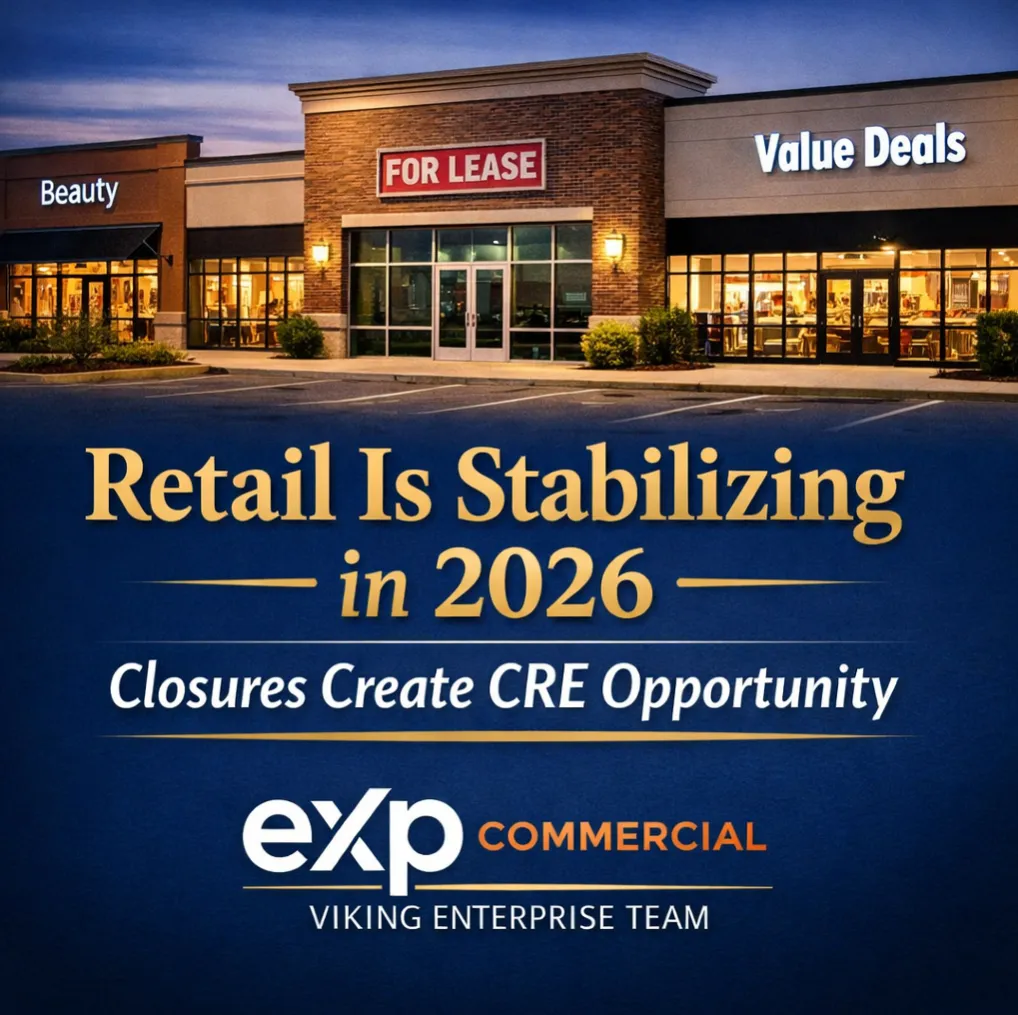
🛍️📊 Retail Is Stabilizing in 2026 — What Slower Store Closures Mean for CRE Investors 🏢📈
🛍️📊 Retail Is Stabilizing in 2026 — What Slower Store Closures Mean for CRE Investors 🏢📈
🏬📉 Closures Still Lead, But Retail Is Rebalancing in 2026 — A CRE Opportunity Story 💡🧱
Retail Real Estate in 2026: Stabilization, Not a Rebound—And Why That Matters
After several years of disruption, U.S. retail real estate is entering a new phase in 2026—measured stabilization rather than a full-cycle recovery. While store closures are still expected to outpace openings, the pace of contraction is slowing, and selective expansion is underway in resilient retail categories.
For commercial real estate investors, landlords, and business owners, this shift signals opportunity—particularly in well-located centers and second-generation retail space.
📊 The Numbers: Incremental Improvement, Not a Boom
Industry forecasts project approximately 5,500 new store openings and 7,900 closures nationwide in 2026. While closures remain higher, this represents an improvement from 2025, with fewer bankruptcies and less forced liquidation activity.
Retail churn at this level is not abnormal given the size of the U.S. retail footprint. What is notable is the slowing rate of closures, which suggests balance sheets and operating models have adjusted to today’s economic realities.
💰 Macro Conditions Supporting Retail Stability
Several macroeconomic forces are working in retail’s favor:
·Lower and stabilizing interest rates, improving refinancing and expansion feasibility
·Resilient consumer spending, particularly among higher-income households
·Moderating inflation, easing margin pressure
·Strong equity markets, supporting retailer access to capital
·Muted tariff impact, relative to earlier expectations
Together, these factors have reduced the pace of retail bankruptcies and created a more predictable operating environment—something investors and lenders value highly.
🏷️ Who’s Expanding—and Who Isn’t
Retail growth in 2026 is highly segmented:
Leading Expansion Categories
·Off-price and discount retail
·Beauty and personal care
·Value-oriented and necessity-based retailers
Contracting or Rationalizing
·Department stores
·Specialty apparel
·Certain big-box formats
·Select casual dining, QSR, and pharmacy operators
For CRE owners, this reinforces the importance of tenant mix, use flexibility, and location quality over brand name alone.
🔄 Closures Create Opportunity for Strong Assets
Store closures are not uniformly negative. Many vacated locations are:
·Well-located
·Built out with existing infrastructure
·Available at favorable lease terms
With very limited new retail construction nationwide, demand for high-quality second-generation retail space remains elevated—especially in supply-constrained suburban markets.
This dynamic is particularly attractive for investors seeking:
·Value-add leasing strategies
·Re-tenanting opportunities
·Redevelopment or adaptive reuse plays
🧭 What This Means for Texas, Houston, Katy & Fulshear
In Texas—and especially fast-growing submarkets like Katy, Fulshear, and West Houston—retail stabilization looks even stronger. Population growth, household formation, and suburban spending patterns continue to support neighborhood retail.
Key takeaways for local investors:
·Grocery-anchored and service-based retail remains highly defensible
·Second-generation retail near rooftops is in demand
·Flexible layouts outperform single-use spaces
·Financing is available—but underwriting is disciplined
🏁 Bottom Line
2026 is shaping up as a year of retail rebalancing, not retreat. Physical retail is no longer in widespread contraction—it’s adjusting to a more sustainable footprint.
For commercial real estate investors and landlords, the opportunity lies in selectivity, asset quality, and local market knowledge.
If you’re evaluating retail acquisitions, leasing strategies, or financing options in the Houston area, now is the time to act with clarity—not fear.
https://www.houstonrealestatebrokerage.com/
https://www.houstonrealestatebrokerage.com/houston-cre-navigator
https://www.commercialexchange.com/agent/653bf5593e3a3e1dcec275a6
http://expressoffers.com/[email protected]
https://app.bullpenre.com/profile/1742476177701x437444415125976000
https://author.billrapponline.com/
https://www.amazon.com/dp/B0F32Z5BH2
https://veed.cello.so/FOmzTty6oi9
https://buymeacoffee.com/vikingente3
https://creplaybookseries.billrapponline.com
https://creplaybook.billrapponline.com/
© 2023-2024 Bill Rapp, Broker Associate, eXp Commercial Viking Enterprise Team

eXp Commercial - Viking Enterprise team real estate network provides unparalleled commercial real estate services to Tenants and Landlords around the greater Katy & Houston MSA area. Our knowledge, experience, and reputation sets us apart from many firms.
A commercial property owner might have various plans that would necessitate the services of a commercial real estate broker. Some of the common scenarios include:
1. Selling the Property: If the owner decides it’s time to sell the property, a commercial real estate broker can help determine the market value, market the property effectively, and negotiate with potential buyers to get the best possible price.
2. Leasing Space: For property owners looking to lease out part or all of their commercial space, a broker can help find suitable tenants, negotiate lease terms, and ensure the lease agreements meet all legal requirements and serve the owner’s best interests.
3. Acquiring More Properties: Owners looking to expand their portfolio would benefit from a broker's knowledge of the market, access to listings, and negotiation skills to secure additional properties at favorable terms.
4. Property Management: While not all brokers offer this service, some commercial real estate brokers or their affiliates offer property management services. This can be particularly appealing for owners who prefer a hands-off approach or are managing properties from a distance.
5. Market Analysis: Owners considering future developments, renovations, or rebranding of their property might engage a broker for a comprehensive market analysis. This helps in understanding current market trends, the demand for different types of spaces, and potential returns on investment for various strategies.
6. Refinancing: In situations where a property owner is looking to refinance their property, a commercial real estate broker can provide valuable insights into the property’s current market value, assist in gathering necessary documentation, and even help in finding the best financing options.
7. Partnership or Investment Opportunities: Owners interested in exploring partnerships, joint ventures, or seeking investors for expansion or development projects might use a broker to find and vet potential partners or investors.
8. Consulting on Zoning and Use Changes: When contemplating a change in the use of the property or dealing with zoning issues, a broker with experience in local regulations and the specific property type can provide guidance and strategic planning assistance.
9. Exit Strategy Planning: For owners looking to plan an exit strategy from their investment, whether it’s through a strategic sale or a gradual winding down of operations, brokers can provide market insights, timing advice, and valuation services to optimize the exit process.
In any of these scenarios, the expertise and services provided by a commercial real estate broker can save the property owner time and money, while also providing access to a wider network of potential buyers, tenants, and industry professionals. Give us a call today!

Find the perfect location for your business.
Let us help your business succeed.
🛍️📊 Retail Is Stabilizing in 2026 — What Slower Store Closures Mean for CRE Investors 🏢📈
🛍️📊 Retail Is Stabilizing in 2026 — What Slower Store Closures Mean for CRE Investors 🏢📈
🏬📉 Closures Still Lead, But Retail Is Rebalancing in 2026 — A CRE Opportunity Story 💡🧱
Retail Real Estate in 2026: Stabilization, Not a Rebound—And Why That Matters
After several years of disruption, U.S. retail real estate is entering a new phase in 2026—measured stabilization rather than a full-cycle recovery. While store closures are still expected to outpace openings, the pace of contraction is slowing, and selective expansion is underway in resilient retail categories.
For commercial real estate investors, landlords, and business owners, this shift signals opportunity—particularly in well-located centers and second-generation retail space.
📊 The Numbers: Incremental Improvement, Not a Boom
Industry forecasts project approximately 5,500 new store openings and 7,900 closures nationwide in 2026. While closures remain higher, this represents an improvement from 2025, with fewer bankruptcies and less forced liquidation activity.
Retail churn at this level is not abnormal given the size of the U.S. retail footprint. What is notable is the slowing rate of closures, which suggests balance sheets and operating models have adjusted to today’s economic realities.
💰 Macro Conditions Supporting Retail Stability
Several macroeconomic forces are working in retail’s favor:
·Lower and stabilizing interest rates, improving refinancing and expansion feasibility
·Resilient consumer spending, particularly among higher-income households
·Moderating inflation, easing margin pressure
·Strong equity markets, supporting retailer access to capital
·Muted tariff impact, relative to earlier expectations
Together, these factors have reduced the pace of retail bankruptcies and created a more predictable operating environment—something investors and lenders value highly.
🏷️ Who’s Expanding—and Who Isn’t
Retail growth in 2026 is highly segmented:
Leading Expansion Categories
·Off-price and discount retail
·Beauty and personal care
·Value-oriented and necessity-based retailers
Contracting or Rationalizing
·Department stores
·Specialty apparel
·Certain big-box formats
·Select casual dining, QSR, and pharmacy operators
For CRE owners, this reinforces the importance of tenant mix, use flexibility, and location quality over brand name alone.
🔄 Closures Create Opportunity for Strong Assets
Store closures are not uniformly negative. Many vacated locations are:
·Well-located
·Built out with existing infrastructure
·Available at favorable lease terms
With very limited new retail construction nationwide, demand for high-quality second-generation retail space remains elevated—especially in supply-constrained suburban markets.
This dynamic is particularly attractive for investors seeking:
·Value-add leasing strategies
·Re-tenanting opportunities
·Redevelopment or adaptive reuse plays
🧭 What This Means for Texas, Houston, Katy & Fulshear
In Texas—and especially fast-growing submarkets like Katy, Fulshear, and West Houston—retail stabilization looks even stronger. Population growth, household formation, and suburban spending patterns continue to support neighborhood retail.
Key takeaways for local investors:
·Grocery-anchored and service-based retail remains highly defensible
·Second-generation retail near rooftops is in demand
·Flexible layouts outperform single-use spaces
·Financing is available—but underwriting is disciplined
🏁 Bottom Line
2026 is shaping up as a year of retail rebalancing, not retreat. Physical retail is no longer in widespread contraction—it’s adjusting to a more sustainable footprint.
For commercial real estate investors and landlords, the opportunity lies in selectivity, asset quality, and local market knowledge.
If you’re evaluating retail acquisitions, leasing strategies, or financing options in the Houston area, now is the time to act with clarity—not fear.
https://www.houstonrealestatebrokerage.com/
https://www.houstonrealestatebrokerage.com/houston-cre-navigator
https://www.commercialexchange.com/agent/653bf5593e3a3e1dcec275a6
http://expressoffers.com/[email protected]
https://app.bullpenre.com/profile/1742476177701x437444415125976000
https://author.billrapponline.com/
https://www.amazon.com/dp/B0F32Z5BH2
https://veed.cello.so/FOmzTty6oi9
https://buymeacoffee.com/vikingente3
https://creplaybookseries.billrapponline.com
https://creplaybook.billrapponline.com/
© 2023-2024 Bill Rapp, Broker Associate, eXp Commercial Viking Enterprise Team
Find the perfect location for your business.
Let us help your business succeed.
Sign up to receive the latest news on property investment and commercial real estate listings.
9600 Great Hills Trail, Suite 150w Austin, TX 78759 |
855.450.0324 xx255
Texas Real Estate Commission Consumer Protection Notice Texas Real Estate Commission
Information About Brokerage Services eXp Commercial LLC #9010212
Viking Enterprise LLC #9009614

Sign up to receive the latest news on property investment and commercial real estate listings.


Contact Us
901 S Mopac Expwy, Bldg 2, Suite 350 Austin, TX 78746 | 512.474.5557Texas Real Estate Commission
Consumer Protection Notice Texas Real Estate Commission Information About Brokerage Services Reliance Retail, LLC #603091
Texas RS, LLC #9003193 | RESOLUT RE Is Licensed In Louisiana #0995694083
Facebook
Instagram
X
LinkedIn
Youtube
TikTok