Your Trusted Houston Commercial Real Estate Brokerage
Viking Enterprise LLC is part of eXp Commercial, an agent-led, cloud-based commercial real estate brokerage with agents across the globe.
Email: [email protected]
Call: (281) 222-0433
Your Trusted Katy / Fulshear & Houston Commercial Real Estate Brokerage
Viking Enterprise LLC is part of eXp Commercial, an agent-led, cloud-based commercial real estate brokerage with agents across the globe.
Looking to invest, buy, sell or lease? We can help.
Looking to invest, buy, sell or lease? We can help.
FEATURED PROPERTIES




OUR FEATURED TENANTS & CLIENTS
eXp Commercial - Viking Enterprise Team's real estate network provides unparalleled commercial real estate services to Tenants and Landlords around the Katy- Houston area. Our knowledge, experience, and reputation sets us apart from many firms.
A commercial property owner might have various plans that would necessitate the services of a commercial real estate broker. Some of the common scenarios include:
1. Selling the Property: If the owner decides it’s time to sell the property, a commercial real estate broker can help determine the market value, market the property effectively, and negotiate with potential buyers to get the best possible price.
2. Leasing Space: For property owners looking to lease out part or all of their commercial space, a broker can help find suitable tenants, negotiate lease terms, and ensure the lease agreements meet all legal requirements and serve the owner’s best interests.
3. Acquiring More Properties: Owners looking to expand their portfolio would benefit from a broker's knowledge of the market, access to listings, and negotiation skills to secure additional properties at favorable terms.
4. Property Management: While not all brokers offer this service, some commercial real estate brokers or their affiliates offer property management services. This can be particularly appealing for owners who prefer a hands-off approach or are managing properties from a distance.
5. Market Analysis: Owners considering future developments, renovations, or rebranding of their property might engage a broker for a comprehensive market analysis. This helps in understanding current market trends, the demand for different types of spaces, and potential returns on investment for various strategies.
6. Refinancing: In situations where a property owner is looking to refinance their property, a commercial real estate broker can provide valuable insights into the property’s current market value, assist in gathering necessary documentation, and even help in finding the best financing options.
7. Partnership or Investment Opportunities: Owners interested in exploring partnerships, joint ventures, or seeking investors for expansion or development projects might use a broker to find and vet potential partners or investors.
8. Consulting on Zoning and Use Changes: When contemplating a change in the use of the property or dealing with zoning issues, a broker with experience in local regulations and the specific property type can provide guidance and strategic planning assistance.
9. Exit Strategy Planning: For owners looking to plan an exit strategy from their investment, whether it’s through a strategic sale or a gradual winding down of operations, brokers can provide market insights, timing advice, and valuation services to optimize the exit process.
In any of these scenarios, the expertise and services provided by a commercial real estate broker can save the property owner time and money, while also providing access to a wider network of potential buyers, tenants, and industry professionals. Give us a call today!
Reviews
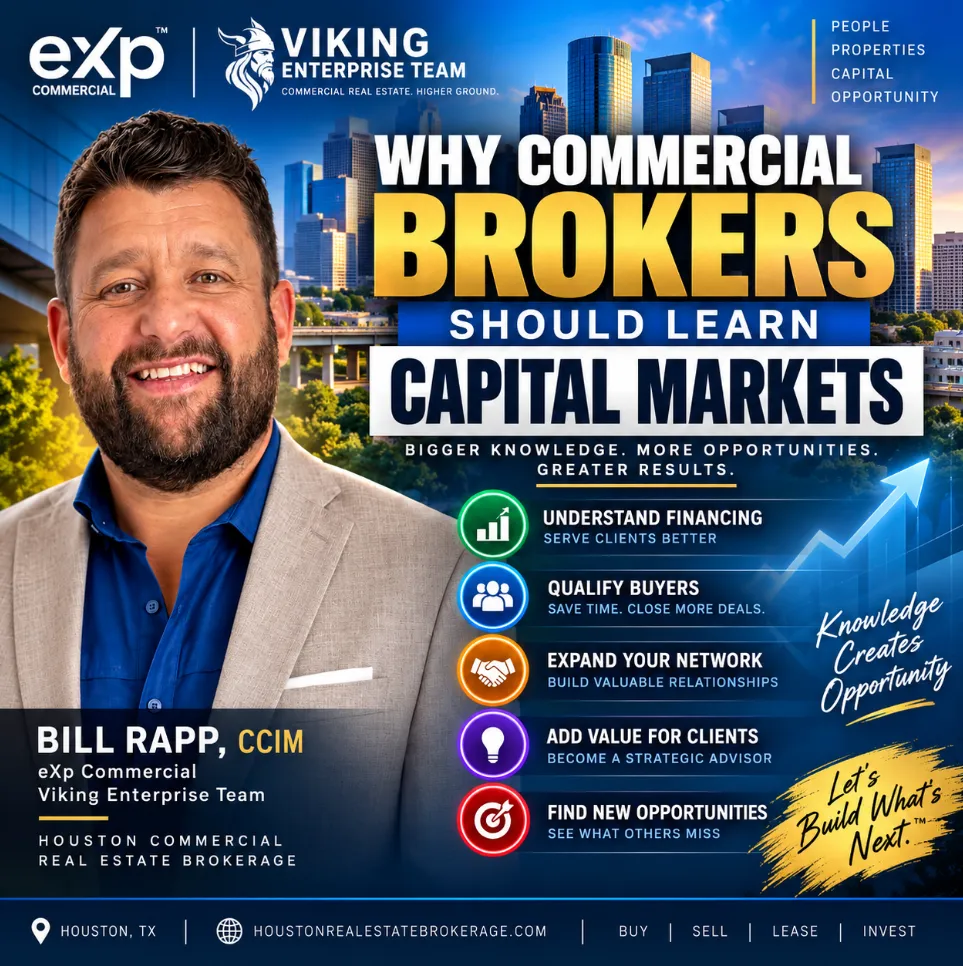
💰 Why Commercial Brokers Should Learn Capital Markets: Become More Valuable to CRE Clients 🏢
💰 Why Commercial Brokers Should Learn Capital Markets: Become More Valuable to CRE Clients 🏢
🚀 From Broker to Strategic Advisor: Why Capital Markets Knowledge Matters in Commercial Real Estate 💵
Why Commercial Brokers Should Learn Capital Markets
Commercial real estate brokerage has traditionally focused on three core activities: buying, selling, and leasing commercial property.
But completing a transaction often depends on something outside the traditional brokerage role:
Capital.
A buyer can find the right building and still lose the transaction because the financing does not work. An investor can negotiate an attractive purchase price but discover that the property's NOI does not support the desired loan amount. An owner may want to refinance or pull equity from a property but have no idea which capital source fits the deal.
This is why commercial brokers who understand capital markets can bring another level of value to their clients.
Capital markets knowledge does not require a commercial real estate broker to become a lender. It means understanding how financing affects value, leverage, cash flow, returns, deal structure, and ultimately whether a transaction can close.
What Are Capital Markets in Commercial Real Estate?
In commercial real estate, capital markets broadly refer to the sources and structures used to finance real estate transactions.
Depending on the property, borrower, and business plan, those sources can include:
·Banks and credit unions
·Commercial mortgage lenders
·SBA lenders
·Bridge lenders
·Debt funds
·Agency lenders
·CMBS lenders
·Life insurance companies
·Private lenders
·Equity investors
Each source evaluates risk differently.
A local bank financing an owner-occupied warehouse may approach the transaction very differently from a debt fund financing a transitional multifamily property.
Understanding those differences can help a broker recognize financing obstacles before they become closing problems.
Commercial Brokers Should Understand the Three Numbers That Often Control the Loan
Three underwriting metrics frequently influence commercial real estate financing:
1. Loan-to-Value Ratio — LTV
LTV measures the loan relative to the property's value.
For example, a $3 million loan against a $4 million property represents a 75% LTV.
But maximum LTV does not automatically determine the loan amount. The property's cash flow may create a lower limit.
2. Debt Service Coverage Ratio — DSCR
DSCR compares the property's net operating income to its annual debt service.
If a property generates $250,000 in NOI and annual debt service is $200,000:
DSCR = 1.25x
Understanding DSCR can be particularly important when interest rates rise because higher debt service can reduce the amount of debt supported by the same NOI.
3. Debt Yield
Debt yield compares NOI directly with the loan balance.
If NOI is $250,000 and the requested loan is $3 million:
Debt Yield = 8.33%
Unlike DSCR, debt yield is not directly dependent on the interest rate or amortization schedule.
A broker who understands LTV, DSCR, and debt yield can begin identifying potential financing constraints while evaluating the transaction rather than discovering them shortly before closing.
Capital Markets Knowledge Can Make Brokers Better at Pricing Properties
Financing and valuation are closely connected.
Suppose an investment property generates $300,000 in NOI.
At a 6% capitalization rate:
$300,000 ÷ 6% = $5,000,000
But determining value is only one part of the investment analysis.
The buyer also needs to determine how much debt the property supports and what that debt does to projected returns.
Changes in interest rates, lender spreads, amortization, DSCR requirements, and leverage can materially change the buyer's economics.
That means a commercial broker evaluating investment property should understand both sides of the equation:
Property economics + capital structure.
Financing Should Be Discussed Before the LOI
One of the biggest opportunities for brokers is bringing financing into the conversation earlier.
Consider a buyer negotiating a $5 million acquisition.
The buyer expects 75% financing and therefore assumes the equity requirement will be approximately $1.25 million.
But underwriting later determines the property supports only a $3.25 million loan.
The buyer now needs approximately $1.75 million plus closing costs and reserves.
That additional equity requirement can materially change the transaction.
Discussing financing assumptions before or during the LOI process can help identify these issues earlier.
Understanding Capital Markets Can Help Brokers Qualify Buyers
Proof of funds is useful, but it does not tell the entire story.
Commercial financing depends on more than liquidity.
Depending on the loan program, lenders may examine:
·Property cash flow
·Borrower liquidity
·Net worth
·Credit
·Global cash flow
·Sponsor experience
·Tenant quality
·Lease rollover
·Property condition
·Business financials
·Guarantor strength
·Exit strategy
A buyer can have significant liquidity and still encounter financing challenges if the proposed transaction does not satisfy the lender's underwriting criteria.
A broker who understands these issues can ask better questions before spending weeks or months pursuing a transaction.
Capital Markets Knowledge Helps Brokers Serve Owner-Users
Capital markets knowledge is not limited to investment sales.
It can be particularly valuable when advising business owners purchasing commercial real estate.
Owner-users may have access to financing structures different from those available to traditional investors, including conventional bank financing and potentially SBA programs when eligibility requirements are satisfied.
The financing structure can influence whether the business should:
buy an existing property, continue leasing, purchase land and build, or pursue a build-to-suit strategy.
That makes financing part of the real estate strategy rather than simply something addressed after a property is selected.
Capital Markets Can Create Additional Deal Opportunities
Financing knowledge can also help brokers recognize situations that might create transactions.
For example, an owner may face a loan maturity and discover that refinancing at today's terms requires additional equity.
That owner might decide to:
·Refinance
·Bring in additional equity
·Sell the property
·Recapitalize the asset
·Exchange into another property
Without understanding the debt side of commercial real estate, a broker may never recognize why that owner is considering a transaction.
Capital markets can therefore become another lens for business development and prospecting.
Brokers Can Communicate More Effectively With Investors
Sophisticated investors frequently speak the language of capital.
They discuss:
NOI. Cap rates. DSCR. Debt yield. Leverage. Cash-on-cash return. IRR. Equity multiple. Loan proceeds. Prepayment. Recourse. Exit strategy.
A commercial broker does not necessarily need to structure the financing personally.
But understanding these concepts allows the broker to participate more effectively in conversations with investors, lenders, attorneys, CPAs, and financial advisors.
That can shift the relationship from simply finding properties to helping clients evaluate transactions.
Capital Markets Knowledge Can Expand a Broker's Network
Commercial real estate is a relationship-driven business.
Learning capital markets naturally expands the professionals a broker interacts with, including:
·Commercial bankers
·Mortgage brokers
·SBA lenders
·Private lenders
·Debt funds
·Equity investors
·CPAs
·Attorneys
·Financial advisors
·Developers
Those relationships can also become referral sources.
A lender may encounter a borrower who needs to sell a building.
A CPA may have a client considering a 1031 exchange.
An investor may need acquisition opportunities.
A broker who understands both real estate and capital can become a valuable connection between those groups.
You Don't Have to Become a Commercial Mortgage Broker
Commercial brokers do not necessarily need to arrange loans themselves.
The objective is to understand financing well enough to identify important questions:
How much leverage might this property support?
Does the NOI support the expected debt?
How will higher rates affect proceeds?
Is this an owner-user or investment financing opportunity?
Could the property require bridge financing before permanent financing?
What financing contingencies should the buyer consider?
Knowing when to involve a qualified lending professional is itself valuable.
The Future Commercial Broker Is a Strategic Advisor
Commercial real estate clients have access to more property information than ever before.
Listings, ownership information, market data, demographics, and transaction information have become increasingly accessible.
That makes a broker's analysis, relationships, negotiation skills, and strategic knowledge increasingly important differentiators.
Capital markets knowledge strengthens each of those areas.
A broker who understands both the property and the financing can help clients examine the entire transaction:
Property → Operations → NOI → Value → Debt → Equity → Returns → Exit
That is a much broader conversation than simply asking:
"Do you want to buy this building?"
Final Takeaway
Commercial real estate transactions ultimately bring together property, people, and capital.
Brokers already understand the property side.
Learning the capital side can help them identify problems earlier, communicate more effectively with investors, understand what drives loan proceeds, expand their professional network, and provide clients with a more complete view of the transaction.
At eXp Commercial – Viking Enterprise Team, our approach is built around helping commercial property owners, investors, developers, and business owners evaluate opportunities from both a real estate and financial perspective.
Whether you're looking to buy, sell, lease, invest, or evaluate your next commercial real estate opportunity in Greater Houston, let's talk.
Connect With Viking Enterprise Team
📍 eXp Commercial & eXp Realty
📍 Houston | Katy | Fulshear | West Houston
📅 Calendly.com/VikingEnterprise
📞 281-222-0433
📞 Bill Rapp, CCIM
eXp Commercial | Viking Enterprise Team
Commercial Real Estate & Capital Advisory
🌐 https://houstonrealestatebrokerage.com
https://www.houstonrealestatebrokerage.com/
https://www.houstonrealestatebrokerage.com/houston-cre-navigator
https://www.commercialexchange.com/agent/653bf5593e3a3e1dcec275a6
http://expressoffers.com/[email protected]
https://app.bullpenre.com/profile/1742476177701x437444415125976000
https://author.billrapponline.com/
https://www.amazon.com/dp/B0F32Z5BH2
https://veed.cello.so/FOmzTty6oi9
https://buymeacoffee.com/vikingente3
https://creplaybookseries.billrapponline.com
https://creplaybook.billrapponline.com/
© Bill Rapp, Broker Associate, eXp Commercial Viking Enterprise Team

Commercial Real Estate Advisors Serving Katy, Fulshear & Greater Houston
Helping Property Owners, Investors & Businesses Make Smarter Commercial Real Estate Decisions
Whether you're buying, selling, leasing, investing, or financing commercial real estate, having the right advisor can make all the difference.
At eXp Commercial – Viking Enterprise Team, we provide comprehensive commercial real estate brokerage and advisory services for property owners, investors, developers, landlords, tenants, and business owners throughout Katy, Fulshear, Houston, and the surrounding Texas markets.
Our team combines local market expertise with commercial investment knowledge and capital markets experience to help clients maximize property value, identify new opportunities, reduce risk, and achieve long-term investment success.
From a single office building to a growing investment portfolio, we provide strategic guidance from acquisition through disposition.
Comprehensive Commercial Real Estate Services
Commercial Property Sales
Selling commercial real estate requires far more than placing a property on the market. We develop customized marketing strategies designed to maximize exposure while targeting qualified buyers locally, regionally, and nationally.
Our services include:
Property valuation and pricing strategy
Investment analysis
Professional marketing campaigns
Buyer qualification
Contract negotiation
Due diligence coordination
Transaction management through closing
Whether you're selling office, retail, industrial, multifamily, land, medical, mixed-use, or investment property, our objective is simple—maximize your property's value while creating a smooth transaction.
Commercial Leasing Services
Vacancies reduce cash flow and impact property performance.
We help landlords lease available space by creating effective marketing campaigns, identifying qualified tenants, negotiating favorable lease terms, and minimizing downtime.
Our leasing services include:
Office leasing
Retail leasing
Industrial leasing
Medical office leasing
Flex space leasing
Warehouse leasing
Landlord representation
Tenant representation
Lease renewals
Lease negotiations
Our goal is to keep your property occupied with quality tenants while protecting your long-term investment.
Commercial Property Acquisitions
Whether you're purchasing your first commercial property or expanding a large investment portfolio, we help identify opportunities that align with your investment objectives.
Our acquisition services include:
Market research
Property sourcing
Financial analysis
Cap rate evaluation
Cash flow analysis
Due diligence
Negotiation
Closing coordination
We help investors make informed decisions backed by market data and financial analysis—not emotion.
Investment Property Analysis
Every investment should begin with a thorough understanding of risk and return.
We assist investors by evaluating:
Net Operating Income (NOI)
Capitalization Rates
Cash-on-Cash Returns
Internal Rate of Return (IRR)
Market Rent Analysis
Occupancy Trends
Comparable Sales
Exit Strategies
Our investment analysis helps clients make data-driven decisions before committing capital.
Commercial Financing & Capital Advisory
One of the biggest advantages of working with Viking Enterprise Team is access to commercial financing expertise.
Through our capital markets relationships, we help clients evaluate financing options for acquisitions, refinancing, construction, bridge financing, SBA loans, investment properties, and owner-occupied commercial real estate.
We help clients:
Evaluate financing options
Analyze refinancing opportunities
Improve loan positioning
Understand lender requirements
Coordinate with commercial lenders
Structure financing strategies
Real estate and financing should work together—not independently.
Portfolio Growth & Investment Strategy
Building long-term wealth through commercial real estate requires strategic planning.
We work with investors to:
Expand investment portfolios
Identify off-market opportunities
Improve portfolio performance
Evaluate redevelopment opportunities
Reposition underperforming assets
Develop long-term acquisition strategies
Whether you're purchasing your second investment or your fiftieth, we help create a roadmap for continued growth.
Landlord Representation
Commercial property owners face constant challenges:
Tenant turnover
Lease negotiations
Rental rates
Market competition
Property positioning
We provide landlord representation focused on maximizing occupancy, improving lease terms, increasing property value, and strengthening long-term cash flow.
Tenant Representation
Businesses often outgrow their current space or need a location that better supports future growth.
We represent tenants throughout the site selection process, helping negotiate favorable lease terms while identifying properties that fit operational and financial objectives.
Our tenant services include:
Office space
Retail locations
Industrial facilities
Warehouse space
Medical offices
Flex properties
Build-to-suit opportunities
Market Analysis & Commercial Consulting
Successful commercial real estate decisions begin with accurate market intelligence.
Our advisory services include:
Market studies
Property positioning
Rent analysis
Development feasibility
Redevelopment analysis
Demographic research
Growth corridor identification
Competitive property analysis
Whether you're considering selling today or planning five years ahead, we help you understand where the market is headed.
Joint Ventures & Investment Partnerships
Many commercial opportunities require additional equity, strategic partners, or experienced investors.
We help facilitate introductions between qualified investors, developers, operators, and commercial property owners seeking partnership opportunities for acquisitions, development, redevelopment, or recapitalization.
Exit Planning & Wealth Preservation
Every commercial investment eventually reaches a transition point.
Whether you're considering:
Selling
Refinancing
Recapitalizing
Completing a 1031 Exchange
Passing assets to the next generation
Repositioning your portfolio
we help create an exit strategy that aligns with your financial goals while maximizing value and minimizing unnecessary risk.
Why Choose Viking Enterprise Team?
Commercial real estate is about more than buying and selling properties—it's about creating long-term value.
Our clients benefit from:
Local expertise throughout Katy, Fulshear, Houston, and surrounding markets
Experience representing investors, developers, business owners, landlords, and tenants
Comprehensive brokerage and advisory services
Commercial financing insight and capital markets knowledge
Investment-focused analysis
Strategic negotiation
Professional marketing
Personalized service from initial consultation through closing
We believe informed clients make better decisions, and our role is to provide the expertise, market intelligence, and guidance needed to help you succeed.
Let's Discuss Your Commercial Real Estate Goals
Whether you're buying, selling, leasing, investing, refinancing, or planning your next commercial real estate transaction, Viking Enterprise Team is ready to help.
Schedule a confidential consultation to discuss your objectives and discover how our experience, market knowledge, and strategic approach can help you maximize the value of your commercial real estate investments.
Contact eXp Commercial – Viking Enterprise Team today and let's build your commercial real estate strategy together.


Find the perfect location for your business.
Let us help your business succeed.
💰 Why Commercial Brokers Should Learn Capital Markets: Become More Valuable to CRE Clients 🏢
💰 Why Commercial Brokers Should Learn Capital Markets: Become More Valuable to CRE Clients 🏢
🚀 From Broker to Strategic Advisor: Why Capital Markets Knowledge Matters in Commercial Real Estate 💵
Why Commercial Brokers Should Learn Capital Markets
Commercial real estate brokerage has traditionally focused on three core activities: buying, selling, and leasing commercial property.
But completing a transaction often depends on something outside the traditional brokerage role:
Capital.
A buyer can find the right building and still lose the transaction because the financing does not work. An investor can negotiate an attractive purchase price but discover that the property's NOI does not support the desired loan amount. An owner may want to refinance or pull equity from a property but have no idea which capital source fits the deal.
This is why commercial brokers who understand capital markets can bring another level of value to their clients.
Capital markets knowledge does not require a commercial real estate broker to become a lender. It means understanding how financing affects value, leverage, cash flow, returns, deal structure, and ultimately whether a transaction can close.
What Are Capital Markets in Commercial Real Estate?
In commercial real estate, capital markets broadly refer to the sources and structures used to finance real estate transactions.
Depending on the property, borrower, and business plan, those sources can include:
·Banks and credit unions
·Commercial mortgage lenders
·SBA lenders
·Bridge lenders
·Debt funds
·Agency lenders
·CMBS lenders
·Life insurance companies
·Private lenders
·Equity investors
Each source evaluates risk differently.
A local bank financing an owner-occupied warehouse may approach the transaction very differently from a debt fund financing a transitional multifamily property.
Understanding those differences can help a broker recognize financing obstacles before they become closing problems.
Commercial Brokers Should Understand the Three Numbers That Often Control the Loan
Three underwriting metrics frequently influence commercial real estate financing:
1. Loan-to-Value Ratio — LTV
LTV measures the loan relative to the property's value.
For example, a $3 million loan against a $4 million property represents a 75% LTV.
But maximum LTV does not automatically determine the loan amount. The property's cash flow may create a lower limit.
2. Debt Service Coverage Ratio — DSCR
DSCR compares the property's net operating income to its annual debt service.
If a property generates $250,000 in NOI and annual debt service is $200,000:
DSCR = 1.25x
Understanding DSCR can be particularly important when interest rates rise because higher debt service can reduce the amount of debt supported by the same NOI.
3. Debt Yield
Debt yield compares NOI directly with the loan balance.
If NOI is $250,000 and the requested loan is $3 million:
Debt Yield = 8.33%
Unlike DSCR, debt yield is not directly dependent on the interest rate or amortization schedule.
A broker who understands LTV, DSCR, and debt yield can begin identifying potential financing constraints while evaluating the transaction rather than discovering them shortly before closing.
Capital Markets Knowledge Can Make Brokers Better at Pricing Properties
Financing and valuation are closely connected.
Suppose an investment property generates $300,000 in NOI.
At a 6% capitalization rate:
$300,000 ÷ 6% = $5,000,000
But determining value is only one part of the investment analysis.
The buyer also needs to determine how much debt the property supports and what that debt does to projected returns.
Changes in interest rates, lender spreads, amortization, DSCR requirements, and leverage can materially change the buyer's economics.
That means a commercial broker evaluating investment property should understand both sides of the equation:
Property economics + capital structure.
Financing Should Be Discussed Before the LOI
One of the biggest opportunities for brokers is bringing financing into the conversation earlier.
Consider a buyer negotiating a $5 million acquisition.
The buyer expects 75% financing and therefore assumes the equity requirement will be approximately $1.25 million.
But underwriting later determines the property supports only a $3.25 million loan.
The buyer now needs approximately $1.75 million plus closing costs and reserves.
That additional equity requirement can materially change the transaction.
Discussing financing assumptions before or during the LOI process can help identify these issues earlier.
Understanding Capital Markets Can Help Brokers Qualify Buyers
Proof of funds is useful, but it does not tell the entire story.
Commercial financing depends on more than liquidity.
Depending on the loan program, lenders may examine:
·Property cash flow
·Borrower liquidity
·Net worth
·Credit
·Global cash flow
·Sponsor experience
·Tenant quality
·Lease rollover
·Property condition
·Business financials
·Guarantor strength
·Exit strategy
A buyer can have significant liquidity and still encounter financing challenges if the proposed transaction does not satisfy the lender's underwriting criteria.
A broker who understands these issues can ask better questions before spending weeks or months pursuing a transaction.
Capital Markets Knowledge Helps Brokers Serve Owner-Users
Capital markets knowledge is not limited to investment sales.
It can be particularly valuable when advising business owners purchasing commercial real estate.
Owner-users may have access to financing structures different from those available to traditional investors, including conventional bank financing and potentially SBA programs when eligibility requirements are satisfied.
The financing structure can influence whether the business should:
buy an existing property, continue leasing, purchase land and build, or pursue a build-to-suit strategy.
That makes financing part of the real estate strategy rather than simply something addressed after a property is selected.
Capital Markets Can Create Additional Deal Opportunities
Financing knowledge can also help brokers recognize situations that might create transactions.
For example, an owner may face a loan maturity and discover that refinancing at today's terms requires additional equity.
That owner might decide to:
·Refinance
·Bring in additional equity
·Sell the property
·Recapitalize the asset
·Exchange into another property
Without understanding the debt side of commercial real estate, a broker may never recognize why that owner is considering a transaction.
Capital markets can therefore become another lens for business development and prospecting.
Brokers Can Communicate More Effectively With Investors
Sophisticated investors frequently speak the language of capital.
They discuss:
NOI. Cap rates. DSCR. Debt yield. Leverage. Cash-on-cash return. IRR. Equity multiple. Loan proceeds. Prepayment. Recourse. Exit strategy.
A commercial broker does not necessarily need to structure the financing personally.
But understanding these concepts allows the broker to participate more effectively in conversations with investors, lenders, attorneys, CPAs, and financial advisors.
That can shift the relationship from simply finding properties to helping clients evaluate transactions.
Capital Markets Knowledge Can Expand a Broker's Network
Commercial real estate is a relationship-driven business.
Learning capital markets naturally expands the professionals a broker interacts with, including:
·Commercial bankers
·Mortgage brokers
·SBA lenders
·Private lenders
·Debt funds
·Equity investors
·CPAs
·Attorneys
·Financial advisors
·Developers
Those relationships can also become referral sources.
A lender may encounter a borrower who needs to sell a building.
A CPA may have a client considering a 1031 exchange.
An investor may need acquisition opportunities.
A broker who understands both real estate and capital can become a valuable connection between those groups.
You Don't Have to Become a Commercial Mortgage Broker
Commercial brokers do not necessarily need to arrange loans themselves.
The objective is to understand financing well enough to identify important questions:
How much leverage might this property support?
Does the NOI support the expected debt?
How will higher rates affect proceeds?
Is this an owner-user or investment financing opportunity?
Could the property require bridge financing before permanent financing?
What financing contingencies should the buyer consider?
Knowing when to involve a qualified lending professional is itself valuable.
The Future Commercial Broker Is a Strategic Advisor
Commercial real estate clients have access to more property information than ever before.
Listings, ownership information, market data, demographics, and transaction information have become increasingly accessible.
That makes a broker's analysis, relationships, negotiation skills, and strategic knowledge increasingly important differentiators.
Capital markets knowledge strengthens each of those areas.
A broker who understands both the property and the financing can help clients examine the entire transaction:
Property → Operations → NOI → Value → Debt → Equity → Returns → Exit
That is a much broader conversation than simply asking:
"Do you want to buy this building?"
Final Takeaway
Commercial real estate transactions ultimately bring together property, people, and capital.
Brokers already understand the property side.
Learning the capital side can help them identify problems earlier, communicate more effectively with investors, understand what drives loan proceeds, expand their professional network, and provide clients with a more complete view of the transaction.
At eXp Commercial – Viking Enterprise Team, our approach is built around helping commercial property owners, investors, developers, and business owners evaluate opportunities from both a real estate and financial perspective.
Whether you're looking to buy, sell, lease, invest, or evaluate your next commercial real estate opportunity in Greater Houston, let's talk.
Connect With Viking Enterprise Team
📍 eXp Commercial & eXp Realty
📍 Houston | Katy | Fulshear | West Houston
📅 Calendly.com/VikingEnterprise
📞 281-222-0433
📞 Bill Rapp, CCIM
eXp Commercial | Viking Enterprise Team
Commercial Real Estate & Capital Advisory
🌐 https://houstonrealestatebrokerage.com
https://www.houstonrealestatebrokerage.com/
https://www.houstonrealestatebrokerage.com/houston-cre-navigator
https://www.commercialexchange.com/agent/653bf5593e3a3e1dcec275a6
http://expressoffers.com/[email protected]
https://app.bullpenre.com/profile/1742476177701x437444415125976000
https://author.billrapponline.com/
https://www.amazon.com/dp/B0F32Z5BH2
https://veed.cello.so/FOmzTty6oi9
https://buymeacoffee.com/vikingente3
https://creplaybookseries.billrapponline.com
https://creplaybook.billrapponline.com/
© Bill Rapp, Broker Associate, eXp Commercial Viking Enterprise Team
Find the perfect location for your business.
Let us help your business succeed.

Sign up to receive the latest news on property investment and commercial real estate listings.
9600 Great Hills Trail, Suite 150w Austin, TX 78759 |
855.450.0324 xx255
Texas Real Estate Commission Consumer Protection Notice Texas Real Estate Commission
Information About Brokerage Services eXp Commercial LLC #9010212
Viking Enterprise LLC #9009614

Sign up to receive the latest news on property investment and commercial real estate listings.


Contact Us
901 S Mopac Expwy, Bldg 2, Suite 350 Austin, TX 78746 | 512.474.5557Texas Real Estate Commission
Consumer Protection Notice Texas Real Estate Commission Information About Brokerage Services Reliance Retail, LLC #603091
Texas RS, LLC #9003193 | RESOLUT RE Is Licensed In Louisiana #0995694083
Facebook
Instagram
X
LinkedIn
Youtube
TikTok