Your Trusted Houston Commercial Real Estate Brokerage
Viking Enterprise LLC is part of eXp Commercial, an agent-led, cloud-based commercial real estate brokerage with agents across the globe.
Email: [email protected]
Call: (281) 222-0433
Your Trusted Katy / Fulshear & Houston Commercial Real Estate Brokerage
Viking Enterprise LLC is part of eXp Commercial, an agent-led, cloud-based commercial real estate brokerage with agents across the globe.
Looking to invest, buy, sell or lease? We can help.
Looking to invest, buy, sell or lease? We can help.
FEATURED PROPERTIES




OUR FEATURED TENANTS & CLIENTS
eXp Commercial - Viking Enterprise Team's real estate network provides unparalleled commercial real estate services to Tenants and Landlords around the Katy- Houston area. Our knowledge, experience, and reputation sets us apart from many firms.
A commercial property owner might have various plans that would necessitate the services of a commercial real estate broker. Some of the common scenarios include:
1. Selling the Property: If the owner decides it’s time to sell the property, a commercial real estate broker can help determine the market value, market the property effectively, and negotiate with potential buyers to get the best possible price.
2. Leasing Space: For property owners looking to lease out part or all of their commercial space, a broker can help find suitable tenants, negotiate lease terms, and ensure the lease agreements meet all legal requirements and serve the owner’s best interests.
3. Acquiring More Properties: Owners looking to expand their portfolio would benefit from a broker's knowledge of the market, access to listings, and negotiation skills to secure additional properties at favorable terms.
4. Property Management: While not all brokers offer this service, some commercial real estate brokers or their affiliates offer property management services. This can be particularly appealing for owners who prefer a hands-off approach or are managing properties from a distance.
5. Market Analysis: Owners considering future developments, renovations, or rebranding of their property might engage a broker for a comprehensive market analysis. This helps in understanding current market trends, the demand for different types of spaces, and potential returns on investment for various strategies.
6. Refinancing: In situations where a property owner is looking to refinance their property, a commercial real estate broker can provide valuable insights into the property’s current market value, assist in gathering necessary documentation, and even help in finding the best financing options.
7. Partnership or Investment Opportunities: Owners interested in exploring partnerships, joint ventures, or seeking investors for expansion or development projects might use a broker to find and vet potential partners or investors.
8. Consulting on Zoning and Use Changes: When contemplating a change in the use of the property or dealing with zoning issues, a broker with experience in local regulations and the specific property type can provide guidance and strategic planning assistance.
9. Exit Strategy Planning: For owners looking to plan an exit strategy from their investment, whether it’s through a strategic sale or a gradual winding down of operations, brokers can provide market insights, timing advice, and valuation services to optimize the exit process.
In any of these scenarios, the expertise and services provided by a commercial real estate broker can save the property owner time and money, while also providing access to a wider network of potential buyers, tenants, and industry professionals. Give us a call today!
Reviews
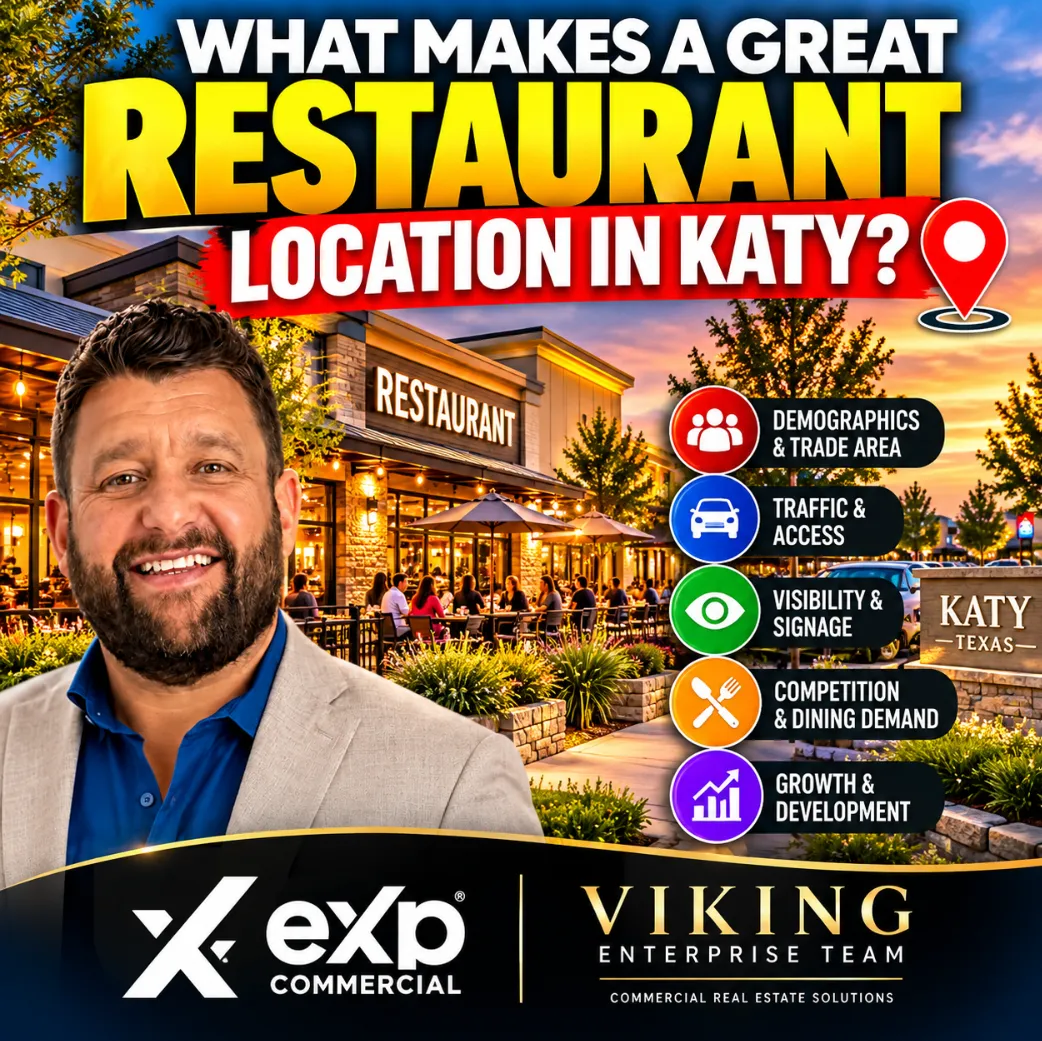
🍽️ What Makes a Great Restaurant Location in Katy, Texas? 10 Site Selection Factors That Matter 📍
🍽️ What Makes a Great Restaurant Location in Katy, Texas? 10 Site Selection Factors That Matter 📍
📍 Restaurant Site Selection in Katy: How to Choose a Location Built for Success 🚀
________________________________________________________________________________
What Makes a Great Restaurant Location in Katy?
Katy, Texas continues to attract new residents, businesses, retailers, and restaurant concepts. But population growth alone does not make every retail center or available restaurant space a great location.
For restaurant owners, franchisees, investors, and developers, restaurant site selection in Katy requires a much deeper analysis.
A highly visible building can fail because access is difficult. An attractive new development can struggle because traffic patterns do not support the concept. A location surrounded by rooftops may look perfect until you discover that the demographics, competition, parking, rent structure, or trade area do not match the restaurant's business model.
The objective isn't simply to find available restaurant space.
It is to find a location where demographics, traffic, access, visibility, competition, economics, and real estate fundamentals align with the concept.
Here are some of the most important factors to evaluate.
1. Start With the Restaurant's Target Customer
Before looking at individual properties, define who the restaurant needs to attract.
A fast-casual lunch concept may depend heavily on daytime employees and convenient access. A family restaurant may benefit more from nearby rooftops, schools, youth activities, and evening traffic. A higher-end restaurant may need strong household incomes and customers willing to travel farther for the experience.
Important demographic variables can include:
·Population density and growth
·Household income
·Age distribution
·Household composition
·Daytime employment
·Consumer spending patterns
·Residential development
·Traffic generators
The best Katy restaurant location is therefore not universal.
It is the location that best matches the restaurant's specific customer profile.
2. Understand the Real Trade Area
Restaurant operators sometimes evaluate sites using simple one-, three-, and five-mile rings.
Those measurements are useful, but they can be misleading.
Actual trade areas are shaped by road networks, traffic patterns, schools, neighborhoods, employment centers, competing restaurants, natural barriers, and customer behavior.
In a growing suburban market such as Katy, five miles in one direction may represent a completely different customer base from five miles in another.
Drive-time analysis can often provide a more realistic picture.
Ask:
Where will customers realistically come from, and how easy is it for them to reach the restaurant?
3. Traffic Counts Matter—but Traffic Quality Matters More
High traffic counts are attractive, but not every passing vehicle represents a potential customer.
Operators should examine:
·Daily traffic volume
·Directional traffic
·Morning versus evening patterns
·Weekday versus weekend traffic
·Commuter routes
·Intersection activity
·Nearby traffic generators
A restaurant dependent on dinner business, for example, may place greater value on strong evening traffic moving toward residential neighborhoods.
The question isn't simply, "How many cars pass this site?"
It is:
"Are the right customers passing this site at the right time?"
4. Visibility Can Be a Major Competitive Advantage
Restaurants benefit significantly from repeated exposure.
Strong visibility can create thousands of daily impressions without the restaurant purchasing additional advertising.
Evaluate:
·Building visibility
·Monument signage
·Pylon signage
·Storefront exposure
·Visibility from intersections
·Landscaping obstructions
·Setback from the roadway
A location that customers pass every day can gradually become part of their mental map.
That makes visibility both a real estate consideration and a marketing asset.
5. Access Can Be More Important Than Visibility
A customer seeing the restaurant doesn't help much if reaching it is frustrating.
Examine how customers actually enter and leave the property.
Important considerations include:
·Number of curb cuts
·Signalized access
·Median restrictions
·Left-turn accessibility
·Shared access with neighboring developments
·Internal circulation
·Entry and exit congestion
One of the most important exercises during restaurant site selection is simply driving the location like a customer would.
Approach it from multiple directions during lunch, dinner, weekday, and weekend traffic.
6. Parking Must Match the Concept
Restaurants typically generate more concentrated parking demand than many traditional retailers.
Parking requirements also vary dramatically between concepts.
A coffee shop, drive-thru QSR, full-service restaurant, bar, fast-casual concept, and fine-dining restaurant may have very different requirements.
Consider:
·Parking ratio
·Shared parking agreements
·Peak-hour demand
·Employee parking
·Pickup/delivery parking
·ADA accessibility
·Drive-thru stacking
·Traffic circulation
A restaurant space can have excellent demographics and still underperform operationally if parking creates constant friction.
7. Study the Competition—and the Restaurant Clusters
Competition isn't automatically negative.
Restaurants frequently benefit from being near other restaurants because consumers already recognize the area as a dining destination.
The analysis should distinguish between healthy clustering and excessive saturation.
Map:
·Direct competitors
·Indirect competitors
·Price points
·Cuisine categories
·Restaurant openings
·Closures
·Drive-thru concepts
·National chains
·Successful local operators
Then ask whether the new restaurant fills a gap or simply adds another similar concept to an already crowded category.
8. Watch for Cannibalization
This becomes especially important for franchisees and multi-unit operators.
A new Katy restaurant might produce excellent sales while simultaneously transferring revenue from an existing location.
That's why expansion analysis should evaluate incremental sales versus transferred sales.
Two stores only a few miles apart may serve very different customers because of roads and traffic patterns. Conversely, locations farther apart can compete heavily because they share the same commuter or residential trade area.
Site selection should therefore examine the entire restaurant network—not just the proposed location.
9. Follow Residential and Commercial Growth
Katy's development patterns create another opportunity.
The strongest location today may not necessarily offer the strongest long-term growth potential.
Restaurant operators should monitor:
·New subdivisions
·Apartment development
·Master-planned communities
·Retail construction
·Schools
·Medical facilities
·Office development
·Industrial employment
·Road and infrastructure improvements
Sometimes entering a growth corridor early can provide attractive positioning.
The tradeoff is timing.
Opening too early can mean waiting for rooftops and traffic to materialize.
10. Evaluate the Economics Before Falling in Love With the Site
A beautiful location can still be a bad deal.
Restaurant operators need to calculate the true occupancy cost, not simply the advertised base rent.
For leased restaurant space, analyze:
Base Rent + NNN/CAM + Taxes + Insurance + Utilities + Buildout + Equipment + Signage + Other Occupancy Expenses
Tenant improvement allowances, free rent, landlord contributions, and delivery condition should also be negotiated.
A second-generation restaurant may offer substantial savings if usable infrastructure already exists.
However, existing improvements should never automatically be assigned full value. HVAC, electrical capacity, grease traps, vent hoods, plumbing, kitchen equipment, and other systems need proper inspection.
11. Determine Whether the Space Can Physically Support the Restaurant
Before signing a lease, operators should confirm whether the property can accommodate the intended use.
Potential considerations include:
·Zoning
·Certificate of occupancy
·Grease trap
·Ventilation
·Hood system
·Gas availability
·Electrical capacity
·Water and sewer capacity
·Fire suppression
·Patio rights
·Signage
·Drive-thru approval
·Alcohol-related requirements
·Delivery access
Restaurant construction can become expensive very quickly.
The cheapest rent may therefore produce the most expensive overall project.
12. Consider Co-Tenancy and Nearby Traffic Generators
The surrounding tenant mix can significantly influence restaurant traffic.
Potential demand generators include grocery stores, fitness centers, entertainment venues, medical facilities, schools, offices, hotels, major retailers, and complementary food concepts.
Strong neighboring tenants can generate repeat trips to a center and create additional customer exposure.
For restaurant investors and developers, tenant mix also matters because restaurants can themselves become important traffic generators for a retail project.
The Best Restaurant Location Isn't Always the Most Expensive Corner
High-profile corners can command premium rents.
Sometimes that premium is justified.
Sometimes it isn't.
A restaurant may generate stronger returns from a slightly less prominent location with lower occupancy costs, better parking, easier access, favorable tenant improvements, and an underserved trade area.
The objective should be location efficiency, not simply location prestige.
The restaurant must generate enough revenue and profit to justify the cost of occupying the real estate.
Restaurant Site Selection in Katy Requires Both Market and Property Analysis
Choosing restaurant space involves considerably more than searching available listings.
A comprehensive restaurant site analysis should combine:
Demographics + Trade Area + Traffic + Visibility + Access + Parking + Competition + Growth + Physical Feasibility + Occupancy Cost
When those variables align, the real estate supports the restaurant's business model instead of working against it.
For restaurant owners, franchisees, investors, and developers considering Katy commercial real estate, professional site selection can also help identify opportunities that may not be obvious from an online property search.
Looking for Restaurant Space in Katy or West Houston?
The eXp Commercial – Viking Enterprise Team works with restaurant operators, business owners, investors, and developers throughout Katy, Fulshear, West Houston, and the Greater Houston area.
Whether you're evaluating a second-generation restaurant, new construction, end-cap space, drive-thru opportunity, or ground-up development site, the objective is the same:
Find the real estate that best supports the business.
Bill Rapp, CCIM
eXp Commercial — Viking Enterprise Team
📍 Serving Katy | Fulshear | Richmond | Brookshire | West Houston | Greater Houston
📧 [email protected]
☎️ 281-222-0433
🌐 HoustonRealEstateBrokerage.com
📍 eXp Commercial & eXp Realty
📅 Calendly.com/VikingEnterprise
https://www.houstonrealestatebrokerage.com/
https://www.houstonrealestatebrokerage.com/houston-cre-navigator
https://www.commercialexchange.com/agent/653bf5593e3a3e1dcec275a6
http://expressoffers.com/[email protected]
https://app.bullpenre.com/profile/1742476177701x437444415125976000
https://author.billrapponline.com/
https://www.amazon.com/dp/B0F32Z5BH2
https://veed.cello.so/FOmzTty6oi9
https://buymeacoffee.com/vikingente3
https://creplaybookseries.billrapponline.com
https://creplaybook.billrapponline.com/
© Bill Rapp, Broker Associate, eXp Commercial Viking Enterprise Team

Commercial Real Estate Advisors Serving Katy, Fulshear & Greater Houston
Helping Property Owners, Investors & Businesses Make Smarter Commercial Real Estate Decisions
Whether you're buying, selling, leasing, investing, or financing commercial real estate, having the right advisor can make all the difference.
At eXp Commercial – Viking Enterprise Team, we provide comprehensive commercial real estate brokerage and advisory services for property owners, investors, developers, landlords, tenants, and business owners throughout Katy, Fulshear, Houston, and the surrounding Texas markets.
Our team combines local market expertise with commercial investment knowledge and capital markets experience to help clients maximize property value, identify new opportunities, reduce risk, and achieve long-term investment success.
From a single office building to a growing investment portfolio, we provide strategic guidance from acquisition through disposition.
Comprehensive Commercial Real Estate Services
Commercial Property Sales
Selling commercial real estate requires far more than placing a property on the market. We develop customized marketing strategies designed to maximize exposure while targeting qualified buyers locally, regionally, and nationally.
Our services include:
Property valuation and pricing strategy
Investment analysis
Professional marketing campaigns
Buyer qualification
Contract negotiation
Due diligence coordination
Transaction management through closing
Whether you're selling office, retail, industrial, multifamily, land, medical, mixed-use, or investment property, our objective is simple—maximize your property's value while creating a smooth transaction.
Commercial Leasing Services
Vacancies reduce cash flow and impact property performance.
We help landlords lease available space by creating effective marketing campaigns, identifying qualified tenants, negotiating favorable lease terms, and minimizing downtime.
Our leasing services include:
Office leasing
Retail leasing
Industrial leasing
Medical office leasing
Flex space leasing
Warehouse leasing
Landlord representation
Tenant representation
Lease renewals
Lease negotiations
Our goal is to keep your property occupied with quality tenants while protecting your long-term investment.
Commercial Property Acquisitions
Whether you're purchasing your first commercial property or expanding a large investment portfolio, we help identify opportunities that align with your investment objectives.
Our acquisition services include:
Market research
Property sourcing
Financial analysis
Cap rate evaluation
Cash flow analysis
Due diligence
Negotiation
Closing coordination
We help investors make informed decisions backed by market data and financial analysis—not emotion.
Investment Property Analysis
Every investment should begin with a thorough understanding of risk and return.
We assist investors by evaluating:
Net Operating Income (NOI)
Capitalization Rates
Cash-on-Cash Returns
Internal Rate of Return (IRR)
Market Rent Analysis
Occupancy Trends
Comparable Sales
Exit Strategies
Our investment analysis helps clients make data-driven decisions before committing capital.
Commercial Financing & Capital Advisory
One of the biggest advantages of working with Viking Enterprise Team is access to commercial financing expertise.
Through our capital markets relationships, we help clients evaluate financing options for acquisitions, refinancing, construction, bridge financing, SBA loans, investment properties, and owner-occupied commercial real estate.
We help clients:
Evaluate financing options
Analyze refinancing opportunities
Improve loan positioning
Understand lender requirements
Coordinate with commercial lenders
Structure financing strategies
Real estate and financing should work together—not independently.
Portfolio Growth & Investment Strategy
Building long-term wealth through commercial real estate requires strategic planning.
We work with investors to:
Expand investment portfolios
Identify off-market opportunities
Improve portfolio performance
Evaluate redevelopment opportunities
Reposition underperforming assets
Develop long-term acquisition strategies
Whether you're purchasing your second investment or your fiftieth, we help create a roadmap for continued growth.
Landlord Representation
Commercial property owners face constant challenges:
Tenant turnover
Lease negotiations
Rental rates
Market competition
Property positioning
We provide landlord representation focused on maximizing occupancy, improving lease terms, increasing property value, and strengthening long-term cash flow.
Tenant Representation
Businesses often outgrow their current space or need a location that better supports future growth.
We represent tenants throughout the site selection process, helping negotiate favorable lease terms while identifying properties that fit operational and financial objectives.
Our tenant services include:
Office space
Retail locations
Industrial facilities
Warehouse space
Medical offices
Flex properties
Build-to-suit opportunities
Market Analysis & Commercial Consulting
Successful commercial real estate decisions begin with accurate market intelligence.
Our advisory services include:
Market studies
Property positioning
Rent analysis
Development feasibility
Redevelopment analysis
Demographic research
Growth corridor identification
Competitive property analysis
Whether you're considering selling today or planning five years ahead, we help you understand where the market is headed.
Joint Ventures & Investment Partnerships
Many commercial opportunities require additional equity, strategic partners, or experienced investors.
We help facilitate introductions between qualified investors, developers, operators, and commercial property owners seeking partnership opportunities for acquisitions, development, redevelopment, or recapitalization.
Exit Planning & Wealth Preservation
Every commercial investment eventually reaches a transition point.
Whether you're considering:
Selling
Refinancing
Recapitalizing
Completing a 1031 Exchange
Passing assets to the next generation
Repositioning your portfolio
we help create an exit strategy that aligns with your financial goals while maximizing value and minimizing unnecessary risk.
Why Choose Viking Enterprise Team?
Commercial real estate is about more than buying and selling properties—it's about creating long-term value.
Our clients benefit from:
Local expertise throughout Katy, Fulshear, Houston, and surrounding markets
Experience representing investors, developers, business owners, landlords, and tenants
Comprehensive brokerage and advisory services
Commercial financing insight and capital markets knowledge
Investment-focused analysis
Strategic negotiation
Professional marketing
Personalized service from initial consultation through closing
We believe informed clients make better decisions, and our role is to provide the expertise, market intelligence, and guidance needed to help you succeed.
Let's Discuss Your Commercial Real Estate Goals
Whether you're buying, selling, leasing, investing, refinancing, or planning your next commercial real estate transaction, Viking Enterprise Team is ready to help.
Schedule a confidential consultation to discuss your objectives and discover how our experience, market knowledge, and strategic approach can help you maximize the value of your commercial real estate investments.
Contact eXp Commercial – Viking Enterprise Team today and let's build your commercial real estate strategy together.


Find the perfect location for your business.
Let us help your business succeed.
🍽️ What Makes a Great Restaurant Location in Katy, Texas? 10 Site Selection Factors That Matter 📍
🍽️ What Makes a Great Restaurant Location in Katy, Texas? 10 Site Selection Factors That Matter 📍
📍 Restaurant Site Selection in Katy: How to Choose a Location Built for Success 🚀
________________________________________________________________________________
What Makes a Great Restaurant Location in Katy?
Katy, Texas continues to attract new residents, businesses, retailers, and restaurant concepts. But population growth alone does not make every retail center or available restaurant space a great location.
For restaurant owners, franchisees, investors, and developers, restaurant site selection in Katy requires a much deeper analysis.
A highly visible building can fail because access is difficult. An attractive new development can struggle because traffic patterns do not support the concept. A location surrounded by rooftops may look perfect until you discover that the demographics, competition, parking, rent structure, or trade area do not match the restaurant's business model.
The objective isn't simply to find available restaurant space.
It is to find a location where demographics, traffic, access, visibility, competition, economics, and real estate fundamentals align with the concept.
Here are some of the most important factors to evaluate.
1. Start With the Restaurant's Target Customer
Before looking at individual properties, define who the restaurant needs to attract.
A fast-casual lunch concept may depend heavily on daytime employees and convenient access. A family restaurant may benefit more from nearby rooftops, schools, youth activities, and evening traffic. A higher-end restaurant may need strong household incomes and customers willing to travel farther for the experience.
Important demographic variables can include:
·Population density and growth
·Household income
·Age distribution
·Household composition
·Daytime employment
·Consumer spending patterns
·Residential development
·Traffic generators
The best Katy restaurant location is therefore not universal.
It is the location that best matches the restaurant's specific customer profile.
2. Understand the Real Trade Area
Restaurant operators sometimes evaluate sites using simple one-, three-, and five-mile rings.
Those measurements are useful, but they can be misleading.
Actual trade areas are shaped by road networks, traffic patterns, schools, neighborhoods, employment centers, competing restaurants, natural barriers, and customer behavior.
In a growing suburban market such as Katy, five miles in one direction may represent a completely different customer base from five miles in another.
Drive-time analysis can often provide a more realistic picture.
Ask:
Where will customers realistically come from, and how easy is it for them to reach the restaurant?
3. Traffic Counts Matter—but Traffic Quality Matters More
High traffic counts are attractive, but not every passing vehicle represents a potential customer.
Operators should examine:
·Daily traffic volume
·Directional traffic
·Morning versus evening patterns
·Weekday versus weekend traffic
·Commuter routes
·Intersection activity
·Nearby traffic generators
A restaurant dependent on dinner business, for example, may place greater value on strong evening traffic moving toward residential neighborhoods.
The question isn't simply, "How many cars pass this site?"
It is:
"Are the right customers passing this site at the right time?"
4. Visibility Can Be a Major Competitive Advantage
Restaurants benefit significantly from repeated exposure.
Strong visibility can create thousands of daily impressions without the restaurant purchasing additional advertising.
Evaluate:
·Building visibility
·Monument signage
·Pylon signage
·Storefront exposure
·Visibility from intersections
·Landscaping obstructions
·Setback from the roadway
A location that customers pass every day can gradually become part of their mental map.
That makes visibility both a real estate consideration and a marketing asset.
5. Access Can Be More Important Than Visibility
A customer seeing the restaurant doesn't help much if reaching it is frustrating.
Examine how customers actually enter and leave the property.
Important considerations include:
·Number of curb cuts
·Signalized access
·Median restrictions
·Left-turn accessibility
·Shared access with neighboring developments
·Internal circulation
·Entry and exit congestion
One of the most important exercises during restaurant site selection is simply driving the location like a customer would.
Approach it from multiple directions during lunch, dinner, weekday, and weekend traffic.
6. Parking Must Match the Concept
Restaurants typically generate more concentrated parking demand than many traditional retailers.
Parking requirements also vary dramatically between concepts.
A coffee shop, drive-thru QSR, full-service restaurant, bar, fast-casual concept, and fine-dining restaurant may have very different requirements.
Consider:
·Parking ratio
·Shared parking agreements
·Peak-hour demand
·Employee parking
·Pickup/delivery parking
·ADA accessibility
·Drive-thru stacking
·Traffic circulation
A restaurant space can have excellent demographics and still underperform operationally if parking creates constant friction.
7. Study the Competition—and the Restaurant Clusters
Competition isn't automatically negative.
Restaurants frequently benefit from being near other restaurants because consumers already recognize the area as a dining destination.
The analysis should distinguish between healthy clustering and excessive saturation.
Map:
·Direct competitors
·Indirect competitors
·Price points
·Cuisine categories
·Restaurant openings
·Closures
·Drive-thru concepts
·National chains
·Successful local operators
Then ask whether the new restaurant fills a gap or simply adds another similar concept to an already crowded category.
8. Watch for Cannibalization
This becomes especially important for franchisees and multi-unit operators.
A new Katy restaurant might produce excellent sales while simultaneously transferring revenue from an existing location.
That's why expansion analysis should evaluate incremental sales versus transferred sales.
Two stores only a few miles apart may serve very different customers because of roads and traffic patterns. Conversely, locations farther apart can compete heavily because they share the same commuter or residential trade area.
Site selection should therefore examine the entire restaurant network—not just the proposed location.
9. Follow Residential and Commercial Growth
Katy's development patterns create another opportunity.
The strongest location today may not necessarily offer the strongest long-term growth potential.
Restaurant operators should monitor:
·New subdivisions
·Apartment development
·Master-planned communities
·Retail construction
·Schools
·Medical facilities
·Office development
·Industrial employment
·Road and infrastructure improvements
Sometimes entering a growth corridor early can provide attractive positioning.
The tradeoff is timing.
Opening too early can mean waiting for rooftops and traffic to materialize.
10. Evaluate the Economics Before Falling in Love With the Site
A beautiful location can still be a bad deal.
Restaurant operators need to calculate the true occupancy cost, not simply the advertised base rent.
For leased restaurant space, analyze:
Base Rent + NNN/CAM + Taxes + Insurance + Utilities + Buildout + Equipment + Signage + Other Occupancy Expenses
Tenant improvement allowances, free rent, landlord contributions, and delivery condition should also be negotiated.
A second-generation restaurant may offer substantial savings if usable infrastructure already exists.
However, existing improvements should never automatically be assigned full value. HVAC, electrical capacity, grease traps, vent hoods, plumbing, kitchen equipment, and other systems need proper inspection.
11. Determine Whether the Space Can Physically Support the Restaurant
Before signing a lease, operators should confirm whether the property can accommodate the intended use.
Potential considerations include:
·Zoning
·Certificate of occupancy
·Grease trap
·Ventilation
·Hood system
·Gas availability
·Electrical capacity
·Water and sewer capacity
·Fire suppression
·Patio rights
·Signage
·Drive-thru approval
·Alcohol-related requirements
·Delivery access
Restaurant construction can become expensive very quickly.
The cheapest rent may therefore produce the most expensive overall project.
12. Consider Co-Tenancy and Nearby Traffic Generators
The surrounding tenant mix can significantly influence restaurant traffic.
Potential demand generators include grocery stores, fitness centers, entertainment venues, medical facilities, schools, offices, hotels, major retailers, and complementary food concepts.
Strong neighboring tenants can generate repeat trips to a center and create additional customer exposure.
For restaurant investors and developers, tenant mix also matters because restaurants can themselves become important traffic generators for a retail project.
The Best Restaurant Location Isn't Always the Most Expensive Corner
High-profile corners can command premium rents.
Sometimes that premium is justified.
Sometimes it isn't.
A restaurant may generate stronger returns from a slightly less prominent location with lower occupancy costs, better parking, easier access, favorable tenant improvements, and an underserved trade area.
The objective should be location efficiency, not simply location prestige.
The restaurant must generate enough revenue and profit to justify the cost of occupying the real estate.
Restaurant Site Selection in Katy Requires Both Market and Property Analysis
Choosing restaurant space involves considerably more than searching available listings.
A comprehensive restaurant site analysis should combine:
Demographics + Trade Area + Traffic + Visibility + Access + Parking + Competition + Growth + Physical Feasibility + Occupancy Cost
When those variables align, the real estate supports the restaurant's business model instead of working against it.
For restaurant owners, franchisees, investors, and developers considering Katy commercial real estate, professional site selection can also help identify opportunities that may not be obvious from an online property search.
Looking for Restaurant Space in Katy or West Houston?
The eXp Commercial – Viking Enterprise Team works with restaurant operators, business owners, investors, and developers throughout Katy, Fulshear, West Houston, and the Greater Houston area.
Whether you're evaluating a second-generation restaurant, new construction, end-cap space, drive-thru opportunity, or ground-up development site, the objective is the same:
Find the real estate that best supports the business.
Bill Rapp, CCIM
eXp Commercial — Viking Enterprise Team
📍 Serving Katy | Fulshear | Richmond | Brookshire | West Houston | Greater Houston
📧 [email protected]
☎️ 281-222-0433
🌐 HoustonRealEstateBrokerage.com
📍 eXp Commercial & eXp Realty
📅 Calendly.com/VikingEnterprise
https://www.houstonrealestatebrokerage.com/
https://www.houstonrealestatebrokerage.com/houston-cre-navigator
https://www.commercialexchange.com/agent/653bf5593e3a3e1dcec275a6
http://expressoffers.com/[email protected]
https://app.bullpenre.com/profile/1742476177701x437444415125976000
https://author.billrapponline.com/
https://www.amazon.com/dp/B0F32Z5BH2
https://veed.cello.so/FOmzTty6oi9
https://buymeacoffee.com/vikingente3
https://creplaybookseries.billrapponline.com
https://creplaybook.billrapponline.com/
© Bill Rapp, Broker Associate, eXp Commercial Viking Enterprise Team
Find the perfect location for your business.
Let us help your business succeed.

Sign up to receive the latest news on property investment and commercial real estate listings.
9600 Great Hills Trail, Suite 150w Austin, TX 78759 |
855.450.0324 xx255
Texas Real Estate Commission Consumer Protection Notice Texas Real Estate Commission
Information About Brokerage Services eXp Commercial LLC #9010212
Viking Enterprise LLC #9009614

Sign up to receive the latest news on property investment and commercial real estate listings.


Contact Us
901 S Mopac Expwy, Bldg 2, Suite 350 Austin, TX 78746 | 512.474.5557Texas Real Estate Commission
Consumer Protection Notice Texas Real Estate Commission Information About Brokerage Services Reliance Retail, LLC #603091
Texas RS, LLC #9003193 | RESOLUT RE Is Licensed In Louisiana #0995694083
Facebook
Instagram
X
LinkedIn
Youtube
TikTok