Your Trusted Houston Commercial Real Estate Brokerage
Viking Enterprise LLC is part of eXp Commercial, an agent-led, cloud-based commercial real estate brokerage with agents across the globe.
Email: [email protected]
Call: (281) 222-0433
Your Trusted Katy / Fulshear & Houston Commercial Real Estate Brokerage
Viking Enterprise LLC is part of eXp Commercial, an agent-led, cloud-based commercial real estate brokerage with agents across the globe.
Looking to invest, buy, sell or lease? We can help.
Looking to invest, buy, sell or lease? We can help.
FEATURED PROPERTIES



OUR FEATURED TENANTS & CLIENTS
eXp Commercial - Viking Enterprise Team's real estate network provides unparalleled commercial real estate services to Tenants and Landlords around the Katy- Houston area. Our knowledge, experience, and reputation sets us apart from many firms.
A commercial property owner might have various plans that would necessitate the services of a commercial real estate broker. Some of the common scenarios include:
1. Selling the Property: If the owner decides it’s time to sell the property, a commercial real estate broker can help determine the market value, market the property effectively, and negotiate with potential buyers to get the best possible price.
2. Leasing Space: For property owners looking to lease out part or all of their commercial space, a broker can help find suitable tenants, negotiate lease terms, and ensure the lease agreements meet all legal requirements and serve the owner’s best interests.
3. Acquiring More Properties: Owners looking to expand their portfolio would benefit from a broker's knowledge of the market, access to listings, and negotiation skills to secure additional properties at favorable terms.
4. Property Management: While not all brokers offer this service, some commercial real estate brokers or their affiliates offer property management services. This can be particularly appealing for owners who prefer a hands-off approach or are managing properties from a distance.
5. Market Analysis: Owners considering future developments, renovations, or rebranding of their property might engage a broker for a comprehensive market analysis. This helps in understanding current market trends, the demand for different types of spaces, and potential returns on investment for various strategies.
6. Refinancing: In situations where a property owner is looking to refinance their property, a commercial real estate broker can provide valuable insights into the property’s current market value, assist in gathering necessary documentation, and even help in finding the best financing options.
7. Partnership or Investment Opportunities: Owners interested in exploring partnerships, joint ventures, or seeking investors for expansion or development projects might use a broker to find and vet potential partners or investors.
8. Consulting on Zoning and Use Changes: When contemplating a change in the use of the property or dealing with zoning issues, a broker with experience in local regulations and the specific property type can provide guidance and strategic planning assistance.
9. Exit Strategy Planning: For owners looking to plan an exit strategy from their investment, whether it’s through a strategic sale or a gradual winding down of operations, brokers can provide market insights, timing advice, and valuation services to optimize the exit process.
In any of these scenarios, the expertise and services provided by a commercial real estate broker can save the property owner time and money, while also providing access to a wider network of potential buyers, tenants, and industry professionals. Give us a call today!
Reviews
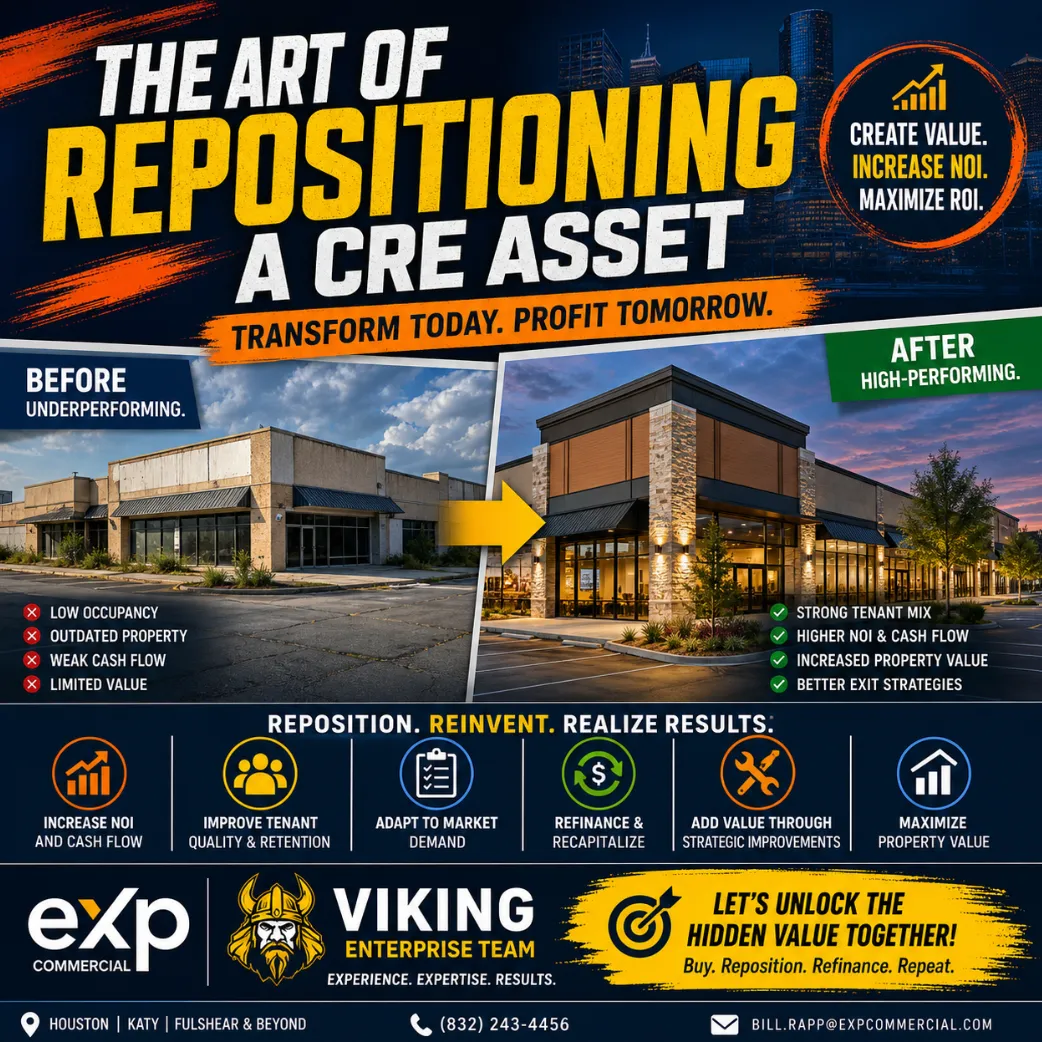
🏢 The Art of Repositioning a CRE Asset: How Investors Unlock Hidden Value 💰
🏢 The Art of Repositioning a CRE Asset: How Investors Unlock Hidden Value 💰
🚀 Commercial Property Repositioning Strategies That Increase NOI & Exit Value 📈
The Art of Repositioning a CRE Asset: Transforming Underperforming Properties Into High-Performing Investments
In commercial real estate, great investors don’t just buy properties—they create value.
While many investors focus solely on acquisitions, the real upside often comes after closing through strategic repositioning.
Whether you're dealing with an outdated retail center, struggling office property, aging multifamily complex, or underutilized industrial asset, repositioning can dramatically improve:
·Net Operating Income (NOI)
·Occupancy rates
·Tenant quality
·Property valuation
·Refinance opportunities
·Exit pricing
In markets like Houston, Katy, and Fulshear, rapid population growth and shifting consumer behavior are creating major opportunities for investors willing to adapt.
What Does Repositioning Mean in Commercial Real Estate?
Repositioning is the process of improving a property’s performance by changing how it operates, looks, or serves the market.
This can include:
·Renovations
·Rebranding
·Lease restructuring
·Tenant mix changes
·Converting property usage
·Operational improvements
·Expense reduction strategies
·Technology upgrades
Example:
An outdated office building may become medical office space.
A struggling shopping center may shift toward service retail.
An old warehouse may be converted into small-bay flex industrial space.
A vacant big-box retail building could become mixed-use redevelopment.
Smart investors ask:
“What does this asset need to become more valuable?”
Why Investors Reposition Assets
1. Increase NOI
This is where serious value creation happens.
If your cap rate is 5%, every additional dollar of NOI creates roughly:
Example:
Increase NOI by $100,000 annually:
$100,000 ÷ 0.05 = $2,000,000 in potential value creation
Small operational changes can create massive valuation gains.
2. Improve Occupancy
Vacancy destroys cash flow.
Repositioning helps attract:
·Better tenants
·Longer lease commitments
·Stronger rental rates
·Lower turnover
This is especially relevant in older suburban office and retail centers.
3. Adapt to Market Demand
Markets evolve.
Older office product may struggle while industrial flex space thrives.
Retail may shift toward:
·Medical users
·Fitness tenants
·Restaurants
·Service businesses
Investors who adapt early often win.
4. Prepare for Refinance
Many investors reposition assets to improve DSCR and refinance into permanent debt.
Better performance can help secure:
·Lower rates
·Better terms
·Cash-out refinancing
·Portfolio expansion opportunities
This aligns with your BRRRR-style commercial investing strategy.
Common CRE Repositioning Strategies
Physical Improvements
·New roofing
·Parking lot repairs
·Exterior upgrades
·Modern interiors
·Improved signage
·Landscaping improvements
Lease Repositioning
Many landlords inherit weak leases.
Fixing issues like:
·Below-market rents
·Short lease terms
·Poor expense pass-throughs
·Weak tenant guarantees
Can significantly improve asset value.
Tenant Mix Optimization
Retail centers often suffer from poor tenant combinations.
Replacing weak tenants with stronger operators can boost traffic and stability.
Examples:
·Restaurants
·Medical clinics
·Fitness concepts
·Financial services
·Grocery anchors
Adaptive Reuse
One of the biggest trends in today's market.
Examples:
Older office buildings converting into:
·Multifamily
·Medical office
·Hospitality
·Mixed-use developments
This trend is growing nationally.
Risks of Repositioning
Not every project works.
Watch for:
·Over-improving the asset
·Misreading demand
·Construction overruns
·Financing issues
·Permit delays
·Exit timing mistakes
This is why underwriting matters.
Always stress test:
·Rent assumptions
·Taxes
·Insurance
·Vacancy rates
·Exit cap assumptions
As I often say:
The deal isn’t made on the purchase—it’s made in the business plan.
Example: Small NOI Changes = Massive Wealth
Let’s say an investor buys an underperforming retail center in Katy.
They:
·Improve tenant mix
·Raise occupancy from 75% to 92%
·Add stronger lease structures
·Improve curb appeal
NOI grows by $250,000.
At a 6% cap rate:
Potential value creation = $4.16M+
That’s why repositioning is one of the most powerful wealth-building tools in commercial real estate.
Final Thoughts
The best investors don’t chase shiny deals.
They buy overlooked assets and create value through execution.
In today’s market reset, repositioning may be one of the best ways to outperform.
If you're looking to buy, reposition, refinance, or sell commercial property in Houston, Katy, or Fulshear, let's talk strategy.
Smart capital moves before headlines.
https://www.houstonrealestatebrokerage.com/
https://www.houstonrealestatebrokerage.com/houston-cre-navigator
https://www.commercialexchange.com/agent/653bf5593e3a3e1dcec275a6
http://expressoffers.com/[email protected]
https://app.bullpenre.com/profile/1742476177701x437444415125976000
https://author.billrapponline.com/
https://www.amazon.com/dp/B0F32Z5BH2
https://veed.cello.so/FOmzTty6oi9
https://buymeacoffee.com/vikingente3
https://creplaybookseries.billrapponline.com
https://creplaybook.billrapponline.com/
© 2023-2024 Bill Rapp, Broker Associate, eXp Commercial Viking Enterprise Team

eXp Commercial - Viking Enterprise team real estate network provides unparalleled commercial real estate services to Tenants and Landlords around the greater Katy & Houston MSA area. Our knowledge, experience, and reputation sets us apart from many firms.
A commercial property owner might have various plans that would necessitate the services of a commercial real estate broker. Some of the common scenarios include:
1. Selling the Property: If the owner decides it’s time to sell the property, a commercial real estate broker can help determine the market value, market the property effectively, and negotiate with potential buyers to get the best possible price.
2. Leasing Space: For property owners looking to lease out part or all of their commercial space, a broker can help find suitable tenants, negotiate lease terms, and ensure the lease agreements meet all legal requirements and serve the owner’s best interests.
3. Acquiring More Properties: Owners looking to expand their portfolio would benefit from a broker's knowledge of the market, access to listings, and negotiation skills to secure additional properties at favorable terms.
4. Property Management: While not all brokers offer this service, some commercial real estate brokers or their affiliates offer property management services. This can be particularly appealing for owners who prefer a hands-off approach or are managing properties from a distance.
5. Market Analysis: Owners considering future developments, renovations, or rebranding of their property might engage a broker for a comprehensive market analysis. This helps in understanding current market trends, the demand for different types of spaces, and potential returns on investment for various strategies.
6. Refinancing: In situations where a property owner is looking to refinance their property, a commercial real estate broker can provide valuable insights into the property’s current market value, assist in gathering necessary documentation, and even help in finding the best financing options.
7. Partnership or Investment Opportunities: Owners interested in exploring partnerships, joint ventures, or seeking investors for expansion or development projects might use a broker to find and vet potential partners or investors.
8. Consulting on Zoning and Use Changes: When contemplating a change in the use of the property or dealing with zoning issues, a broker with experience in local regulations and the specific property type can provide guidance and strategic planning assistance.
9. Exit Strategy Planning: For owners looking to plan an exit strategy from their investment, whether it’s through a strategic sale or a gradual winding down of operations, brokers can provide market insights, timing advice, and valuation services to optimize the exit process.
In any of these scenarios, the expertise and services provided by a commercial real estate broker can save the property owner time and money, while also providing access to a wider network of potential buyers, tenants, and industry professionals. Give us a call today!

Find the perfect location for your business.
Let us help your business succeed.
🏢 The Art of Repositioning a CRE Asset: How Investors Unlock Hidden Value 💰
🏢 The Art of Repositioning a CRE Asset: How Investors Unlock Hidden Value 💰
🚀 Commercial Property Repositioning Strategies That Increase NOI & Exit Value 📈
The Art of Repositioning a CRE Asset: Transforming Underperforming Properties Into High-Performing Investments
In commercial real estate, great investors don’t just buy properties—they create value.
While many investors focus solely on acquisitions, the real upside often comes after closing through strategic repositioning.
Whether you're dealing with an outdated retail center, struggling office property, aging multifamily complex, or underutilized industrial asset, repositioning can dramatically improve:
·Net Operating Income (NOI)
·Occupancy rates
·Tenant quality
·Property valuation
·Refinance opportunities
·Exit pricing
In markets like Houston, Katy, and Fulshear, rapid population growth and shifting consumer behavior are creating major opportunities for investors willing to adapt.
What Does Repositioning Mean in Commercial Real Estate?
Repositioning is the process of improving a property’s performance by changing how it operates, looks, or serves the market.
This can include:
·Renovations
·Rebranding
·Lease restructuring
·Tenant mix changes
·Converting property usage
·Operational improvements
·Expense reduction strategies
·Technology upgrades
Example:
An outdated office building may become medical office space.
A struggling shopping center may shift toward service retail.
An old warehouse may be converted into small-bay flex industrial space.
A vacant big-box retail building could become mixed-use redevelopment.
Smart investors ask:
“What does this asset need to become more valuable?”
Why Investors Reposition Assets
1. Increase NOI
This is where serious value creation happens.
If your cap rate is 5%, every additional dollar of NOI creates roughly:
Example:
Increase NOI by $100,000 annually:
$100,000 ÷ 0.05 = $2,000,000 in potential value creation
Small operational changes can create massive valuation gains.
2. Improve Occupancy
Vacancy destroys cash flow.
Repositioning helps attract:
·Better tenants
·Longer lease commitments
·Stronger rental rates
·Lower turnover
This is especially relevant in older suburban office and retail centers.
3. Adapt to Market Demand
Markets evolve.
Older office product may struggle while industrial flex space thrives.
Retail may shift toward:
·Medical users
·Fitness tenants
·Restaurants
·Service businesses
Investors who adapt early often win.
4. Prepare for Refinance
Many investors reposition assets to improve DSCR and refinance into permanent debt.
Better performance can help secure:
·Lower rates
·Better terms
·Cash-out refinancing
·Portfolio expansion opportunities
This aligns with your BRRRR-style commercial investing strategy.
Common CRE Repositioning Strategies
Physical Improvements
·New roofing
·Parking lot repairs
·Exterior upgrades
·Modern interiors
·Improved signage
·Landscaping improvements
Lease Repositioning
Many landlords inherit weak leases.
Fixing issues like:
·Below-market rents
·Short lease terms
·Poor expense pass-throughs
·Weak tenant guarantees
Can significantly improve asset value.
Tenant Mix Optimization
Retail centers often suffer from poor tenant combinations.
Replacing weak tenants with stronger operators can boost traffic and stability.
Examples:
·Restaurants
·Medical clinics
·Fitness concepts
·Financial services
·Grocery anchors
Adaptive Reuse
One of the biggest trends in today's market.
Examples:
Older office buildings converting into:
·Multifamily
·Medical office
·Hospitality
·Mixed-use developments
This trend is growing nationally.
Risks of Repositioning
Not every project works.
Watch for:
·Over-improving the asset
·Misreading demand
·Construction overruns
·Financing issues
·Permit delays
·Exit timing mistakes
This is why underwriting matters.
Always stress test:
·Rent assumptions
·Taxes
·Insurance
·Vacancy rates
·Exit cap assumptions
As I often say:
The deal isn’t made on the purchase—it’s made in the business plan.
Example: Small NOI Changes = Massive Wealth
Let’s say an investor buys an underperforming retail center in Katy.
They:
·Improve tenant mix
·Raise occupancy from 75% to 92%
·Add stronger lease structures
·Improve curb appeal
NOI grows by $250,000.
At a 6% cap rate:
Potential value creation = $4.16M+
That’s why repositioning is one of the most powerful wealth-building tools in commercial real estate.
Final Thoughts
The best investors don’t chase shiny deals.
They buy overlooked assets and create value through execution.
In today’s market reset, repositioning may be one of the best ways to outperform.
If you're looking to buy, reposition, refinance, or sell commercial property in Houston, Katy, or Fulshear, let's talk strategy.
Smart capital moves before headlines.
https://www.houstonrealestatebrokerage.com/
https://www.houstonrealestatebrokerage.com/houston-cre-navigator
https://www.commercialexchange.com/agent/653bf5593e3a3e1dcec275a6
http://expressoffers.com/[email protected]
https://app.bullpenre.com/profile/1742476177701x437444415125976000
https://author.billrapponline.com/
https://www.amazon.com/dp/B0F32Z5BH2
https://veed.cello.so/FOmzTty6oi9
https://buymeacoffee.com/vikingente3
https://creplaybookseries.billrapponline.com
https://creplaybook.billrapponline.com/
© 2023-2024 Bill Rapp, Broker Associate, eXp Commercial Viking Enterprise Team
Find the perfect location for your business.
Let us help your business succeed.

Sign up to receive the latest news on property investment and commercial real estate listings.
9600 Great Hills Trail, Suite 150w Austin, TX 78759 |
855.450.0324 xx255
Texas Real Estate Commission Consumer Protection Notice Texas Real Estate Commission
Information About Brokerage Services eXp Commercial LLC #9010212
Viking Enterprise LLC #9009614

Sign up to receive the latest news on property investment and commercial real estate listings.


Contact Us
901 S Mopac Expwy, Bldg 2, Suite 350 Austin, TX 78746 | 512.474.5557Texas Real Estate Commission
Consumer Protection Notice Texas Real Estate Commission Information About Brokerage Services Reliance Retail, LLC #603091
Texas RS, LLC #9003193 | RESOLUT RE Is Licensed In Louisiana #0995694083
Facebook
Instagram
X
LinkedIn
Youtube
TikTok