Your Trusted Houston Commercial Real Estate Brokerage
Viking Enterprise LLC is part of eXp Commercial, an agent-led, cloud-based commercial real estate brokerage with agents across the globe.
Email: [email protected]
Call: (281) 222-0433
Your Trusted Katy / Fulshear & Houston Commercial Real Estate Brokerage
Viking Enterprise LLC is part of eXp Commercial, an agent-led, cloud-based commercial real estate brokerage with agents across the globe.
Looking to invest, buy, sell or lease? We can help.
Looking to invest, buy, sell or lease? We can help.
FEATURED PROPERTIES


OUR FEATURED TENANTS & CLIENTS
eXp Commercial - Viking Enterprise Team's real estate network provides unparalleled commercial real estate services to Tenants and Landlords around the Katy- Houston area. Our knowledge, experience, and reputation sets us apart from many firms.
A commercial property owner might have various plans that would necessitate the services of a commercial real estate broker. Some of the common scenarios include:
1. Selling the Property: If the owner decides it’s time to sell the property, a commercial real estate broker can help determine the market value, market the property effectively, and negotiate with potential buyers to get the best possible price.
2. Leasing Space: For property owners looking to lease out part or all of their commercial space, a broker can help find suitable tenants, negotiate lease terms, and ensure the lease agreements meet all legal requirements and serve the owner’s best interests.
3. Acquiring More Properties: Owners looking to expand their portfolio would benefit from a broker's knowledge of the market, access to listings, and negotiation skills to secure additional properties at favorable terms.
4. Property Management: While not all brokers offer this service, some commercial real estate brokers or their affiliates offer property management services. This can be particularly appealing for owners who prefer a hands-off approach or are managing properties from a distance.
5. Market Analysis: Owners considering future developments, renovations, or rebranding of their property might engage a broker for a comprehensive market analysis. This helps in understanding current market trends, the demand for different types of spaces, and potential returns on investment for various strategies.
6. Refinancing: In situations where a property owner is looking to refinance their property, a commercial real estate broker can provide valuable insights into the property’s current market value, assist in gathering necessary documentation, and even help in finding the best financing options.
7. Partnership or Investment Opportunities: Owners interested in exploring partnerships, joint ventures, or seeking investors for expansion or development projects might use a broker to find and vet potential partners or investors.
8. Consulting on Zoning and Use Changes: When contemplating a change in the use of the property or dealing with zoning issues, a broker with experience in local regulations and the specific property type can provide guidance and strategic planning assistance.
9. Exit Strategy Planning: For owners looking to plan an exit strategy from their investment, whether it’s through a strategic sale or a gradual winding down of operations, brokers can provide market insights, timing advice, and valuation services to optimize the exit process.
In any of these scenarios, the expertise and services provided by a commercial real estate broker can save the property owner time and money, while also providing access to a wider network of potential buyers, tenants, and industry professionals. Give us a call today!
Reviews
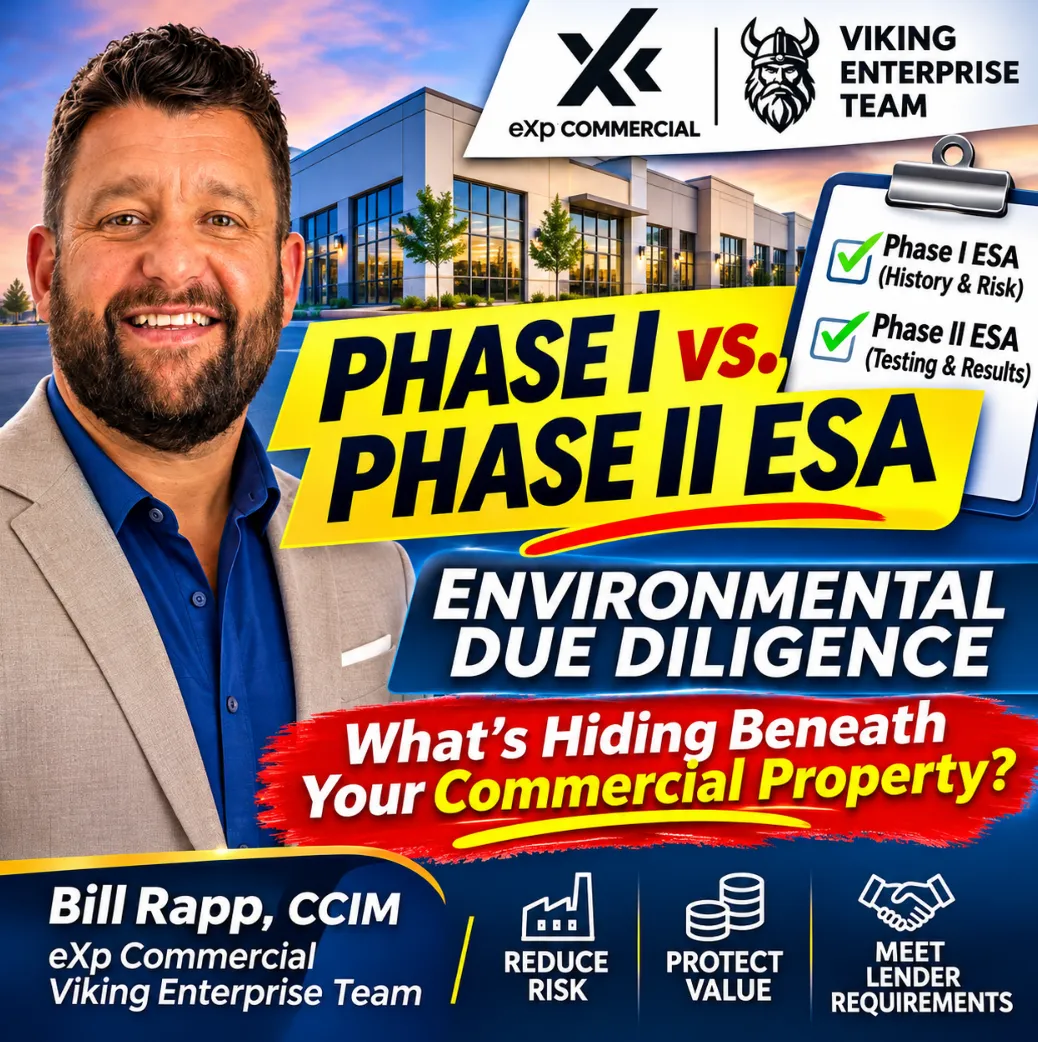
🌎 Phase I vs. Phase II ESA: What CRE Buyers Must Know 🏢
🌎 Phase I vs. Phase II ESA: What CRE Buyers Must Know 🏢
⚠️ Environmental Due Diligence: Avoid Costly CRE Mistakes 💰
____________________________________________________________________________
Phase I vs. Phase II ESA: What Commercial Real Estate Buyers Must Know
Imagine purchasing a $3 million commercial property, only to discover six months later that an underground storage tank leaked petroleum into the soil decades ago.
Suddenly, your investment could face environmental investigation costs, cleanup obligations, financing complications, and significant resale challenges.
The problem? You may have inherited a risk that existed long before you owned the property.
That's why environmental due diligence is one of the most important steps in commercial real estate investing.
Whether you're purchasing a retail center in Katy, an industrial warehouse in Houston, a medical office building in Fulshear, or development land in West Texas, understanding a Phase I Environmental Site Assessment (ESA) and Phase II ESA can help protect your investment.
I'm Bill Rapp, CCIM, with eXp Commercial and the Viking Enterprise Team. In this guide, I'll explain what these assessments do, how they differ, what they typically cost, and when buyers should consider them.
What Is Environmental Due Diligence in Commercial Real Estate?
Environmental due diligence is the process of investigating potential environmental contamination and related liabilities before purchasing, financing, or developing commercial real estate.
Environmental conditions can affect:
·Property value and marketability
·Financing eligibility and lender requirements
·Construction and redevelopment costs
·Insurance coverage and exclusions
·Future leasing and occupancy
·Environmental cleanup obligations
·Investment returns and exit strategies
A property can appear perfectly maintained while having contamination beneath the surface.
For example, a modern retail center may have been constructed on land previously occupied by a gasoline station, automotive repair shop, dry cleaner, or industrial operation.
The current property use does not necessarily reveal its environmental history.
What Is a Phase I Environmental Site Assessment?
A Phase I ESA is an environmental investigation designed to identify recognized environmental conditions, commonly called RECs, associated with a commercial property.
In the United States, Phase I assessments commonly follow ASTM E1527-21, which the EPA recognizes for satisfying the All Appropriate Inquiries (AAI) rule when properly conducted.
A Phase I ESA generally includes four major components.
1. Historical Property Research
Environmental professionals examine historical information to determine how the property and surrounding parcels were used.
Research may include historical aerial photographs, Sanborn fire insurance maps, city directories, topographic maps, and land-use records.
For example, a commercial building currently occupied by a professional services company may have operated as a dry-cleaning facility decades earlier.
That history could raise concerns about chlorinated solvent contamination.
2. Environmental Database Review
The environmental professional reviews relevant federal, state, and local regulatory records.
These can identify nearby or historical activities involving underground storage tanks, hazardous waste, spills, and reported contamination.
In Texas, records maintained by the Texas Commission on Environmental Quality (TCEQ) can be especially relevant.
3. Site Inspection
An environmental professional visits the property to look for indications of possible contamination.
Examples include stained soil, chemical storage areas, distressed vegetation, abandoned containers, unusual odors, and evidence of underground storage tanks.
The inspection also considers surrounding properties and their potential environmental impact.
4. Interviews and Documentation
The assessor may interview current owners, occupants, property managers, and other knowledgeable parties.
Available environmental reports and relevant documents are reviewed.
Important: A standard Phase I ESA generally does not include soil, groundwater, or laboratory testing. It is primarily a records-based and visual investigation.
What Happens When a Phase I ESA Finds a Problem?
The report may identify a Recognized Environmental Condition (REC).
Under ASTM terminology, a REC generally involves the presence or likely presence of hazardous substances or petroleum products due to a release, conditions indicating a release, or circumstances presenting a material threat of a future release.
A report may also identify a Controlled Recognized Environmental Condition (CREC), where contamination has been addressed to an applicable standard but remains subject to required controls, or a Historical Recognized Environmental Condition (HREC), where a past release has been addressed to an unrestricted-use standard.
These distinctions matter.
Not every historical environmental issue requires additional testing, and not every REC automatically makes a property unsuitable for purchase.
However, a REC may justify additional investigation before closing.
That's where a Phase II ESA comes into play.
What Is a Phase II Environmental Site Assessment?
A Phase II ESA involves physical investigation and environmental sampling to evaluate suspected contamination.
Unlike a Phase I, which focuses on identifying potential environmental concerns, a Phase II seeks to collect evidence about whether contamination exists and, where appropriate, its nature and extent.
Testing may involve soil samples, groundwater monitoring wells, soil-gas samples, laboratory analysis, or other site-specific investigative techniques.
For example, if a Phase I identifies a former gasoline station, a Phase II may investigate whether petroleum hydrocarbons have affected the soil or groundwater.
If the site previously housed a dry cleaner, testing may focus on solvents such as tetrachloroethylene, commonly called PCE.
The scope depends on the suspected contaminants, site conditions, applicable regulatory standards, and the objectives of the investigation.
A Phase II ESA is often performed in general accordance with ASTM E1903-19, with the scope developed for the particular property.
Phase I vs. Phase II ESA: Key Differences
Category | Phase I ESA | Phase II ESA |
Primary purpose | Identify potential environmental concerns | Investigate suspected contamination |
Physical sampling | Generally no | Yes, as needed |
Historical records | Major component | Used to guide testing |
Typical cost* | $2,000–$5,000 | $5,000–$25,000+ |
Typical duration* | 2–4 weeks | 3–8+ weeks |
Common trigger | Property acquisition or lender requirement | Phase I findings or known concerns |
Main result | Identification and evaluation of RECs | Analytical evidence and recommendations |
*Costs and timelines are illustrative planning ranges, not fixed industry prices. Large, complex, or heavily contaminated sites may cost substantially more and require longer investigations.
When Is a Phase I ESA Required?
A Phase I ESA is not legally mandatory for every commercial real estate transaction.
However, many commercial lenders require one as part of underwriting, especially for industrial properties, gas stations, automotive facilities, and properties with potentially hazardous historical uses.
Certain SBA-financed transactions also involve environmental investigation requirements that vary by property type, industry classification, and lender procedures.
Buyers seeking potential federal landowner liability protections under CERCLA generally must satisfy the applicable All Appropriate Inquiries requirements before acquiring the property, along with other legal conditions.
That makes timing critical.
A Phase I report is not simply a lender checklist item. It may play an important role in a buyer's environmental liability strategy.
How Long Is a Phase I ESA Valid?
For purposes of the federal All Appropriate Inquiries rule, the relevant timing is tied to the acquisition date.
Generally, the investigation must have been conducted or updated within one year before acquisition, with certain components completed or updated within 180 days.
Those components include interviews, environmental lien searches, government records reviews, site inspections, and the environmental professional's declaration.
A report's practical acceptability can also depend on lender requirements and ASTM standards.
Buyers should not assume that a Phase I report from a prior transaction automatically satisfies current requirements.
What Happens if a Phase II ESA Confirms Contamination?
A positive Phase II finding does not automatically mean the transaction is dead.
Depending on the type, concentration, location, and regulatory significance of contamination, the buyer and seller may consider several options.
One option is additional investigation to define the extent of contamination.
Another is remediation, such as removing contaminated soil, treating groundwater, or implementing an approved risk-based cleanup approach.
Parties may also negotiate purchase-price adjustments, seller-funded remediation, escrow arrangements, indemnification provisions, or environmental insurance.
Some properties can remain in productive commercial use with appropriate regulatory controls and ongoing management.
However, these arrangements require careful evaluation by qualified environmental professionals and legal counsel.
A low acquisition price is not automatically a bargain if environmental obligations are uncertain.
Real-World Example: Buying a Houston Industrial Warehouse
Consider a hypothetical investor purchasing a 20,000-square-foot warehouse in West Houston for $2.5 million.
The building looks functional, has tenants, and offers attractive cash flow.
During due diligence, a Phase I ESA identifies evidence that a portion of the property previously operated as an automotive maintenance facility.
Historical records suggest underground petroleum storage tanks may once have existed on the site.
The environmental consultant identifies a REC and recommends further investigation.
The buyer negotiates additional due diligence time and commissions a targeted Phase II ESA.
Testing finds petroleum-related contamination in one area of the property.
Additional evaluation estimates that the required response could cost $85,000, subject to regulatory review and further investigation.
Rather than immediately canceling the purchase, the investor evaluates the findings with the consultant, lender, and attorney.
The parties negotiate a seller-funded environmental response arrangement, with documentation and appropriate protections.
The transaction may still proceed if the remaining risk is acceptable to the buyer and lender.
The lesson is straightforward: environmental due diligence gives investors information before they commit capital.
Without that investigation, the buyer might have discovered the issue after closing, when negotiating leverage was substantially reduced.
Environmental Due Diligence in Katy, Fulshear, and Houston
Commercial real estate investors in Greater Houston should pay particular attention to the historical uses of properties.
Industrial and flex properties: Prior manufacturing, automotive work, chemical storage, or equipment maintenance may warrant closer review.
Retail centers: Former dry cleaners, gasoline stations, and automotive tenants can create environmental concerns even after those businesses leave.
Development land: Historical agricultural, industrial, or waste-disposal uses may require investigation before grading or construction.
Medical and dental properties: The property's history and neighboring uses matter, even when the current tenant operates a low-risk professional practice.
Older commercial corridors: Decades of changing land uses can make historical records particularly important.
For buyers in Katy, Fulshear, Brookshire, the Energy Corridor, and the broader Houston market, environmental due diligence should be integrated into the acquisition strategy rather than treated as a last-minute closing task.
Five Environmental Due Diligence Tips for CRE Investors
1.Order the Phase I early. Build adequate time into the feasibility or inspection period.
2.Use a qualified environmental professional. Confirm the report meets applicable ASTM, EPA, and lender requirements.
3.Review historical uses, not just current tenants. Past operations may present greater environmental risk than current occupancy.
4.Negotiate Phase II access and timing. Ensure the purchase contract addresses sampling permissions and extensions where needed.
5.Coordinate environmental findings with financing. Lenders may require additional investigation, remediation, or risk mitigation before funding.
Frequently Asked Questions
Is a Phase I ESA required for every commercial property purchase?
No. Requirements depend on financing, legal considerations, property history, and the buyer's risk tolerance. Nevertheless, it is commonly recommended for commercial acquisitions.
Does a Phase I ESA test for asbestos or mold?
Not ordinarily. Asbestos, mold, lead-based paint, radon, and other non-scope considerations generally require separate evaluation when appropriate.
Does every REC require a Phase II ESA?
No. The need for further investigation depends on the nature of the finding, available evidence, lender requirements, and the buyer's objectives.
Who pays for a Phase I or Phase II ESA?
Frequently the buyer, although payment and responsibility can be negotiated. Some sellers commission environmental reports before marketing a property.
Can contaminated commercial real estate still be financed?
Sometimes. Financing depends on the contamination, regulatory status, available protections, remediation strategy, and lender risk standards.
Does a clean Phase I guarantee there is no contamination?
No. A Phase I is not a guarantee of environmental condition and has inherent limitations.
Final Thoughts: Protect Your Commercial Real Estate Investment
Environmental due diligence is about understanding the risks associated with commercial property ownership.
A Phase I ESA identifies potential environmental concerns.
A Phase II ESA investigates those concerns through testing.
Together, they can help investors make more informed acquisition, financing, and development decisions.
Whether you're purchasing your first owner-occupied commercial building or expanding a multimillion-dollar investment portfolio, the right due diligence can prevent expensive surprises.
Looking to buy, sell, lease, or invest in commercial real estate in Greater Houston?
I'm Bill Rapp, CCIM, with eXp Commercial and the Viking Enterprise Team. I help commercial property owners, investors, and business owners evaluate real estate opportunities, structure transactions, and navigate the acquisition process.
Bill Rapp, CCIM
eXp Commercial — Viking Enterprise Team
📍 Serving Katy | Fulshear | Richmond | Brookshire | West Houston | Greater Houston
📧 [email protected]
☎️ 281-222-0433
🌐 HoustonRealEstateBrokerage.com
📍 eXp Commercial & eXp Realty
📅 Calendly.com/VikingEnterprise
https://www.houstonrealestatebrokerage.com/
https://www.houstonrealestatebrokerage.com/houston-cre-navigator
https://www.commercialexchange.com/agent/653bf5593e3a3e1dcec275a6
http://expressoffers.com/[email protected]
https://app.bullpenre.com/profile/1742476177701x437444415125976000
https://author.billrapponline.com/
https://www.amazon.com/dp/B0F32Z5BH2
https://veed.cello.so/FOmzTty6oi9
https://buymeacoffee.com/vikingente3
https://creplaybookseries.billrapponline.com
https://creplaybook.billrapponline.com/
© Bill Rapp, Broker Associate, eXp Commercial Viking Enterprise Team

Commercial Real Estate Advisors Serving Katy, Fulshear & Greater Houston
Helping Property Owners, Investors & Businesses Make Smarter Commercial Real Estate Decisions
Whether you're buying, selling, leasing, investing, or financing commercial real estate, having the right advisor can make all the difference.
At eXp Commercial – Viking Enterprise Team, we provide comprehensive commercial real estate brokerage and advisory services for property owners, investors, developers, landlords, tenants, and business owners throughout Katy, Fulshear, Houston, and the surrounding Texas markets.
Our team combines local market expertise with commercial investment knowledge and capital markets experience to help clients maximize property value, identify new opportunities, reduce risk, and achieve long-term investment success.
From a single office building to a growing investment portfolio, we provide strategic guidance from acquisition through disposition.
Comprehensive Commercial Real Estate Services
Commercial Property Sales
Selling commercial real estate requires far more than placing a property on the market. We develop customized marketing strategies designed to maximize exposure while targeting qualified buyers locally, regionally, and nationally.
Our services include:
Property valuation and pricing strategy
Investment analysis
Professional marketing campaigns
Buyer qualification
Contract negotiation
Due diligence coordination
Transaction management through closing
Whether you're selling office, retail, industrial, multifamily, land, medical, mixed-use, or investment property, our objective is simple—maximize your property's value while creating a smooth transaction.
Commercial Leasing Services
Vacancies reduce cash flow and impact property performance.
We help landlords lease available space by creating effective marketing campaigns, identifying qualified tenants, negotiating favorable lease terms, and minimizing downtime.
Our leasing services include:
Office leasing
Retail leasing
Industrial leasing
Medical office leasing
Flex space leasing
Warehouse leasing
Landlord representation
Tenant representation
Lease renewals
Lease negotiations
Our goal is to keep your property occupied with quality tenants while protecting your long-term investment.
Commercial Property Acquisitions
Whether you're purchasing your first commercial property or expanding a large investment portfolio, we help identify opportunities that align with your investment objectives.
Our acquisition services include:
Market research
Property sourcing
Financial analysis
Cap rate evaluation
Cash flow analysis
Due diligence
Negotiation
Closing coordination
We help investors make informed decisions backed by market data and financial analysis—not emotion.
Investment Property Analysis
Every investment should begin with a thorough understanding of risk and return.
We assist investors by evaluating:
Net Operating Income (NOI)
Capitalization Rates
Cash-on-Cash Returns
Internal Rate of Return (IRR)
Market Rent Analysis
Occupancy Trends
Comparable Sales
Exit Strategies
Our investment analysis helps clients make data-driven decisions before committing capital.
Commercial Financing & Capital Advisory
One of the biggest advantages of working with Viking Enterprise Team is access to commercial financing expertise.
Through our capital markets relationships, we help clients evaluate financing options for acquisitions, refinancing, construction, bridge financing, SBA loans, investment properties, and owner-occupied commercial real estate.
We help clients:
Evaluate financing options
Analyze refinancing opportunities
Improve loan positioning
Understand lender requirements
Coordinate with commercial lenders
Structure financing strategies
Real estate and financing should work together—not independently.
Portfolio Growth & Investment Strategy
Building long-term wealth through commercial real estate requires strategic planning.
We work with investors to:
Expand investment portfolios
Identify off-market opportunities
Improve portfolio performance
Evaluate redevelopment opportunities
Reposition underperforming assets
Develop long-term acquisition strategies
Whether you're purchasing your second investment or your fiftieth, we help create a roadmap for continued growth.
Landlord Representation
Commercial property owners face constant challenges:
Tenant turnover
Lease negotiations
Rental rates
Market competition
Property positioning
We provide landlord representation focused on maximizing occupancy, improving lease terms, increasing property value, and strengthening long-term cash flow.
Tenant Representation
Businesses often outgrow their current space or need a location that better supports future growth.
We represent tenants throughout the site selection process, helping negotiate favorable lease terms while identifying properties that fit operational and financial objectives.
Our tenant services include:
Office space
Retail locations
Industrial facilities
Warehouse space
Medical offices
Flex properties
Build-to-suit opportunities
Market Analysis & Commercial Consulting
Successful commercial real estate decisions begin with accurate market intelligence.
Our advisory services include:
Market studies
Property positioning
Rent analysis
Development feasibility
Redevelopment analysis
Demographic research
Growth corridor identification
Competitive property analysis
Whether you're considering selling today or planning five years ahead, we help you understand where the market is headed.
Joint Ventures & Investment Partnerships
Many commercial opportunities require additional equity, strategic partners, or experienced investors.
We help facilitate introductions between qualified investors, developers, operators, and commercial property owners seeking partnership opportunities for acquisitions, development, redevelopment, or recapitalization.
Exit Planning & Wealth Preservation
Every commercial investment eventually reaches a transition point.
Whether you're considering:
Selling
Refinancing
Recapitalizing
Completing a 1031 Exchange
Passing assets to the next generation
Repositioning your portfolio
we help create an exit strategy that aligns with your financial goals while maximizing value and minimizing unnecessary risk.
Why Choose Viking Enterprise Team?
Commercial real estate is about more than buying and selling properties—it's about creating long-term value.
Our clients benefit from:
Local expertise throughout Katy, Fulshear, Houston, and surrounding markets
Experience representing investors, developers, business owners, landlords, and tenants
Comprehensive brokerage and advisory services
Commercial financing insight and capital markets knowledge
Investment-focused analysis
Strategic negotiation
Professional marketing
Personalized service from initial consultation through closing
We believe informed clients make better decisions, and our role is to provide the expertise, market intelligence, and guidance needed to help you succeed.
Let's Discuss Your Commercial Real Estate Goals
Whether you're buying, selling, leasing, investing, refinancing, or planning your next commercial real estate transaction, Viking Enterprise Team is ready to help.
Schedule a confidential consultation to discuss your objectives and discover how our experience, market knowledge, and strategic approach can help you maximize the value of your commercial real estate investments.
Contact eXp Commercial – Viking Enterprise Team today and let's build your commercial real estate strategy together.


Find the perfect location for your business.
Let us help your business succeed.
🌎 Phase I vs. Phase II ESA: What CRE Buyers Must Know 🏢
🌎 Phase I vs. Phase II ESA: What CRE Buyers Must Know 🏢
⚠️ Environmental Due Diligence: Avoid Costly CRE Mistakes 💰
____________________________________________________________________________
Phase I vs. Phase II ESA: What Commercial Real Estate Buyers Must Know
Imagine purchasing a $3 million commercial property, only to discover six months later that an underground storage tank leaked petroleum into the soil decades ago.
Suddenly, your investment could face environmental investigation costs, cleanup obligations, financing complications, and significant resale challenges.
The problem? You may have inherited a risk that existed long before you owned the property.
That's why environmental due diligence is one of the most important steps in commercial real estate investing.
Whether you're purchasing a retail center in Katy, an industrial warehouse in Houston, a medical office building in Fulshear, or development land in West Texas, understanding a Phase I Environmental Site Assessment (ESA) and Phase II ESA can help protect your investment.
I'm Bill Rapp, CCIM, with eXp Commercial and the Viking Enterprise Team. In this guide, I'll explain what these assessments do, how they differ, what they typically cost, and when buyers should consider them.
What Is Environmental Due Diligence in Commercial Real Estate?
Environmental due diligence is the process of investigating potential environmental contamination and related liabilities before purchasing, financing, or developing commercial real estate.
Environmental conditions can affect:
·Property value and marketability
·Financing eligibility and lender requirements
·Construction and redevelopment costs
·Insurance coverage and exclusions
·Future leasing and occupancy
·Environmental cleanup obligations
·Investment returns and exit strategies
A property can appear perfectly maintained while having contamination beneath the surface.
For example, a modern retail center may have been constructed on land previously occupied by a gasoline station, automotive repair shop, dry cleaner, or industrial operation.
The current property use does not necessarily reveal its environmental history.
What Is a Phase I Environmental Site Assessment?
A Phase I ESA is an environmental investigation designed to identify recognized environmental conditions, commonly called RECs, associated with a commercial property.
In the United States, Phase I assessments commonly follow ASTM E1527-21, which the EPA recognizes for satisfying the All Appropriate Inquiries (AAI) rule when properly conducted.
A Phase I ESA generally includes four major components.
1. Historical Property Research
Environmental professionals examine historical information to determine how the property and surrounding parcels were used.
Research may include historical aerial photographs, Sanborn fire insurance maps, city directories, topographic maps, and land-use records.
For example, a commercial building currently occupied by a professional services company may have operated as a dry-cleaning facility decades earlier.
That history could raise concerns about chlorinated solvent contamination.
2. Environmental Database Review
The environmental professional reviews relevant federal, state, and local regulatory records.
These can identify nearby or historical activities involving underground storage tanks, hazardous waste, spills, and reported contamination.
In Texas, records maintained by the Texas Commission on Environmental Quality (TCEQ) can be especially relevant.
3. Site Inspection
An environmental professional visits the property to look for indications of possible contamination.
Examples include stained soil, chemical storage areas, distressed vegetation, abandoned containers, unusual odors, and evidence of underground storage tanks.
The inspection also considers surrounding properties and their potential environmental impact.
4. Interviews and Documentation
The assessor may interview current owners, occupants, property managers, and other knowledgeable parties.
Available environmental reports and relevant documents are reviewed.
Important: A standard Phase I ESA generally does not include soil, groundwater, or laboratory testing. It is primarily a records-based and visual investigation.
What Happens When a Phase I ESA Finds a Problem?
The report may identify a Recognized Environmental Condition (REC).
Under ASTM terminology, a REC generally involves the presence or likely presence of hazardous substances or petroleum products due to a release, conditions indicating a release, or circumstances presenting a material threat of a future release.
A report may also identify a Controlled Recognized Environmental Condition (CREC), where contamination has been addressed to an applicable standard but remains subject to required controls, or a Historical Recognized Environmental Condition (HREC), where a past release has been addressed to an unrestricted-use standard.
These distinctions matter.
Not every historical environmental issue requires additional testing, and not every REC automatically makes a property unsuitable for purchase.
However, a REC may justify additional investigation before closing.
That's where a Phase II ESA comes into play.
What Is a Phase II Environmental Site Assessment?
A Phase II ESA involves physical investigation and environmental sampling to evaluate suspected contamination.
Unlike a Phase I, which focuses on identifying potential environmental concerns, a Phase II seeks to collect evidence about whether contamination exists and, where appropriate, its nature and extent.
Testing may involve soil samples, groundwater monitoring wells, soil-gas samples, laboratory analysis, or other site-specific investigative techniques.
For example, if a Phase I identifies a former gasoline station, a Phase II may investigate whether petroleum hydrocarbons have affected the soil or groundwater.
If the site previously housed a dry cleaner, testing may focus on solvents such as tetrachloroethylene, commonly called PCE.
The scope depends on the suspected contaminants, site conditions, applicable regulatory standards, and the objectives of the investigation.
A Phase II ESA is often performed in general accordance with ASTM E1903-19, with the scope developed for the particular property.
Phase I vs. Phase II ESA: Key Differences
Category | Phase I ESA | Phase II ESA |
Primary purpose | Identify potential environmental concerns | Investigate suspected contamination |
Physical sampling | Generally no | Yes, as needed |
Historical records | Major component | Used to guide testing |
Typical cost* | $2,000–$5,000 | $5,000–$25,000+ |
Typical duration* | 2–4 weeks | 3–8+ weeks |
Common trigger | Property acquisition or lender requirement | Phase I findings or known concerns |
Main result | Identification and evaluation of RECs | Analytical evidence and recommendations |
*Costs and timelines are illustrative planning ranges, not fixed industry prices. Large, complex, or heavily contaminated sites may cost substantially more and require longer investigations.
When Is a Phase I ESA Required?
A Phase I ESA is not legally mandatory for every commercial real estate transaction.
However, many commercial lenders require one as part of underwriting, especially for industrial properties, gas stations, automotive facilities, and properties with potentially hazardous historical uses.
Certain SBA-financed transactions also involve environmental investigation requirements that vary by property type, industry classification, and lender procedures.
Buyers seeking potential federal landowner liability protections under CERCLA generally must satisfy the applicable All Appropriate Inquiries requirements before acquiring the property, along with other legal conditions.
That makes timing critical.
A Phase I report is not simply a lender checklist item. It may play an important role in a buyer's environmental liability strategy.
How Long Is a Phase I ESA Valid?
For purposes of the federal All Appropriate Inquiries rule, the relevant timing is tied to the acquisition date.
Generally, the investigation must have been conducted or updated within one year before acquisition, with certain components completed or updated within 180 days.
Those components include interviews, environmental lien searches, government records reviews, site inspections, and the environmental professional's declaration.
A report's practical acceptability can also depend on lender requirements and ASTM standards.
Buyers should not assume that a Phase I report from a prior transaction automatically satisfies current requirements.
What Happens if a Phase II ESA Confirms Contamination?
A positive Phase II finding does not automatically mean the transaction is dead.
Depending on the type, concentration, location, and regulatory significance of contamination, the buyer and seller may consider several options.
One option is additional investigation to define the extent of contamination.
Another is remediation, such as removing contaminated soil, treating groundwater, or implementing an approved risk-based cleanup approach.
Parties may also negotiate purchase-price adjustments, seller-funded remediation, escrow arrangements, indemnification provisions, or environmental insurance.
Some properties can remain in productive commercial use with appropriate regulatory controls and ongoing management.
However, these arrangements require careful evaluation by qualified environmental professionals and legal counsel.
A low acquisition price is not automatically a bargain if environmental obligations are uncertain.
Real-World Example: Buying a Houston Industrial Warehouse
Consider a hypothetical investor purchasing a 20,000-square-foot warehouse in West Houston for $2.5 million.
The building looks functional, has tenants, and offers attractive cash flow.
During due diligence, a Phase I ESA identifies evidence that a portion of the property previously operated as an automotive maintenance facility.
Historical records suggest underground petroleum storage tanks may once have existed on the site.
The environmental consultant identifies a REC and recommends further investigation.
The buyer negotiates additional due diligence time and commissions a targeted Phase II ESA.
Testing finds petroleum-related contamination in one area of the property.
Additional evaluation estimates that the required response could cost $85,000, subject to regulatory review and further investigation.
Rather than immediately canceling the purchase, the investor evaluates the findings with the consultant, lender, and attorney.
The parties negotiate a seller-funded environmental response arrangement, with documentation and appropriate protections.
The transaction may still proceed if the remaining risk is acceptable to the buyer and lender.
The lesson is straightforward: environmental due diligence gives investors information before they commit capital.
Without that investigation, the buyer might have discovered the issue after closing, when negotiating leverage was substantially reduced.
Environmental Due Diligence in Katy, Fulshear, and Houston
Commercial real estate investors in Greater Houston should pay particular attention to the historical uses of properties.
Industrial and flex properties: Prior manufacturing, automotive work, chemical storage, or equipment maintenance may warrant closer review.
Retail centers: Former dry cleaners, gasoline stations, and automotive tenants can create environmental concerns even after those businesses leave.
Development land: Historical agricultural, industrial, or waste-disposal uses may require investigation before grading or construction.
Medical and dental properties: The property's history and neighboring uses matter, even when the current tenant operates a low-risk professional practice.
Older commercial corridors: Decades of changing land uses can make historical records particularly important.
For buyers in Katy, Fulshear, Brookshire, the Energy Corridor, and the broader Houston market, environmental due diligence should be integrated into the acquisition strategy rather than treated as a last-minute closing task.
Five Environmental Due Diligence Tips for CRE Investors
1.Order the Phase I early. Build adequate time into the feasibility or inspection period.
2.Use a qualified environmental professional. Confirm the report meets applicable ASTM, EPA, and lender requirements.
3.Review historical uses, not just current tenants. Past operations may present greater environmental risk than current occupancy.
4.Negotiate Phase II access and timing. Ensure the purchase contract addresses sampling permissions and extensions where needed.
5.Coordinate environmental findings with financing. Lenders may require additional investigation, remediation, or risk mitigation before funding.
Frequently Asked Questions
Is a Phase I ESA required for every commercial property purchase?
No. Requirements depend on financing, legal considerations, property history, and the buyer's risk tolerance. Nevertheless, it is commonly recommended for commercial acquisitions.
Does a Phase I ESA test for asbestos or mold?
Not ordinarily. Asbestos, mold, lead-based paint, radon, and other non-scope considerations generally require separate evaluation when appropriate.
Does every REC require a Phase II ESA?
No. The need for further investigation depends on the nature of the finding, available evidence, lender requirements, and the buyer's objectives.
Who pays for a Phase I or Phase II ESA?
Frequently the buyer, although payment and responsibility can be negotiated. Some sellers commission environmental reports before marketing a property.
Can contaminated commercial real estate still be financed?
Sometimes. Financing depends on the contamination, regulatory status, available protections, remediation strategy, and lender risk standards.
Does a clean Phase I guarantee there is no contamination?
No. A Phase I is not a guarantee of environmental condition and has inherent limitations.
Final Thoughts: Protect Your Commercial Real Estate Investment
Environmental due diligence is about understanding the risks associated with commercial property ownership.
A Phase I ESA identifies potential environmental concerns.
A Phase II ESA investigates those concerns through testing.
Together, they can help investors make more informed acquisition, financing, and development decisions.
Whether you're purchasing your first owner-occupied commercial building or expanding a multimillion-dollar investment portfolio, the right due diligence can prevent expensive surprises.
Looking to buy, sell, lease, or invest in commercial real estate in Greater Houston?
I'm Bill Rapp, CCIM, with eXp Commercial and the Viking Enterprise Team. I help commercial property owners, investors, and business owners evaluate real estate opportunities, structure transactions, and navigate the acquisition process.
Bill Rapp, CCIM
eXp Commercial — Viking Enterprise Team
📍 Serving Katy | Fulshear | Richmond | Brookshire | West Houston | Greater Houston
📧 [email protected]
☎️ 281-222-0433
🌐 HoustonRealEstateBrokerage.com
📍 eXp Commercial & eXp Realty
📅 Calendly.com/VikingEnterprise
https://www.houstonrealestatebrokerage.com/
https://www.houstonrealestatebrokerage.com/houston-cre-navigator
https://www.commercialexchange.com/agent/653bf5593e3a3e1dcec275a6
http://expressoffers.com/[email protected]
https://app.bullpenre.com/profile/1742476177701x437444415125976000
https://author.billrapponline.com/
https://www.amazon.com/dp/B0F32Z5BH2
https://veed.cello.so/FOmzTty6oi9
https://buymeacoffee.com/vikingente3
https://creplaybookseries.billrapponline.com
https://creplaybook.billrapponline.com/
© Bill Rapp, Broker Associate, eXp Commercial Viking Enterprise Team
Find the perfect location for your business.
Let us help your business succeed.

Sign up to receive the latest news on property investment and commercial real estate listings.
9600 Great Hills Trail, Suite 150w Austin, TX 78759 |
855.450.0324 xx255
Texas Real Estate Commission Consumer Protection Notice Texas Real Estate Commission
Information About Brokerage Services eXp Commercial LLC #9010212
Viking Enterprise LLC #9009614

Sign up to receive the latest news on property investment and commercial real estate listings.


Contact Us
901 S Mopac Expwy, Bldg 2, Suite 350 Austin, TX 78746 | 512.474.5557Texas Real Estate Commission
Consumer Protection Notice Texas Real Estate Commission Information About Brokerage Services Reliance Retail, LLC #603091
Texas RS, LLC #9003193 | RESOLUT RE Is Licensed In Louisiana #0995694083
Facebook
Instagram
X
LinkedIn
Youtube
TikTok