Your Trusted Houston Commercial Real Estate Brokerage
Viking Enterprise LLC is part of eXp Commercial, an agent-led, cloud-based commercial real estate brokerage with agents across the globe.
Email: [email protected]
Call: (281) 222-0433
Your Trusted Katy / Fulshear & Houston Commercial Real Estate Brokerage
Viking Enterprise LLC is part of eXp Commercial, an agent-led, cloud-based commercial real estate brokerage with agents across the globe.
Looking to invest, buy, sell or lease? We can help.
Looking to invest, buy, sell or lease? We can help.
FEATURED PROPERTIES




OUR FEATURED TENANTS & CLIENTS
eXp Commercial - Viking Enterprise Team's real estate network provides unparalleled commercial real estate services to Tenants and Landlords around the Katy- Houston area. Our knowledge, experience, and reputation sets us apart from many firms.
A commercial property owner might have various plans that would necessitate the services of a commercial real estate broker. Some of the common scenarios include:
1. Selling the Property: If the owner decides it’s time to sell the property, a commercial real estate broker can help determine the market value, market the property effectively, and negotiate with potential buyers to get the best possible price.
2. Leasing Space: For property owners looking to lease out part or all of their commercial space, a broker can help find suitable tenants, negotiate lease terms, and ensure the lease agreements meet all legal requirements and serve the owner’s best interests.
3. Acquiring More Properties: Owners looking to expand their portfolio would benefit from a broker's knowledge of the market, access to listings, and negotiation skills to secure additional properties at favorable terms.
4. Property Management: While not all brokers offer this service, some commercial real estate brokers or their affiliates offer property management services. This can be particularly appealing for owners who prefer a hands-off approach or are managing properties from a distance.
5. Market Analysis: Owners considering future developments, renovations, or rebranding of their property might engage a broker for a comprehensive market analysis. This helps in understanding current market trends, the demand for different types of spaces, and potential returns on investment for various strategies.
6. Refinancing: In situations where a property owner is looking to refinance their property, a commercial real estate broker can provide valuable insights into the property’s current market value, assist in gathering necessary documentation, and even help in finding the best financing options.
7. Partnership or Investment Opportunities: Owners interested in exploring partnerships, joint ventures, or seeking investors for expansion or development projects might use a broker to find and vet potential partners or investors.
8. Consulting on Zoning and Use Changes: When contemplating a change in the use of the property or dealing with zoning issues, a broker with experience in local regulations and the specific property type can provide guidance and strategic planning assistance.
9. Exit Strategy Planning: For owners looking to plan an exit strategy from their investment, whether it’s through a strategic sale or a gradual winding down of operations, brokers can provide market insights, timing advice, and valuation services to optimize the exit process.
In any of these scenarios, the expertise and services provided by a commercial real estate broker can save the property owner time and money, while also providing access to a wider network of potential buyers, tenants, and industry professionals. Give us a call today!
Reviews
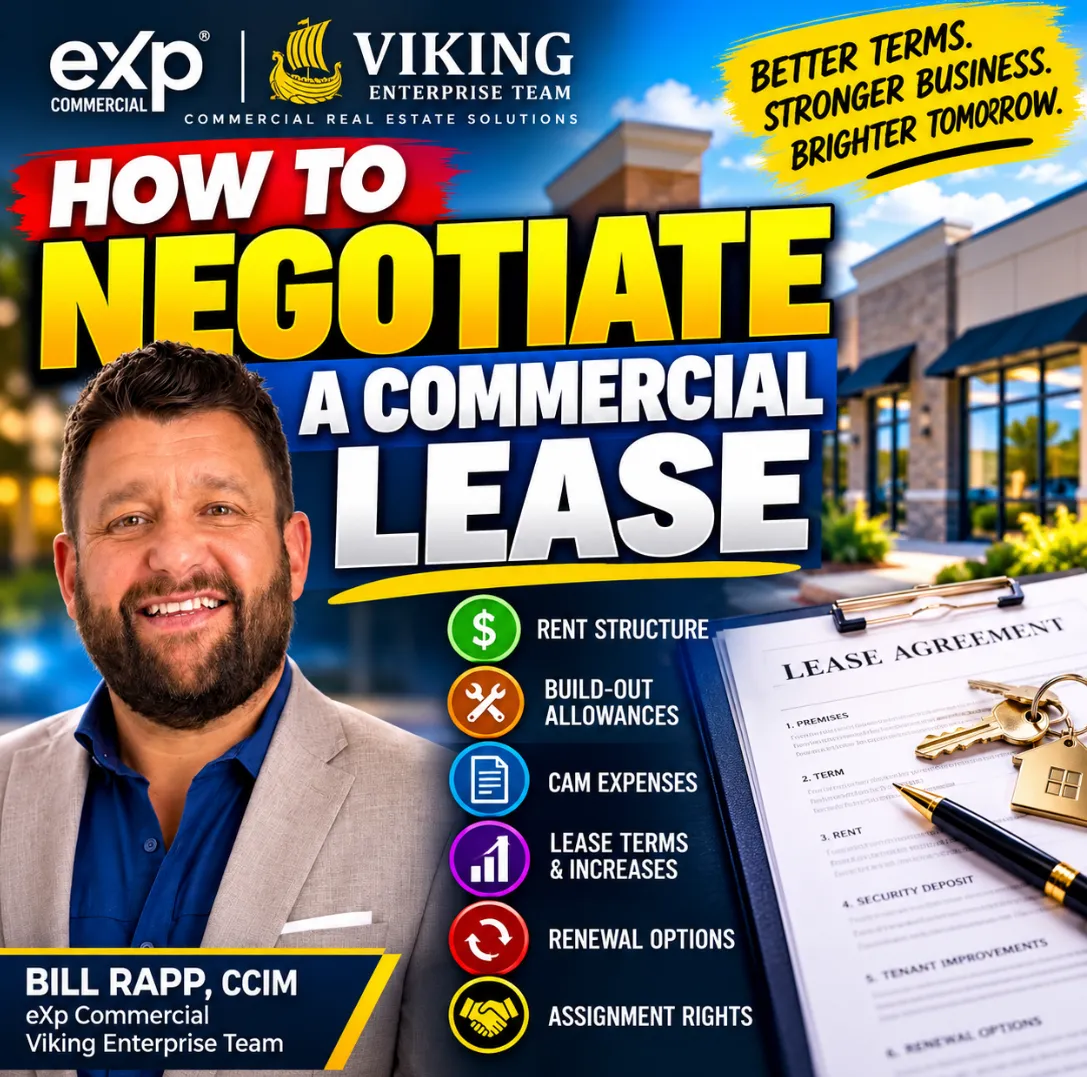
🏢 How to Negotiate a Commercial Lease: 10 Terms Every Business Owner Should Understand 🔑
🏢 How to Negotiate a Commercial Lease: 10 Terms Every Business Owner Should Understand 🔑
🤝 Commercial Lease Negotiation: How to Get Better Rent, Build-Out Allowances & Lease Terms 💰
________________________________________________________________________________
How to Negotiate a Commercial Lease: A Guide for Business Owners
Negotiating a commercial lease is about much more than getting the lowest possible rent.
For a business owner, the wrong lease structure can create unnecessary expenses, restrict future growth, and lock the company into obligations that become increasingly difficult to manage. A well-negotiated lease, on the other hand, can provide predictable occupancy costs, flexibility, landlord contributions toward improvements, and options that support the business for years.
Whether you're leasing retail, office, medical, industrial, warehouse, or flex space, understanding the economics beyond the advertised rental rate is critical.
Here are some of the most important issues to evaluate before signing a commercial lease.
1. Don't Negotiate Rent in Isolation
The quoted rental rate is only one component of occupancy cost.
For example, a retail property might be advertised at $30 per square foot, but the tenant could also be responsible for taxes, insurance, common area maintenance (CAM), and other operating expenses.
If those additional expenses total $12 per square foot, the tenant's initial occupancy cost is effectively $42 per square foot before utilities, maintenance, and other business expenses.
When comparing properties, evaluate the total occupancy cost, not simply the base rent.
2. Understand the Lease Structure
Commercial leases can be structured differently depending on the property type and market.
A full-service gross lease generally bundles many operating expenses into the rental rate, although expense stops and annual reconciliations may still apply.
A modified gross lease divides operating expenses between the landlord and tenant according to negotiated terms.
A triple-net (NNN) lease generally requires the tenant to pay base rent plus its proportionate share of property taxes, insurance, and common-area operating expenses.
Understanding the structure makes competing properties easier to compare.
3. Negotiate Tenant Improvement Allowances
If the property needs substantial improvements, the tenant improvement allowance can be as important as the rental rate.
Depending on the property, market, tenant credit, and lease term, landlords may contribute toward construction expenses such as flooring, electrical work, plumbing, walls, HVAC modifications, lighting, or other improvements.
Suppose one landlord offers a lower rental rate but very little toward a $150,000 build-out, while another offers more rent but contributes substantially toward construction.
The second deal could have better overall economics.
4. Consider Free Rent and Rent Commencement
Another negotiable component is when rent actually begins.
Businesses frequently need time for permitting, construction, inspections, installation, and moving before opening their doors.
Negotiating an appropriate rent commencement date can reduce the risk of paying full rent on space that isn't yet producing revenue.
Depending on the transaction, a landlord may also offer an initial free-rent period.
5. Look Carefully at Annual Rent Increases
A lease that looks affordable in Year 1 may look very different in Year 5 or Year 10.
Commercial leases commonly contain annual increases, sometimes expressed as a fixed percentage or predetermined dollar amount.
Model the entire lease term, including escalations, rather than focusing exclusively on the first year's rental rate.
This helps reveal the true financial commitment.
6. Evaluate CAM and Operating Expenses
CAM expenses can materially affect occupancy costs, particularly in retail and multi-tenant properties.
Ask for historical operating expenses when available and understand exactly which expenses can be passed through to tenants.
Pay particular attention to administrative fees, capital expenditures, management expenses, controllable operating costs, and reconciliation provisions.
Where appropriate, tenants may seek negotiated protections or caps on certain controllable expenses.
7. Protect Your Renewal Options
A successful business may invest substantial money building out and establishing a location.
Without an appropriate renewal option, the tenant could eventually face the choice of accepting unfavorable renewal economics or relocating.
Renewal provisions should clearly address issues such as notice periods, number and length of options, and how future rent will be determined.
8. Think About Assignment and Subleasing
Businesses change.
You may grow faster than expected, sell the company, acquire another company, consolidate locations, or discover that the original space no longer fits your operation.
Assignment and sublease provisions can become extremely important when circumstances change.
Understand the landlord's approval rights and the conditions under which the space can be assigned or subleased.
9. Negotiate Signage, Parking and Exclusivity
Some of the most valuable lease provisions aren't directly related to rent.
A retailer or medical practice may place significant value on building signage and visibility. An office user may prioritize parking. A restaurant may require patio rights, delivery access, grease traps, venting, or sufficient electrical capacity.
Certain retail tenants may also seek exclusive-use protections that restrict the landlord from leasing nearby space within the project to direct competitors.
The value of these provisions depends heavily on the business.
10. Understand Personal Guarantee Requirements
Landlords frequently request guarantees, particularly from newer or privately held businesses.
But a guarantee doesn't necessarily have to be unlimited for the entire lease term.
Depending on the tenant, landlord, and transaction, potential structures could include a limited guarantee, declining guarantee, capped guarantee, or other negotiated arrangement.
This can become an important risk-management issue for the business owner.
The LOI Is an Important Negotiation Stage
Many commercial lease transactions begin with a Letter of Intent (LOI) outlining the primary business terms.
Typical LOI items include rental rate, lease term, escalations, tenant improvement allowance, free rent, security deposit, renewal options, permitted use, signage, assignment rights, and other material economic terms.
Although the subsequent lease document contains considerably more detail, negotiating the major business points during the LOI stage can establish a clearer framework before attorneys begin working through the final lease language.
Why Tenant Representation Matters
The landlord or listing broker represents the landlord's interests.
A tenant representative focuses on the tenant's real estate objectives—identifying alternatives, comparing economics, evaluating locations, negotiating business terms, and helping coordinate the transaction.
Competition can also create leverage.
Rather than negotiating a single property in isolation, evaluating multiple qualified locations gives the tenant better information about rental rates, concessions, build-out allowances, and alternative deal structures.
Commercial Lease Negotiation: The Bottom Line
A commercial lease can represent hundreds of thousands—or millions—of dollars in future obligations.
The goal shouldn't simply be to negotiate the cheapest rent.
The objective is to negotiate a lease structure that supports the business operationally and financially.
Before committing to a location, evaluate the complete package: base rent, NNN/CAM expenses, escalations, tenant improvements, free rent, lease term, renewal options, guarantees, assignment rights, signage, parking, and exit flexibility.
A few dollars per square foot can matter.
But the right lease structure can matter even more.
Connect With Viking Enterprise Team
📍 eXp Commercial & eXp Realty
📍 Houston | Katy | Fulshear | West Houston
📅 Calendly.com/VikingEnterprise
📞 281-222-0433
📞 Bill Rapp, CCIM
eXp Commercial | Viking Enterprise Team
Commercial Real Estate & Capital Advisory
🌐 https://houstonrealestatebrokerage.com
https://www.houstonrealestatebrokerage.com/
https://www.houstonrealestatebrokerage.com/houston-cre-navigator
https://www.commercialexchange.com/agent/653bf5593e3a3e1dcec275a6
http://expressoffers.com/[email protected]
https://app.bullpenre.com/profile/1742476177701x437444415125976000
https://author.billrapponline.com/
https://www.amazon.com/dp/B0F32Z5BH2
https://veed.cello.so/FOmzTty6oi9
https://buymeacoffee.com/vikingente3
https://creplaybookseries.billrapponline.com
https://creplaybook.billrapponline.com/
© Bill Rapp, Broker Associate, eXp Commercial Viking Enterprise Team

Commercial Real Estate Advisors Serving Katy, Fulshear & Greater Houston
Helping Property Owners, Investors & Businesses Make Smarter Commercial Real Estate Decisions
Whether you're buying, selling, leasing, investing, or financing commercial real estate, having the right advisor can make all the difference.
At eXp Commercial – Viking Enterprise Team, we provide comprehensive commercial real estate brokerage and advisory services for property owners, investors, developers, landlords, tenants, and business owners throughout Katy, Fulshear, Houston, and the surrounding Texas markets.
Our team combines local market expertise with commercial investment knowledge and capital markets experience to help clients maximize property value, identify new opportunities, reduce risk, and achieve long-term investment success.
From a single office building to a growing investment portfolio, we provide strategic guidance from acquisition through disposition.
Comprehensive Commercial Real Estate Services
Commercial Property Sales
Selling commercial real estate requires far more than placing a property on the market. We develop customized marketing strategies designed to maximize exposure while targeting qualified buyers locally, regionally, and nationally.
Our services include:
Property valuation and pricing strategy
Investment analysis
Professional marketing campaigns
Buyer qualification
Contract negotiation
Due diligence coordination
Transaction management through closing
Whether you're selling office, retail, industrial, multifamily, land, medical, mixed-use, or investment property, our objective is simple—maximize your property's value while creating a smooth transaction.
Commercial Leasing Services
Vacancies reduce cash flow and impact property performance.
We help landlords lease available space by creating effective marketing campaigns, identifying qualified tenants, negotiating favorable lease terms, and minimizing downtime.
Our leasing services include:
Office leasing
Retail leasing
Industrial leasing
Medical office leasing
Flex space leasing
Warehouse leasing
Landlord representation
Tenant representation
Lease renewals
Lease negotiations
Our goal is to keep your property occupied with quality tenants while protecting your long-term investment.
Commercial Property Acquisitions
Whether you're purchasing your first commercial property or expanding a large investment portfolio, we help identify opportunities that align with your investment objectives.
Our acquisition services include:
Market research
Property sourcing
Financial analysis
Cap rate evaluation
Cash flow analysis
Due diligence
Negotiation
Closing coordination
We help investors make informed decisions backed by market data and financial analysis—not emotion.
Investment Property Analysis
Every investment should begin with a thorough understanding of risk and return.
We assist investors by evaluating:
Net Operating Income (NOI)
Capitalization Rates
Cash-on-Cash Returns
Internal Rate of Return (IRR)
Market Rent Analysis
Occupancy Trends
Comparable Sales
Exit Strategies
Our investment analysis helps clients make data-driven decisions before committing capital.
Commercial Financing & Capital Advisory
One of the biggest advantages of working with Viking Enterprise Team is access to commercial financing expertise.
Through our capital markets relationships, we help clients evaluate financing options for acquisitions, refinancing, construction, bridge financing, SBA loans, investment properties, and owner-occupied commercial real estate.
We help clients:
Evaluate financing options
Analyze refinancing opportunities
Improve loan positioning
Understand lender requirements
Coordinate with commercial lenders
Structure financing strategies
Real estate and financing should work together—not independently.
Portfolio Growth & Investment Strategy
Building long-term wealth through commercial real estate requires strategic planning.
We work with investors to:
Expand investment portfolios
Identify off-market opportunities
Improve portfolio performance
Evaluate redevelopment opportunities
Reposition underperforming assets
Develop long-term acquisition strategies
Whether you're purchasing your second investment or your fiftieth, we help create a roadmap for continued growth.
Landlord Representation
Commercial property owners face constant challenges:
Tenant turnover
Lease negotiations
Rental rates
Market competition
Property positioning
We provide landlord representation focused on maximizing occupancy, improving lease terms, increasing property value, and strengthening long-term cash flow.
Tenant Representation
Businesses often outgrow their current space or need a location that better supports future growth.
We represent tenants throughout the site selection process, helping negotiate favorable lease terms while identifying properties that fit operational and financial objectives.
Our tenant services include:
Office space
Retail locations
Industrial facilities
Warehouse space
Medical offices
Flex properties
Build-to-suit opportunities
Market Analysis & Commercial Consulting
Successful commercial real estate decisions begin with accurate market intelligence.
Our advisory services include:
Market studies
Property positioning
Rent analysis
Development feasibility
Redevelopment analysis
Demographic research
Growth corridor identification
Competitive property analysis
Whether you're considering selling today or planning five years ahead, we help you understand where the market is headed.
Joint Ventures & Investment Partnerships
Many commercial opportunities require additional equity, strategic partners, or experienced investors.
We help facilitate introductions between qualified investors, developers, operators, and commercial property owners seeking partnership opportunities for acquisitions, development, redevelopment, or recapitalization.
Exit Planning & Wealth Preservation
Every commercial investment eventually reaches a transition point.
Whether you're considering:
Selling
Refinancing
Recapitalizing
Completing a 1031 Exchange
Passing assets to the next generation
Repositioning your portfolio
we help create an exit strategy that aligns with your financial goals while maximizing value and minimizing unnecessary risk.
Why Choose Viking Enterprise Team?
Commercial real estate is about more than buying and selling properties—it's about creating long-term value.
Our clients benefit from:
Local expertise throughout Katy, Fulshear, Houston, and surrounding markets
Experience representing investors, developers, business owners, landlords, and tenants
Comprehensive brokerage and advisory services
Commercial financing insight and capital markets knowledge
Investment-focused analysis
Strategic negotiation
Professional marketing
Personalized service from initial consultation through closing
We believe informed clients make better decisions, and our role is to provide the expertise, market intelligence, and guidance needed to help you succeed.
Let's Discuss Your Commercial Real Estate Goals
Whether you're buying, selling, leasing, investing, refinancing, or planning your next commercial real estate transaction, Viking Enterprise Team is ready to help.
Schedule a confidential consultation to discuss your objectives and discover how our experience, market knowledge, and strategic approach can help you maximize the value of your commercial real estate investments.
Contact eXp Commercial – Viking Enterprise Team today and let's build your commercial real estate strategy together.


Find the perfect location for your business.
Let us help your business succeed.
🏢 How to Negotiate a Commercial Lease: 10 Terms Every Business Owner Should Understand 🔑
🏢 How to Negotiate a Commercial Lease: 10 Terms Every Business Owner Should Understand 🔑
🤝 Commercial Lease Negotiation: How to Get Better Rent, Build-Out Allowances & Lease Terms 💰
________________________________________________________________________________
How to Negotiate a Commercial Lease: A Guide for Business Owners
Negotiating a commercial lease is about much more than getting the lowest possible rent.
For a business owner, the wrong lease structure can create unnecessary expenses, restrict future growth, and lock the company into obligations that become increasingly difficult to manage. A well-negotiated lease, on the other hand, can provide predictable occupancy costs, flexibility, landlord contributions toward improvements, and options that support the business for years.
Whether you're leasing retail, office, medical, industrial, warehouse, or flex space, understanding the economics beyond the advertised rental rate is critical.
Here are some of the most important issues to evaluate before signing a commercial lease.
1. Don't Negotiate Rent in Isolation
The quoted rental rate is only one component of occupancy cost.
For example, a retail property might be advertised at $30 per square foot, but the tenant could also be responsible for taxes, insurance, common area maintenance (CAM), and other operating expenses.
If those additional expenses total $12 per square foot, the tenant's initial occupancy cost is effectively $42 per square foot before utilities, maintenance, and other business expenses.
When comparing properties, evaluate the total occupancy cost, not simply the base rent.
2. Understand the Lease Structure
Commercial leases can be structured differently depending on the property type and market.
A full-service gross lease generally bundles many operating expenses into the rental rate, although expense stops and annual reconciliations may still apply.
A modified gross lease divides operating expenses between the landlord and tenant according to negotiated terms.
A triple-net (NNN) lease generally requires the tenant to pay base rent plus its proportionate share of property taxes, insurance, and common-area operating expenses.
Understanding the structure makes competing properties easier to compare.
3. Negotiate Tenant Improvement Allowances
If the property needs substantial improvements, the tenant improvement allowance can be as important as the rental rate.
Depending on the property, market, tenant credit, and lease term, landlords may contribute toward construction expenses such as flooring, electrical work, plumbing, walls, HVAC modifications, lighting, or other improvements.
Suppose one landlord offers a lower rental rate but very little toward a $150,000 build-out, while another offers more rent but contributes substantially toward construction.
The second deal could have better overall economics.
4. Consider Free Rent and Rent Commencement
Another negotiable component is when rent actually begins.
Businesses frequently need time for permitting, construction, inspections, installation, and moving before opening their doors.
Negotiating an appropriate rent commencement date can reduce the risk of paying full rent on space that isn't yet producing revenue.
Depending on the transaction, a landlord may also offer an initial free-rent period.
5. Look Carefully at Annual Rent Increases
A lease that looks affordable in Year 1 may look very different in Year 5 or Year 10.
Commercial leases commonly contain annual increases, sometimes expressed as a fixed percentage or predetermined dollar amount.
Model the entire lease term, including escalations, rather than focusing exclusively on the first year's rental rate.
This helps reveal the true financial commitment.
6. Evaluate CAM and Operating Expenses
CAM expenses can materially affect occupancy costs, particularly in retail and multi-tenant properties.
Ask for historical operating expenses when available and understand exactly which expenses can be passed through to tenants.
Pay particular attention to administrative fees, capital expenditures, management expenses, controllable operating costs, and reconciliation provisions.
Where appropriate, tenants may seek negotiated protections or caps on certain controllable expenses.
7. Protect Your Renewal Options
A successful business may invest substantial money building out and establishing a location.
Without an appropriate renewal option, the tenant could eventually face the choice of accepting unfavorable renewal economics or relocating.
Renewal provisions should clearly address issues such as notice periods, number and length of options, and how future rent will be determined.
8. Think About Assignment and Subleasing
Businesses change.
You may grow faster than expected, sell the company, acquire another company, consolidate locations, or discover that the original space no longer fits your operation.
Assignment and sublease provisions can become extremely important when circumstances change.
Understand the landlord's approval rights and the conditions under which the space can be assigned or subleased.
9. Negotiate Signage, Parking and Exclusivity
Some of the most valuable lease provisions aren't directly related to rent.
A retailer or medical practice may place significant value on building signage and visibility. An office user may prioritize parking. A restaurant may require patio rights, delivery access, grease traps, venting, or sufficient electrical capacity.
Certain retail tenants may also seek exclusive-use protections that restrict the landlord from leasing nearby space within the project to direct competitors.
The value of these provisions depends heavily on the business.
10. Understand Personal Guarantee Requirements
Landlords frequently request guarantees, particularly from newer or privately held businesses.
But a guarantee doesn't necessarily have to be unlimited for the entire lease term.
Depending on the tenant, landlord, and transaction, potential structures could include a limited guarantee, declining guarantee, capped guarantee, or other negotiated arrangement.
This can become an important risk-management issue for the business owner.
The LOI Is an Important Negotiation Stage
Many commercial lease transactions begin with a Letter of Intent (LOI) outlining the primary business terms.
Typical LOI items include rental rate, lease term, escalations, tenant improvement allowance, free rent, security deposit, renewal options, permitted use, signage, assignment rights, and other material economic terms.
Although the subsequent lease document contains considerably more detail, negotiating the major business points during the LOI stage can establish a clearer framework before attorneys begin working through the final lease language.
Why Tenant Representation Matters
The landlord or listing broker represents the landlord's interests.
A tenant representative focuses on the tenant's real estate objectives—identifying alternatives, comparing economics, evaluating locations, negotiating business terms, and helping coordinate the transaction.
Competition can also create leverage.
Rather than negotiating a single property in isolation, evaluating multiple qualified locations gives the tenant better information about rental rates, concessions, build-out allowances, and alternative deal structures.
Commercial Lease Negotiation: The Bottom Line
A commercial lease can represent hundreds of thousands—or millions—of dollars in future obligations.
The goal shouldn't simply be to negotiate the cheapest rent.
The objective is to negotiate a lease structure that supports the business operationally and financially.
Before committing to a location, evaluate the complete package: base rent, NNN/CAM expenses, escalations, tenant improvements, free rent, lease term, renewal options, guarantees, assignment rights, signage, parking, and exit flexibility.
A few dollars per square foot can matter.
But the right lease structure can matter even more.
Connect With Viking Enterprise Team
📍 eXp Commercial & eXp Realty
📍 Houston | Katy | Fulshear | West Houston
📅 Calendly.com/VikingEnterprise
📞 281-222-0433
📞 Bill Rapp, CCIM
eXp Commercial | Viking Enterprise Team
Commercial Real Estate & Capital Advisory
🌐 https://houstonrealestatebrokerage.com
https://www.houstonrealestatebrokerage.com/
https://www.houstonrealestatebrokerage.com/houston-cre-navigator
https://www.commercialexchange.com/agent/653bf5593e3a3e1dcec275a6
http://expressoffers.com/[email protected]
https://app.bullpenre.com/profile/1742476177701x437444415125976000
https://author.billrapponline.com/
https://www.amazon.com/dp/B0F32Z5BH2
https://veed.cello.so/FOmzTty6oi9
https://buymeacoffee.com/vikingente3
https://creplaybookseries.billrapponline.com
https://creplaybook.billrapponline.com/
© Bill Rapp, Broker Associate, eXp Commercial Viking Enterprise Team
Find the perfect location for your business.
Let us help your business succeed.

Sign up to receive the latest news on property investment and commercial real estate listings.
9600 Great Hills Trail, Suite 150w Austin, TX 78759 |
855.450.0324 xx255
Texas Real Estate Commission Consumer Protection Notice Texas Real Estate Commission
Information About Brokerage Services eXp Commercial LLC #9010212
Viking Enterprise LLC #9009614

Sign up to receive the latest news on property investment and commercial real estate listings.


Contact Us
901 S Mopac Expwy, Bldg 2, Suite 350 Austin, TX 78746 | 512.474.5557Texas Real Estate Commission
Consumer Protection Notice Texas Real Estate Commission Information About Brokerage Services Reliance Retail, LLC #603091
Texas RS, LLC #9003193 | RESOLUT RE Is Licensed In Louisiana #0995694083
Facebook
Instagram
X
LinkedIn
Youtube
TikTok