Your Trusted Houston Commercial Real Estate Brokerage
Viking Enterprise LLC is part of eXp Commercial, an agent-led, cloud-based commercial real estate brokerage with agents across the globe.
Email: [email protected]
Call: (281) 222-0433

Your Trusted Katy / Fulshear & Houston Commercial Real Estate Brokerage
Viking Enterprise LLC is part of eXp Commercial, an agent-led, cloud-based commercial real estate brokerage with agents across the globe.
Looking to invest, buy, sell or lease? We can help.
Looking to invest, buy, sell or lease? We can help.
FEATURED PROPERTIES



OUR FEATURED TENANTS & CLIENTS
eXp Commercial - Viking Enterprise Team's real estate network provides unparalleled commercial real estate services to Tenants and Landlords around the Katy- Houston area. Our knowledge, experience, and reputation sets us apart from many firms.
A commercial property owner might have various plans that would necessitate the services of a commercial real estate broker. Some of the common scenarios include:
1. Selling the Property: If the owner decides it’s time to sell the property, a commercial real estate broker can help determine the market value, market the property effectively, and negotiate with potential buyers to get the best possible price.
2. Leasing Space: For property owners looking to lease out part or all of their commercial space, a broker can help find suitable tenants, negotiate lease terms, and ensure the lease agreements meet all legal requirements and serve the owner’s best interests.
3. Acquiring More Properties: Owners looking to expand their portfolio would benefit from a broker's knowledge of the market, access to listings, and negotiation skills to secure additional properties at favorable terms.
4. Property Management: While not all brokers offer this service, some commercial real estate brokers or their affiliates offer property management services. This can be particularly appealing for owners who prefer a hands-off approach or are managing properties from a distance.
5. Market Analysis: Owners considering future developments, renovations, or rebranding of their property might engage a broker for a comprehensive market analysis. This helps in understanding current market trends, the demand for different types of spaces, and potential returns on investment for various strategies.
6. Refinancing: In situations where a property owner is looking to refinance their property, a commercial real estate broker can provide valuable insights into the property’s current market value, assist in gathering necessary documentation, and even help in finding the best financing options.
7. Partnership or Investment Opportunities: Owners interested in exploring partnerships, joint ventures, or seeking investors for expansion or development projects might use a broker to find and vet potential partners or investors.
8. Consulting on Zoning and Use Changes: When contemplating a change in the use of the property or dealing with zoning issues, a broker with experience in local regulations and the specific property type can provide guidance and strategic planning assistance.
9. Exit Strategy Planning: For owners looking to plan an exit strategy from their investment, whether it’s through a strategic sale or a gradual winding down of operations, brokers can provide market insights, timing advice, and valuation services to optimize the exit process.
In any of these scenarios, the expertise and services provided by a commercial real estate broker can save the property owner time and money, while also providing access to a wider network of potential buyers, tenants, and industry professionals. Give us a call today!
Reviews
🚀 Houston Multifamily Market Q1 2026: Why Smart Investors Are Watching Occupancy Trends Closely 📈
🚀 Houston Multifamily Market Q1 2026: Why Smart Investors Are Watching Occupancy Trends Closely 📈
🏢 Houston Apartment Market Update 2026: Supply Pressure Today, Opportunity Tomorrow 🔥
Houston Multifamily Market Q1 2026: Supply Pressure Is Creating Future Opportunity
Houston’s multifamily market entered 2026 in a much stronger long-term position than many investors realize.
While elevated new construction deliveries continue placing short-term pressure on rents and concessions, the underlying fundamentals driving apartment demand across Houston remain extremely strong. Population growth, job expansion, slowing future development activity, and improving occupancy trends are positioning the market for a healthier recovery cycle heading into late 2026 and 2027.
For commercial real estate investors, lenders, syndicators, and multifamily operators, the current market environment may represent a transition period rather than a downturn.
Houston Continues Leading the Nation in Population Growth
One of the biggest drivers supporting Houston multifamily real estate is simple: people continue moving here at an aggressive pace.
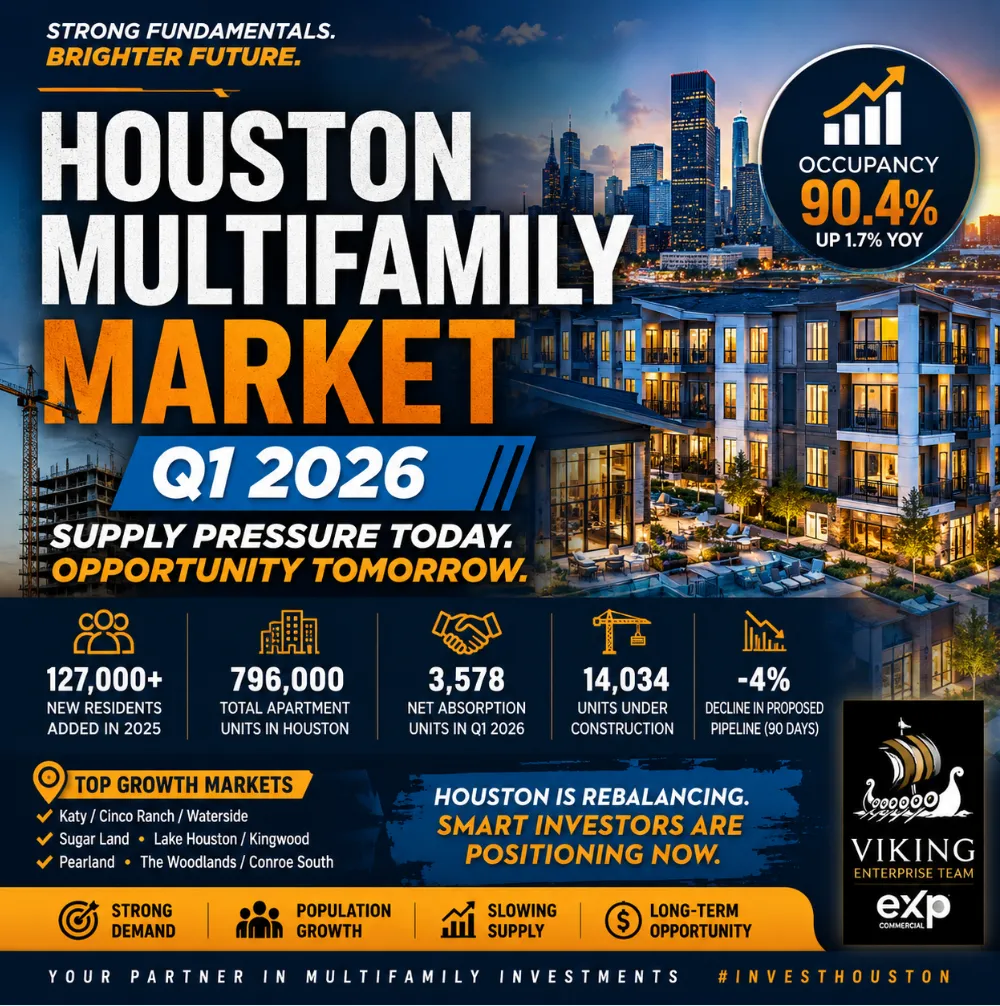
Greater Houston added approximately 127,000 new residents over the past year, leading the nation in population growth. That level of demographic expansion creates long-term apartment demand across virtually every major submarket.
Houston now contains approximately 796,000 apartment units, with overall occupancy reaching 90.4% during Q1 2026. Importantly, Houston is currently outperforming several other major Texas metros, including Dallas-Fort Worth, Austin, and San Antonio in overall occupancy metrics.
This matters because population growth ultimately fuels:
·Apartment demand
·Retail expansion
·Job creation
·Infrastructure growth
·Commercial real estate development
The investor equation remains relatively straightforward:
Jobs → Population → Housing Demand → Commercial Growth
Houston continues checking all four boxes.
Multifamily Absorption Remains Positive
Despite aggressive supply deliveries over the past two years, Houston continues posting positive absorption.
Net absorption reached 3,578 units during Q1 2026, extending more than two consecutive years of positive leasing momentum.
That is a major signal investors should not ignore.
In many oversupplied Sun Belt markets, apartment demand has struggled to keep pace with deliveries. Houston appears to be absorbing inventory more effectively than several competing metros due to stronger economic diversification and population growth.
Class A multifamily properties accounted for approximately 75% of leasing activity during the quarter, showing renters continue prioritizing:
·Newer amenities
·Better locations
·Lifestyle-focused communities
·Modern work-from-home features
Meanwhile, some Class B properties experienced mild negative absorption as renters upgraded into newer properties offering aggressive concessions or transitioned into homeownership opportunities.
Supply Deliveries Are Still Elevated — But the Pipeline Is Beginning to Slow
Developers delivered 4,015 new units during Q1 2026 while maintaining approximately 14,034 units currently under construction.
At first glance, those numbers may appear concerning.
However, the more important forward-looking metric is this:
Future proposed development activity is beginning to decline.
Houston’s proposed multifamily pipeline fell nearly 4% over the past 90 days to approximately 34,300 proposed units.
That slowdown matters significantly.
Commercial real estate markets typically recover when:
1.Supply deliveries stabilize
2.Construction starts slow
3.Occupancy improves
4.Demand continues expanding
Houston appears to be entering the early stages of that rebalancing process.
For investors with a 3–7 year hold strategy, this type of environment can create strong acquisition opportunities before fundamentals fully recover.
Rent Growth Remains Soft — But Occupancy Is Improving
Houston’s effective rents averaged approximately $1,248 per unit during Q1 2026, representing a 2.0% year-over-year decline.
The primary driver behind softer rent growth remains elevated concessions and aggressive lease-up competition among newly delivered projects.
However, occupancy improved approximately 1.7% year-over-year.
That distinction is important.
Improving occupancy often precedes stronger rent growth later in the cycle.
In many cases, operators initially stabilize occupancy through concessions before gradually reducing incentives and increasing effective rental rates as supply pressure fades.
This suggests Houston multifamily may currently be closer to the bottom of the supply cycle than many headlines imply.
Katy and West Houston Continue Outperforming
Several suburban submarkets continue attracting substantial investor and developer attention.
One of the strongest-performing areas remains:
·Katy
·Cinco Ranch
·Waterside
·West Houston growth corridors
These areas posted approximately 434 units of positive net absorption during Q1 2026 while maintaining more than 1,000 units under construction.
West Houston continues benefiting from:
·High household incomes
·Corporate expansion
·Strong school districts
·Population migration
·Retail and infrastructure development
Other active multifamily growth corridors include:
·Sugar Land
·Pearland
·Lake Houston / Kingwood
·The Woodlands
·Conroe South
Many of these suburban markets continue outperforming urban core areas due to affordability, quality-of-life migration trends, and expanding employment hubs.
What Investors Should Watch Going Forward
Houston multifamily investors should closely monitor several key indicators over the next 12–24 months:
1. Occupancy Trends
Improving occupancy often signals future pricing power.
2. Construction Starts
Slowing development activity could help rebalance supply faster.
3. Population Growth
Houston’s long-term housing demand remains highly demographic-driven.
4. Job Creation
Economic growth supports renter stability and household formation.
5. Concession Burn-Off
As concessions fade, effective rents may begin recovering.
Final Thoughts: Houston Multifamily Still Has Strong Long-Term Fundamentals
Houston’s multifamily market is not collapsing.
It is recalibrating after one of the largest supply waves in recent history.
For disciplined investors, this environment may create attractive acquisition opportunities before the next growth cycle fully emerges.
The combination of:
·Strong population growth
·Improving occupancy
·Slowing future development
·Relative affordability
·Economic diversification
Continues supporting a constructive long-term outlook for Houston multifamily real estate.
While near-term rent growth may remain modest, the broader fundamentals suggest Houston is positioning itself for a healthier operating environment heading into 2027.
For investors focused on long-term cash flow, value-add strategies, and demographic growth, Houston remains one of the most important multifamily markets to watch in the United States.
https://www.houstonrealestatebrokerage.com/
https://www.houstonrealestatebrokerage.com/houston-cre-navigator
https://www.commercialexchange.com/agent/653bf5593e3a3e1dcec275a6
http://expressoffers.com/[email protected]
https://app.bullpenre.com/profile/1742476177701x437444415125976000
https://author.billrapponline.com/
https://www.amazon.com/dp/B0F32Z5BH2
https://veed.cello.so/FOmzTty6oi9
https://buymeacoffee.com/vikingente3
https://creplaybookseries.billrapponline.com
https://creplaybook.billrapponline.com/
© 2023-2024 Bill Rapp, Broker Associate, eXp Commercial Viking Enterprise Team

Commercial Real Estate Services for Katy/Fulshear & Houston Property Owners
At eXp Commercial – Viking Enterprise Team, we help commercial property owners, investors, landlords, and tenants throughout Katy, Houston, and the surrounding areas make informed real estate decisions with confidence.
Whether you're buying, selling, leasing, refinancing, or planning your next investment, our local market knowledge, industry experience, and extensive network help create opportunities and deliver results.
How We Help Commercial Property Owners
Sell Your Property
Thinking about selling? We can help determine your property's current market value, create a targeted marketing strategy, and negotiate with qualified buyers to maximize your sale price.
Lease Available Space
Vacancies can be expensive. We help landlords attract qualified tenants, market available space, negotiate favorable lease terms, and keep properties performing at their highest potential.
Expand Your Portfolio
Looking to acquire additional commercial properties? We help identify opportunities, analyze investments, and negotiate favorable purchase terms that align with your goals.
Property Management Solutions
For owners who prefer a hands-off approach, we can connect you with trusted property management resources to help oversee day-to-day operations and tenant relations.
Market Analysis & Investment Strategy
Considering renovations, redevelopment, repositioning, or expansion? Our market research and analysis help owners understand current trends, demand drivers, and potential returns before making major decisions.
Financing & Refinancing Assistance
As commercial real estate and capital markets professionals, we can help evaluate refinancing opportunities, analyze property value, and connect owners with financing options that fit their objectives.
Joint Ventures & Investment Partnerships
Need equity partners or investors for a project? We help identify and connect property owners with qualified investment groups and strategic partners.
Zoning & Property Use Guidance
If you're considering a change of use, redevelopment, or zoning-related project, we can help navigate local market considerations and connect you with the appropriate resources.
Exit Strategy Planning
Every investment eventually reaches a decision point. Whether you're planning to sell, recapitalize, exchange, or transition ownership, we can help develop a strategy designed to maximize value and timing.
Why Work With Viking Enterprise Team?
Commercial real estate decisions often involve significant financial commitments. Having an experienced advisor on your side can save time, reduce risk, and provide access to opportunities that may not be readily available to the public.
Our goal is simple: help our clients make smarter real estate decisions and achieve their long-term investment objectives.
Let's Talk
If you're considering selling, leasing, buying, refinancing, or exploring new opportunities, we'd love to discuss your goals and see how we can help.
Contact eXp Commercial – Viking Enterprise Team today for a confidential consultation.


Find the perfect location for your business.
Let us help your business succeed.
🚀 Houston Multifamily Market Q1 2026: Why Smart Investors Are Watching Occupancy Trends Closely 📈
🚀 Houston Multifamily Market Q1 2026: Why Smart Investors Are Watching Occupancy Trends Closely 📈
🏢 Houston Apartment Market Update 2026: Supply Pressure Today, Opportunity Tomorrow 🔥
Houston Multifamily Market Q1 2026: Supply Pressure Is Creating Future Opportunity
Houston’s multifamily market entered 2026 in a much stronger long-term position than many investors realize.
While elevated new construction deliveries continue placing short-term pressure on rents and concessions, the underlying fundamentals driving apartment demand across Houston remain extremely strong. Population growth, job expansion, slowing future development activity, and improving occupancy trends are positioning the market for a healthier recovery cycle heading into late 2026 and 2027.
For commercial real estate investors, lenders, syndicators, and multifamily operators, the current market environment may represent a transition period rather than a downturn.
Houston Continues Leading the Nation in Population Growth
One of the biggest drivers supporting Houston multifamily real estate is simple: people continue moving here at an aggressive pace.
Greater Houston added approximately 127,000 new residents over the past year, leading the nation in population growth. That level of demographic expansion creates long-term apartment demand across virtually every major submarket.
Houston now contains approximately 796,000 apartment units, with overall occupancy reaching 90.4% during Q1 2026. Importantly, Houston is currently outperforming several other major Texas metros, including Dallas-Fort Worth, Austin, and San Antonio in overall occupancy metrics.
This matters because population growth ultimately fuels:
·Apartment demand
·Retail expansion
·Job creation
·Infrastructure growth
·Commercial real estate development
The investor equation remains relatively straightforward:
Jobs → Population → Housing Demand → Commercial Growth
Houston continues checking all four boxes.
Multifamily Absorption Remains Positive
Despite aggressive supply deliveries over the past two years, Houston continues posting positive absorption.
Net absorption reached 3,578 units during Q1 2026, extending more than two consecutive years of positive leasing momentum.
That is a major signal investors should not ignore.
In many oversupplied Sun Belt markets, apartment demand has struggled to keep pace with deliveries. Houston appears to be absorbing inventory more effectively than several competing metros due to stronger economic diversification and population growth.
Class A multifamily properties accounted for approximately 75% of leasing activity during the quarter, showing renters continue prioritizing:
·Newer amenities
·Better locations
·Lifestyle-focused communities
·Modern work-from-home features
Meanwhile, some Class B properties experienced mild negative absorption as renters upgraded into newer properties offering aggressive concessions or transitioned into homeownership opportunities.
Supply Deliveries Are Still Elevated — But the Pipeline Is Beginning to Slow
Developers delivered 4,015 new units during Q1 2026 while maintaining approximately 14,034 units currently under construction.
At first glance, those numbers may appear concerning.
However, the more important forward-looking metric is this:
Future proposed development activity is beginning to decline.
Houston’s proposed multifamily pipeline fell nearly 4% over the past 90 days to approximately 34,300 proposed units.
That slowdown matters significantly.
Commercial real estate markets typically recover when:
1.Supply deliveries stabilize
2.Construction starts slow
3.Occupancy improves
4.Demand continues expanding
Houston appears to be entering the early stages of that rebalancing process.
For investors with a 3–7 year hold strategy, this type of environment can create strong acquisition opportunities before fundamentals fully recover.
Rent Growth Remains Soft — But Occupancy Is Improving
Houston’s effective rents averaged approximately $1,248 per unit during Q1 2026, representing a 2.0% year-over-year decline.
The primary driver behind softer rent growth remains elevated concessions and aggressive lease-up competition among newly delivered projects.
However, occupancy improved approximately 1.7% year-over-year.
That distinction is important.
Improving occupancy often precedes stronger rent growth later in the cycle.
In many cases, operators initially stabilize occupancy through concessions before gradually reducing incentives and increasing effective rental rates as supply pressure fades.
This suggests Houston multifamily may currently be closer to the bottom of the supply cycle than many headlines imply.
Katy and West Houston Continue Outperforming
Several suburban submarkets continue attracting substantial investor and developer attention.
One of the strongest-performing areas remains:
·Katy
·Cinco Ranch
·Waterside
·West Houston growth corridors
These areas posted approximately 434 units of positive net absorption during Q1 2026 while maintaining more than 1,000 units under construction.
West Houston continues benefiting from:
·High household incomes
·Corporate expansion
·Strong school districts
·Population migration
·Retail and infrastructure development
Other active multifamily growth corridors include:
·Sugar Land
·Pearland
·Lake Houston / Kingwood
·The Woodlands
·Conroe South
Many of these suburban markets continue outperforming urban core areas due to affordability, quality-of-life migration trends, and expanding employment hubs.
What Investors Should Watch Going Forward
Houston multifamily investors should closely monitor several key indicators over the next 12–24 months:
1. Occupancy Trends
Improving occupancy often signals future pricing power.
2. Construction Starts
Slowing development activity could help rebalance supply faster.
3. Population Growth
Houston’s long-term housing demand remains highly demographic-driven.
4. Job Creation
Economic growth supports renter stability and household formation.
5. Concession Burn-Off
As concessions fade, effective rents may begin recovering.
Final Thoughts: Houston Multifamily Still Has Strong Long-Term Fundamentals
Houston’s multifamily market is not collapsing.
It is recalibrating after one of the largest supply waves in recent history.
For disciplined investors, this environment may create attractive acquisition opportunities before the next growth cycle fully emerges.
The combination of:
·Strong population growth
·Improving occupancy
·Slowing future development
·Relative affordability
·Economic diversification
Continues supporting a constructive long-term outlook for Houston multifamily real estate.
While near-term rent growth may remain modest, the broader fundamentals suggest Houston is positioning itself for a healthier operating environment heading into 2027.
For investors focused on long-term cash flow, value-add strategies, and demographic growth, Houston remains one of the most important multifamily markets to watch in the United States.
https://www.houstonrealestatebrokerage.com/
https://www.houstonrealestatebrokerage.com/houston-cre-navigator
https://www.commercialexchange.com/agent/653bf5593e3a3e1dcec275a6
http://expressoffers.com/[email protected]
https://app.bullpenre.com/profile/1742476177701x437444415125976000
https://author.billrapponline.com/
https://www.amazon.com/dp/B0F32Z5BH2
https://veed.cello.so/FOmzTty6oi9
https://buymeacoffee.com/vikingente3
https://creplaybookseries.billrapponline.com
https://creplaybook.billrapponline.com/
© 2023-2024 Bill Rapp, Broker Associate, eXp Commercial Viking Enterprise Team
Find the perfect location for your business.
Let us help your business succeed.

Sign up to receive the latest news on property investment and commercial real estate listings.
9600 Great Hills Trail, Suite 150w Austin, TX 78759 |
855.450.0324 xx255
Texas Real Estate Commission Consumer Protection Notice Texas Real Estate Commission
Information About Brokerage Services eXp Commercial LLC #9010212
Viking Enterprise LLC #9009614

Sign up to receive the latest news on property investment and commercial real estate listings.


Contact Us
901 S Mopac Expwy, Bldg 2, Suite 350 Austin, TX 78746 | 512.474.5557Texas Real Estate Commission
Consumer Protection Notice Texas Real Estate Commission Information About Brokerage Services Reliance Retail, LLC #603091
Texas RS, LLC #9003193 | RESOLUT RE Is Licensed In Louisiana #0995694083
Facebook
Instagram
X
LinkedIn
Youtube
TikTok