Your Trusted Houston Commercial Real Estate Brokerage
Viking Enterprise LLC is part of eXp Commercial, an agent-led, cloud-based commercial real estate brokerage with agents across the globe.
Email: [email protected]
Call: (281) 222-0433
Your Trusted Katy / Fulshear & Houston Commercial Real Estate Brokerage
Viking Enterprise LLC is part of eXp Commercial, an agent-led, cloud-based commercial real estate brokerage with agents across the globe.
Looking to invest, buy, sell or lease? We can help.
Looking to invest, buy, sell or lease? We can help.
FEATURED PROPERTIES

OUR FEATURED TENANTS & CLIENTS
eXp Commercial - Viking Enterprise Team's real estate network provides unparalleled commercial real estate services to Tenants and Landlords around the Katy- Houston area. Our knowledge, experience, and reputation sets us apart from many firms.
A commercial property owner might have various plans that would necessitate the services of a commercial real estate broker. Some of the common scenarios include:
1. Selling the Property: If the owner decides it’s time to sell the property, a commercial real estate broker can help determine the market value, market the property effectively, and negotiate with potential buyers to get the best possible price.
2. Leasing Space: For property owners looking to lease out part or all of their commercial space, a broker can help find suitable tenants, negotiate lease terms, and ensure the lease agreements meet all legal requirements and serve the owner’s best interests.
3. Acquiring More Properties: Owners looking to expand their portfolio would benefit from a broker's knowledge of the market, access to listings, and negotiation skills to secure additional properties at favorable terms.
4. Property Management: While not all brokers offer this service, some commercial real estate brokers or their affiliates offer property management services. This can be particularly appealing for owners who prefer a hands-off approach or are managing properties from a distance.
5. Market Analysis: Owners considering future developments, renovations, or rebranding of their property might engage a broker for a comprehensive market analysis. This helps in understanding current market trends, the demand for different types of spaces, and potential returns on investment for various strategies.
6. Refinancing: In situations where a property owner is looking to refinance their property, a commercial real estate broker can provide valuable insights into the property’s current market value, assist in gathering necessary documentation, and even help in finding the best financing options.
7. Partnership or Investment Opportunities: Owners interested in exploring partnerships, joint ventures, or seeking investors for expansion or development projects might use a broker to find and vet potential partners or investors.
8. Consulting on Zoning and Use Changes: When contemplating a change in the use of the property or dealing with zoning issues, a broker with experience in local regulations and the specific property type can provide guidance and strategic planning assistance.
9. Exit Strategy Planning: For owners looking to plan an exit strategy from their investment, whether it’s through a strategic sale or a gradual winding down of operations, brokers can provide market insights, timing advice, and valuation services to optimize the exit process.
In any of these scenarios, the expertise and services provided by a commercial real estate broker can save the property owner time and money, while also providing access to a wider network of potential buyers, tenants, and industry professionals. Give us a call today!
Reviews
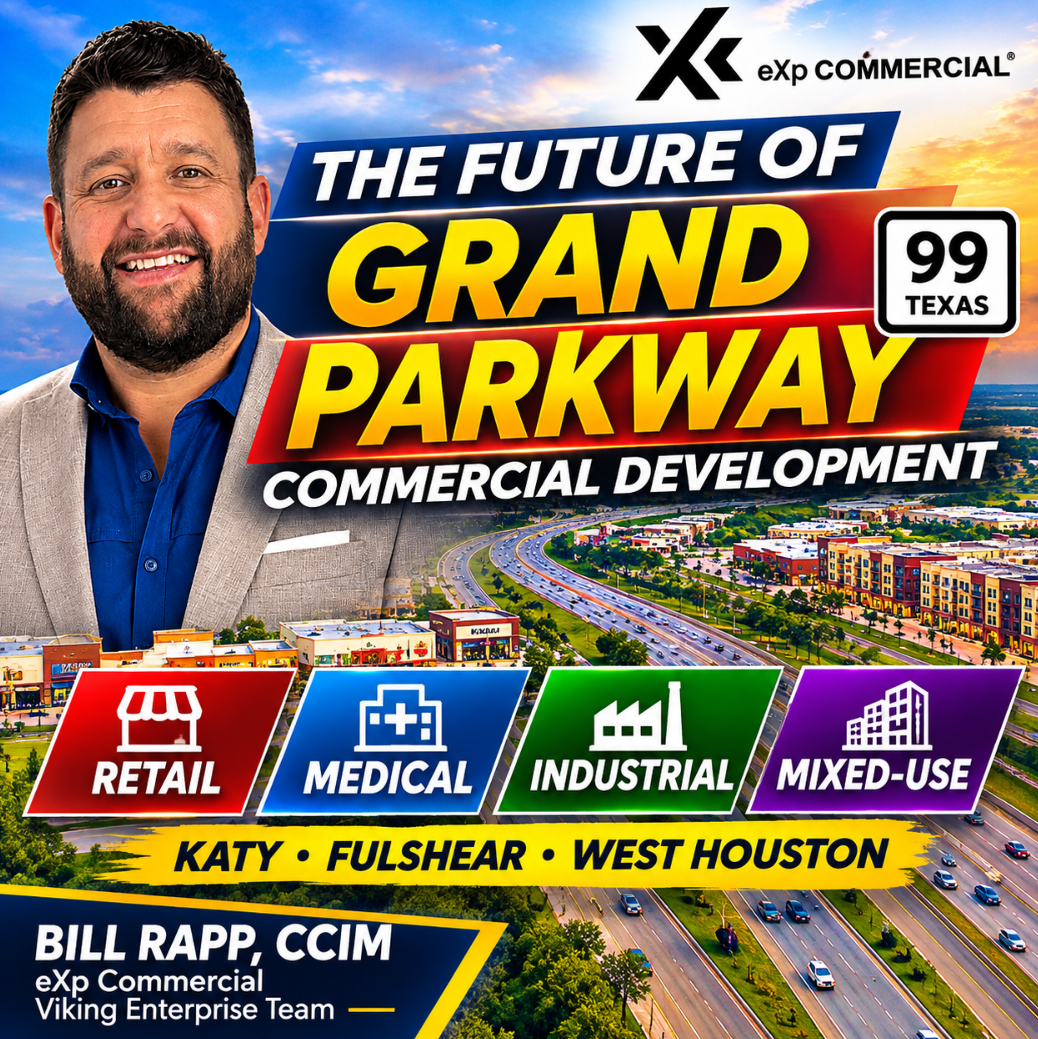
🏗️ Grand Parkway Commercial Development: What's Next? 🚀
🏗️ Grand Parkway Commercial Development: What's Next? 🚀
🏢 Grand Parkway: Where CRE Growth Is Headed 📈
__________________________________________________________________________
Grand Parkway Commercial Development: Retail, Medical, Industrial & Mixed-Use Growth
The future of commercial real estate development in Greater Houston is increasingly tied to one of the region's most important transportation corridors: Grand Parkway, also known as State Highway 99.
For commercial real estate investors, developers, and business owners, the Katy–Fulshear section of Grand Parkway presents opportunities across four major property categories: retail, medical office, industrial and mixed-use development.
As master-planned communities expand, commercial developers are working to deliver the shopping centers, healthcare facilities, warehouses, offices and entertainment destinations needed to serve a growing suburban population.
But where will the strongest opportunities emerge? And how can investors distinguish sustainable growth from speculative development?
Let's examine the forces shaping the next generation of commercial real estate along Grand Parkway.
22225 Elyson Falls Dr, Katy, TX 77449 - Navidad Retail at ELYSON | LoopNet
Massive Elyson Town Center takes shape in North Katy - Covering Katy News
Fulshear Central to Open 2026 | Cross Creek Mixed-Use Development
12
1. Why Grand Parkway Is Becoming a Commercial Development Magnet
Grand Parkway is more than a highway. It is a major transportation corridor connecting Houston-area residential communities, employment centers and commercial districts.
In West Houston, its connectivity with Interstate 10, FM 529, Westpark Tollway and nearby east-west thoroughfares creates multiple commercial development opportunities.
Three fundamental forces are driving demand.
Residential expansion: Master-planned communities in Katy, Fulshear and surrounding Fort Bend, Harris and Waller County areas create demand for neighborhood services.
Transportation connectivity: Access to major highways helps businesses reach customers, employees, suppliers and distribution networks.
Changing suburban demographics: Growing suburban communities support healthcare, restaurants, fitness, professional services, childcare and entertainment.
The most important takeaway is that commercial development generally follows households, accessibility and purchasing power.
However, residential growth does not automatically guarantee profitable commercial development. Developers must evaluate competition, infrastructure capacity, construction costs and tenant demand.
2. Retail Development: Shopping Centers Follow the Rooftops
Retail is one of the most visible commercial property sectors benefiting from growth along Grand Parkway and its connected corridors.
As new neighborhoods mature, residents increasingly demand shopping and services closer to home.
This creates opportunities for grocery-anchored shopping centers, neighborhood retail strips, restaurants, drive-through concepts, fitness centers and service-oriented retail.
Elyson Town Center: Retail at Grand Parkway and FM 529
One development worth watching is Elyson Town Center, located at the northwest corner of Grand Parkway and FM 529.
The project's first phase is approximately 175,000 square feet on 17 acres, positioned to serve the growing Elyson master-planned community and surrounding neighborhoods.
Houston Chronicle
This development illustrates an important investment principle: retail demand is often strongest when new commercial space is supported by an established or rapidly expanding residential customer base.
For investors, the opportunities may extend beyond major shopping centers to smaller retail buildings, restaurant pads and service-oriented properties.
Texas Heritage Marketplace: A Regional Growth Indicator
NewQuest Kicks Off Newest Regional Retail Project: $400M Texas Heritage Marketplace in Katy
Texas Heritage Marketplace is a $400 million, 165-acre development at Interstate 10 and Texas Heritage Parkway, west of Grand Parkway.
The project is planned to contain approximately 800,000 square feet of commercial space. By October 2026, Target, Lowe's and Whataburger had opened, with additional tenant openings expected into 2027.
Covering Katy News+1
Although this project is not directly on SH 99, it demonstrates how development is spreading westward along the connected transportation network.
For commercial investors, the lesson is that major regional retail anchors can influence surrounding demand for smaller businesses and complementary services.
Investor insight: Look beyond the anchor tenant. Evaluate the surrounding trade area, projected rooftops, traffic patterns, lease rates, tenant mix and the amount of competing retail space in the development pipeline.
3. Medical Office Development: Healthcare Follows Population Growth
One of the most compelling opportunities along the Grand Parkway corridor is medical real estate.
As suburban populations expand, healthcare providers increasingly need convenient facilities closer to their patients.
Potential users include primary care physicians, dentists, orthodontists, urgent care operators, physical therapy practices, diagnostic imaging providers, specialists and outpatient treatment centers.
Medical real estate can be particularly attractive because many healthcare businesses make substantial investments in specialized tenant improvements.
These improvements may include plumbing, medical-grade electrical systems, imaging infrastructure, treatment rooms and accessibility upgrades.
That investment can create incentives for longer occupancy, although it does not eliminate vacancy or credit risk.
Why Katy and Fulshear Are Attractive to Healthcare Providers
The expansion of family-oriented master-planned communities creates a growing need for healthcare services.
For medical professionals, buying rather than leasing an office can also create an opportunity to build equity in commercial real estate.
Depending on eligibility and transaction structure, owner-occupied financing options may include SBA 7(a), SBA 504 and conventional commercial mortgages.
For developers, opportunities may include medical office condominiums, build-to-suit facilities and multi-tenant medical buildings.
Investor insight: Before purchasing medical development land, evaluate local patient demographics, physician referral networks, competing practices, parking requirements and the costs associated with medical buildouts.
A location that works for traditional office tenants may not satisfy the infrastructure and access requirements of a medical user.
4. Industrial Development: Warehouses, Flex Space and Small-Bay Opportunities
Industrial development is another important part of the Grand Parkway commercial real estate story.
The corridor connects businesses with Interstate 10, regional distribution networks, labor markets and growing residential communities.
However, industrial opportunities vary significantly by location.
Large distribution facilities typically prioritize highway access, truck circulation and efficient transportation routes.
Small-bay industrial and flex properties may instead serve contractors, equipment suppliers, service companies, light manufacturers and local distributors.
Why Small-Bay Flex Space Deserves Attention
As suburban communities expand, local service businesses need places to store equipment, operate workshops, maintain inventory and house administrative staff.
Examples include HVAC contractors, plumbers, electricians, roofing companies, landscaping companies and warehouse automation businesses.
These companies may require a combination of warehouse space, offices, overhead doors, outdoor storage and three-phase electrical service.
For investors, smaller industrial suites can offer tenant diversification, although turnover, maintenance and specialized improvements must be considered.
What Developers Should Evaluate
Before developing or acquiring industrial property, evaluate:
·Truck access, road restrictions and loading configurations.
·Zoning, deed restrictions and permitted outdoor storage.
·Clear heights, bay depths and overhead door sizes.
·Electrical service capacity, including available three-phase power.
·Drainage, floodplain exposure and utility infrastructure.
·Market rents, absorption and competing industrial inventory.
Investor insight: A building marketed as industrial or flex space is not necessarily suitable for every industrial tenant. Functional specifications can matter as much as location.
5. Mixed-Use Development: Creating Destinations, Not Just Buildings
Mixed-use developments are becoming increasingly important in suburban commercial real estate.
Instead of separating shopping, dining, offices, entertainment and residential uses into isolated developments, mixed-use projects combine complementary activities into more integrated destinations.
The goal is to create locations where consumers can shop, work, receive services and spend leisure time.
Fulshear Central: A New Commercial Destination
Fulshear Central is a mixed-use development along FM 1093, west of Grand Parkway.
Published project descriptions have reported roughly 130,000–150,600 square feet of commercial space, including retail, restaurants, medical and office uses. The project is being developed in phases.
Houston Chronicle+2
This development illustrates how Fulshear's commercial market is evolving beyond traditional neighborhood strip centers.
Projects that combine dining, services, offices and outdoor gathering spaces may attract consumers seeking convenience and experiences.
Proposed Fulshear Town Square and Fulshear Village
Additional mixed-use concepts have been proposed for Fulshear, including Fulshear Town Square and Fulshear Village.
Plans presented in 2026 included retail, restaurants, entertainment, medical and office space, and other community-oriented uses.
Importantly, these proposals had not formally entered the city's development-review process as of May 2026. They should therefore be considered conceptual rather than approved construction projects.
Covering Katy News
Investor insight: Mixed-use developments may create valuable synergies among tenants, but their economics are more complicated. Investors should analyze each component separately rather than assuming that residential growth will automatically support every commercial use.
6. Where Are the Next Commercial Investment Opportunities?
Illustrative development areas, not a ranking of available properties.
4.8
5.0
4.0
Use two fingers to move the map
Use ctrl + scroll to zoom the map
The map highlights four development locations across the broader Katy–Fulshear growth corridor. They are not all located directly on Grand Parkway.
For investors evaluating commercial development in this region, I would concentrate on four opportunity categories.
Property type | Potential opportunity | Key consideration |
Neighborhood retail | Service retail, restaurants, strip centers | Rooftops, competition and tenant demand |
Medical office | Owner-user buildings, medical condos | Patient access and specialized buildout |
Industrial/flex | Small-bay warehouses, contractor space | Functional layout and truck access |
Mixed-use | Retail, dining, office and entertainment | Phasing, capital requirements and tenant mix |
The best opportunity is not necessarily the largest project or the property closest to the highway.
It is the property where demand, accessibility, pricing and financing support a sustainable investment.
7. How Grand Parkway Development Could Influence Property Values
Commercial development can create opportunities for appreciation, but the relationship is not automatic.
Three factors are particularly important.
Increasing Land Demand
As population and commercial activity expand, well-located parcels may attract more developers.
However, land values must still be supported by realistic development economics.
Stronger Tenant Demand
Growing trade areas can attract additional retailers, healthcare providers and service businesses.
Higher occupancy or stronger rental income may improve investment performance.
Infrastructure Improvements
New roads, utilities and transportation connections can make previously difficult sites more developable.
Infrastructure can also increase land development costs through assessments, required improvements and drainage obligations.
Investors should evaluate both the benefits and the costs of new infrastructure.
8. Practical Example: Evaluating a Grand Parkway Retail Investment
Consider a hypothetical 12,000-square-foot neighborhood retail center serving a growing residential community.
Assume the property generates $300,000 in annual net operating income.
At a 6.5% capitalization rate:
ILLUSTRATIVE PROPERTY VALUATION
Annual NOI
$300,000
Cap rate
6.5%
Estimated property value
$4,615,385
Now suppose additional residential development supports higher occupancy and the owner increases annual NOI to $330,000.
At the same 6.5% capitalization rate, the indicated value rises to approximately $5,076,923.
Potential increase in value: approximately $461,538.
This example demonstrates how increasing net operating income can influence commercial property value without assuming cap-rate compression.
Actual value will depend on market conditions, lease terms, tenant credit, capital expenditures and investor return requirements.
9. Five Questions Investors Should Ask Before Buying
Before investing in commercial real estate along Grand Parkway, I recommend asking:
1.What is driving demand? Is the trade area supported by actual population growth, household income and business activity?
2.How much competing development is coming? Could additional supply weaken rental rates or occupancy?
3.Does the property have the right infrastructure? Consider utilities, drainage, access, parking and permitted uses.
4.Does the financing structure fit the investment? Evaluate debt-service coverage, leverage, interest rates and loan maturity.
5.What is the exit strategy? Consider resale liquidity, refinancing requirements and future tenant demand.
These questions apply whether you're purchasing a retail center, developing medical office space, acquiring a warehouse or evaluating commercial land.
10. Final Outlook: What Comes Next for Grand Parkway?
The next phase of commercial development along Grand Parkway and its connected corridors is likely to be driven by a combination of residential expansion, service-oriented retail, suburban healthcare demand, industrial business activity and destination-style mixed-use projects.
But investors should distinguish confirmed construction, announced developments, conceptual proposals and speculative opportunities.
The most successful investments will be supported by realistic underwriting, strong locations and appropriate financing.
For commercial property owners, the corridor's evolution may also create opportunities to reposition existing assets, improve tenant mixes or evaluate a potential sale.
For business owners, expanding commercial inventory could provide new opportunities to lease or purchase facilities closer to customers.
And for developers, the challenge will be delivering the right property type at the right location, at a cost the market can support.
Work With a Commercial Real Estate Advisor Who Understands the Market
I'm Bill Rapp, CCIM, with eXp Commercial and the Viking Enterprise Team.
I help commercial real estate investors, developers, property owners and business owners navigate acquisitions, dispositions, leasing, development opportunities and commercial financing strategies.
Whether you're considering a retail investment, medical office acquisition, industrial building or development site in Katy, Fulshear or West Houston, let's evaluate the opportunity together.
Bill Rapp, CCIM
eXp Commercial — Viking Enterprise Team
📍 Serving Katy | Fulshear | Richmond | Brookshire | West Houston | Greater Houston
📧 [email protected]
☎️ 281-222-0433
🌐 HoustonRealEstateBrokerage.com
📍 eXp Commercial & eXp Realty
📅 Calendly.com/VikingEnterprise
https://www.houstonrealestatebrokerage.com/
https://www.houstonrealestatebrokerage.com/houston-cre-navigator
https://www.commercialexchange.com/agent/653bf5593e3a3e1dcec275a6
http://expressoffers.com/[email protected]
https://app.bullpenre.com/profile/1742476177701x437444415125976000
https://author.billrapponline.com/
https://www.amazon.com/dp/B0F32Z5BH2
https://veed.cello.so/FOmzTty6oi9
https://buymeacoffee.com/vikingente3
https://creplaybookseries.billrapponline.com
https://creplaybook.billrapponline.com/
© Bill Rapp, Broker Associate, eXp Commercial Viking Enterprise Team

Commercial Real Estate Advisors Serving Katy, Fulshear & Greater Houston
Helping Property Owners, Investors & Businesses Make Smarter Commercial Real Estate Decisions
Whether you're buying, selling, leasing, investing, or financing commercial real estate, having the right advisor can make all the difference.
At eXp Commercial – Viking Enterprise Team, we provide comprehensive commercial real estate brokerage and advisory services for property owners, investors, developers, landlords, tenants, and business owners throughout Katy, Fulshear, Houston, and the surrounding Texas markets.
Our team combines local market expertise with commercial investment knowledge and capital markets experience to help clients maximize property value, identify new opportunities, reduce risk, and achieve long-term investment success.
From a single office building to a growing investment portfolio, we provide strategic guidance from acquisition through disposition.
Comprehensive Commercial Real Estate Services
Commercial Property Sales
Selling commercial real estate requires far more than placing a property on the market. We develop customized marketing strategies designed to maximize exposure while targeting qualified buyers locally, regionally, and nationally.
Our services include:
Property valuation and pricing strategy
Investment analysis
Professional marketing campaigns
Buyer qualification
Contract negotiation
Due diligence coordination
Transaction management through closing
Whether you're selling office, retail, industrial, multifamily, land, medical, mixed-use, or investment property, our objective is simple—maximize your property's value while creating a smooth transaction.
Commercial Leasing Services
Vacancies reduce cash flow and impact property performance.
We help landlords lease available space by creating effective marketing campaigns, identifying qualified tenants, negotiating favorable lease terms, and minimizing downtime.
Our leasing services include:
Office leasing
Retail leasing
Industrial leasing
Medical office leasing
Flex space leasing
Warehouse leasing
Landlord representation
Tenant representation
Lease renewals
Lease negotiations
Our goal is to keep your property occupied with quality tenants while protecting your long-term investment.
Commercial Property Acquisitions
Whether you're purchasing your first commercial property or expanding a large investment portfolio, we help identify opportunities that align with your investment objectives.
Our acquisition services include:
Market research
Property sourcing
Financial analysis
Cap rate evaluation
Cash flow analysis
Due diligence
Negotiation
Closing coordination
We help investors make informed decisions backed by market data and financial analysis—not emotion.
Investment Property Analysis
Every investment should begin with a thorough understanding of risk and return.
We assist investors by evaluating:
Net Operating Income (NOI)
Capitalization Rates
Cash-on-Cash Returns
Internal Rate of Return (IRR)
Market Rent Analysis
Occupancy Trends
Comparable Sales
Exit Strategies
Our investment analysis helps clients make data-driven decisions before committing capital.
Commercial Financing & Capital Advisory
One of the biggest advantages of working with Viking Enterprise Team is access to commercial financing expertise.
Through our capital markets relationships, we help clients evaluate financing options for acquisitions, refinancing, construction, bridge financing, SBA loans, investment properties, and owner-occupied commercial real estate.
We help clients:
Evaluate financing options
Analyze refinancing opportunities
Improve loan positioning
Understand lender requirements
Coordinate with commercial lenders
Structure financing strategies
Real estate and financing should work together—not independently.
Portfolio Growth & Investment Strategy
Building long-term wealth through commercial real estate requires strategic planning.
We work with investors to:
Expand investment portfolios
Identify off-market opportunities
Improve portfolio performance
Evaluate redevelopment opportunities
Reposition underperforming assets
Develop long-term acquisition strategies
Whether you're purchasing your second investment or your fiftieth, we help create a roadmap for continued growth.
Landlord Representation
Commercial property owners face constant challenges:
Tenant turnover
Lease negotiations
Rental rates
Market competition
Property positioning
We provide landlord representation focused on maximizing occupancy, improving lease terms, increasing property value, and strengthening long-term cash flow.
Tenant Representation
Businesses often outgrow their current space or need a location that better supports future growth.
We represent tenants throughout the site selection process, helping negotiate favorable lease terms while identifying properties that fit operational and financial objectives.
Our tenant services include:
Office space
Retail locations
Industrial facilities
Warehouse space
Medical offices
Flex properties
Build-to-suit opportunities
Market Analysis & Commercial Consulting
Successful commercial real estate decisions begin with accurate market intelligence.
Our advisory services include:
Market studies
Property positioning
Rent analysis
Development feasibility
Redevelopment analysis
Demographic research
Growth corridor identification
Competitive property analysis
Whether you're considering selling today or planning five years ahead, we help you understand where the market is headed.
Joint Ventures & Investment Partnerships
Many commercial opportunities require additional equity, strategic partners, or experienced investors.
We help facilitate introductions between qualified investors, developers, operators, and commercial property owners seeking partnership opportunities for acquisitions, development, redevelopment, or recapitalization.
Exit Planning & Wealth Preservation
Every commercial investment eventually reaches a transition point.
Whether you're considering:
Selling
Refinancing
Recapitalizing
Completing a 1031 Exchange
Passing assets to the next generation
Repositioning your portfolio
we help create an exit strategy that aligns with your financial goals while maximizing value and minimizing unnecessary risk.
Why Choose Viking Enterprise Team?
Commercial real estate is about more than buying and selling properties—it's about creating long-term value.
Our clients benefit from:
Local expertise throughout Katy, Fulshear, Houston, and surrounding markets
Experience representing investors, developers, business owners, landlords, and tenants
Comprehensive brokerage and advisory services
Commercial financing insight and capital markets knowledge
Investment-focused analysis
Strategic negotiation
Professional marketing
Personalized service from initial consultation through closing
We believe informed clients make better decisions, and our role is to provide the expertise, market intelligence, and guidance needed to help you succeed.
Let's Discuss Your Commercial Real Estate Goals
Whether you're buying, selling, leasing, investing, refinancing, or planning your next commercial real estate transaction, Viking Enterprise Team is ready to help.
Schedule a confidential consultation to discuss your objectives and discover how our experience, market knowledge, and strategic approach can help you maximize the value of your commercial real estate investments.
Contact eXp Commercial – Viking Enterprise Team today and let's build your commercial real estate strategy together.

Find the perfect location for your business.
Let us help your business succeed.
🏗️ Grand Parkway Commercial Development: What's Next? 🚀
🏗️ Grand Parkway Commercial Development: What's Next? 🚀
🏢 Grand Parkway: Where CRE Growth Is Headed 📈
__________________________________________________________________________
Grand Parkway Commercial Development: Retail, Medical, Industrial & Mixed-Use Growth
The future of commercial real estate development in Greater Houston is increasingly tied to one of the region's most important transportation corridors: Grand Parkway, also known as State Highway 99.
For commercial real estate investors, developers, and business owners, the Katy–Fulshear section of Grand Parkway presents opportunities across four major property categories: retail, medical office, industrial and mixed-use development.
As master-planned communities expand, commercial developers are working to deliver the shopping centers, healthcare facilities, warehouses, offices and entertainment destinations needed to serve a growing suburban population.
But where will the strongest opportunities emerge? And how can investors distinguish sustainable growth from speculative development?
Let's examine the forces shaping the next generation of commercial real estate along Grand Parkway.
22225 Elyson Falls Dr, Katy, TX 77449 - Navidad Retail at ELYSON | LoopNet
Massive Elyson Town Center takes shape in North Katy - Covering Katy News
Fulshear Central to Open 2026 | Cross Creek Mixed-Use Development
12
1. Why Grand Parkway Is Becoming a Commercial Development Magnet
Grand Parkway is more than a highway. It is a major transportation corridor connecting Houston-area residential communities, employment centers and commercial districts.
In West Houston, its connectivity with Interstate 10, FM 529, Westpark Tollway and nearby east-west thoroughfares creates multiple commercial development opportunities.
Three fundamental forces are driving demand.
Residential expansion: Master-planned communities in Katy, Fulshear and surrounding Fort Bend, Harris and Waller County areas create demand for neighborhood services.
Transportation connectivity: Access to major highways helps businesses reach customers, employees, suppliers and distribution networks.
Changing suburban demographics: Growing suburban communities support healthcare, restaurants, fitness, professional services, childcare and entertainment.
The most important takeaway is that commercial development generally follows households, accessibility and purchasing power.
However, residential growth does not automatically guarantee profitable commercial development. Developers must evaluate competition, infrastructure capacity, construction costs and tenant demand.
2. Retail Development: Shopping Centers Follow the Rooftops
Retail is one of the most visible commercial property sectors benefiting from growth along Grand Parkway and its connected corridors.
As new neighborhoods mature, residents increasingly demand shopping and services closer to home.
This creates opportunities for grocery-anchored shopping centers, neighborhood retail strips, restaurants, drive-through concepts, fitness centers and service-oriented retail.
Elyson Town Center: Retail at Grand Parkway and FM 529
One development worth watching is Elyson Town Center, located at the northwest corner of Grand Parkway and FM 529.
The project's first phase is approximately 175,000 square feet on 17 acres, positioned to serve the growing Elyson master-planned community and surrounding neighborhoods.
Houston Chronicle
This development illustrates an important investment principle: retail demand is often strongest when new commercial space is supported by an established or rapidly expanding residential customer base.
For investors, the opportunities may extend beyond major shopping centers to smaller retail buildings, restaurant pads and service-oriented properties.
Texas Heritage Marketplace: A Regional Growth Indicator
NewQuest Kicks Off Newest Regional Retail Project: $400M Texas Heritage Marketplace in Katy
Texas Heritage Marketplace is a $400 million, 165-acre development at Interstate 10 and Texas Heritage Parkway, west of Grand Parkway.
The project is planned to contain approximately 800,000 square feet of commercial space. By October 2026, Target, Lowe's and Whataburger had opened, with additional tenant openings expected into 2027.
Covering Katy News+1
Although this project is not directly on SH 99, it demonstrates how development is spreading westward along the connected transportation network.
For commercial investors, the lesson is that major regional retail anchors can influence surrounding demand for smaller businesses and complementary services.
Investor insight: Look beyond the anchor tenant. Evaluate the surrounding trade area, projected rooftops, traffic patterns, lease rates, tenant mix and the amount of competing retail space in the development pipeline.
3. Medical Office Development: Healthcare Follows Population Growth
One of the most compelling opportunities along the Grand Parkway corridor is medical real estate.
As suburban populations expand, healthcare providers increasingly need convenient facilities closer to their patients.
Potential users include primary care physicians, dentists, orthodontists, urgent care operators, physical therapy practices, diagnostic imaging providers, specialists and outpatient treatment centers.
Medical real estate can be particularly attractive because many healthcare businesses make substantial investments in specialized tenant improvements.
These improvements may include plumbing, medical-grade electrical systems, imaging infrastructure, treatment rooms and accessibility upgrades.
That investment can create incentives for longer occupancy, although it does not eliminate vacancy or credit risk.
Why Katy and Fulshear Are Attractive to Healthcare Providers
The expansion of family-oriented master-planned communities creates a growing need for healthcare services.
For medical professionals, buying rather than leasing an office can also create an opportunity to build equity in commercial real estate.
Depending on eligibility and transaction structure, owner-occupied financing options may include SBA 7(a), SBA 504 and conventional commercial mortgages.
For developers, opportunities may include medical office condominiums, build-to-suit facilities and multi-tenant medical buildings.
Investor insight: Before purchasing medical development land, evaluate local patient demographics, physician referral networks, competing practices, parking requirements and the costs associated with medical buildouts.
A location that works for traditional office tenants may not satisfy the infrastructure and access requirements of a medical user.
4. Industrial Development: Warehouses, Flex Space and Small-Bay Opportunities
Industrial development is another important part of the Grand Parkway commercial real estate story.
The corridor connects businesses with Interstate 10, regional distribution networks, labor markets and growing residential communities.
However, industrial opportunities vary significantly by location.
Large distribution facilities typically prioritize highway access, truck circulation and efficient transportation routes.
Small-bay industrial and flex properties may instead serve contractors, equipment suppliers, service companies, light manufacturers and local distributors.
Why Small-Bay Flex Space Deserves Attention
As suburban communities expand, local service businesses need places to store equipment, operate workshops, maintain inventory and house administrative staff.
Examples include HVAC contractors, plumbers, electricians, roofing companies, landscaping companies and warehouse automation businesses.
These companies may require a combination of warehouse space, offices, overhead doors, outdoor storage and three-phase electrical service.
For investors, smaller industrial suites can offer tenant diversification, although turnover, maintenance and specialized improvements must be considered.
What Developers Should Evaluate
Before developing or acquiring industrial property, evaluate:
·Truck access, road restrictions and loading configurations.
·Zoning, deed restrictions and permitted outdoor storage.
·Clear heights, bay depths and overhead door sizes.
·Electrical service capacity, including available three-phase power.
·Drainage, floodplain exposure and utility infrastructure.
·Market rents, absorption and competing industrial inventory.
Investor insight: A building marketed as industrial or flex space is not necessarily suitable for every industrial tenant. Functional specifications can matter as much as location.
5. Mixed-Use Development: Creating Destinations, Not Just Buildings
Mixed-use developments are becoming increasingly important in suburban commercial real estate.
Instead of separating shopping, dining, offices, entertainment and residential uses into isolated developments, mixed-use projects combine complementary activities into more integrated destinations.
The goal is to create locations where consumers can shop, work, receive services and spend leisure time.
Fulshear Central: A New Commercial Destination
Fulshear Central is a mixed-use development along FM 1093, west of Grand Parkway.
Published project descriptions have reported roughly 130,000–150,600 square feet of commercial space, including retail, restaurants, medical and office uses. The project is being developed in phases.
Houston Chronicle+2
This development illustrates how Fulshear's commercial market is evolving beyond traditional neighborhood strip centers.
Projects that combine dining, services, offices and outdoor gathering spaces may attract consumers seeking convenience and experiences.
Proposed Fulshear Town Square and Fulshear Village
Additional mixed-use concepts have been proposed for Fulshear, including Fulshear Town Square and Fulshear Village.
Plans presented in 2026 included retail, restaurants, entertainment, medical and office space, and other community-oriented uses.
Importantly, these proposals had not formally entered the city's development-review process as of May 2026. They should therefore be considered conceptual rather than approved construction projects.
Covering Katy News
Investor insight: Mixed-use developments may create valuable synergies among tenants, but their economics are more complicated. Investors should analyze each component separately rather than assuming that residential growth will automatically support every commercial use.
6. Where Are the Next Commercial Investment Opportunities?
Illustrative development areas, not a ranking of available properties.
4.8
5.0
4.0
Use two fingers to move the map
Use ctrl + scroll to zoom the map
The map highlights four development locations across the broader Katy–Fulshear growth corridor. They are not all located directly on Grand Parkway.
For investors evaluating commercial development in this region, I would concentrate on four opportunity categories.
Property type | Potential opportunity | Key consideration |
Neighborhood retail | Service retail, restaurants, strip centers | Rooftops, competition and tenant demand |
Medical office | Owner-user buildings, medical condos | Patient access and specialized buildout |
Industrial/flex | Small-bay warehouses, contractor space | Functional layout and truck access |
Mixed-use | Retail, dining, office and entertainment | Phasing, capital requirements and tenant mix |
The best opportunity is not necessarily the largest project or the property closest to the highway.
It is the property where demand, accessibility, pricing and financing support a sustainable investment.
7. How Grand Parkway Development Could Influence Property Values
Commercial development can create opportunities for appreciation, but the relationship is not automatic.
Three factors are particularly important.
Increasing Land Demand
As population and commercial activity expand, well-located parcels may attract more developers.
However, land values must still be supported by realistic development economics.
Stronger Tenant Demand
Growing trade areas can attract additional retailers, healthcare providers and service businesses.
Higher occupancy or stronger rental income may improve investment performance.
Infrastructure Improvements
New roads, utilities and transportation connections can make previously difficult sites more developable.
Infrastructure can also increase land development costs through assessments, required improvements and drainage obligations.
Investors should evaluate both the benefits and the costs of new infrastructure.
8. Practical Example: Evaluating a Grand Parkway Retail Investment
Consider a hypothetical 12,000-square-foot neighborhood retail center serving a growing residential community.
Assume the property generates $300,000 in annual net operating income.
At a 6.5% capitalization rate:
ILLUSTRATIVE PROPERTY VALUATION
Annual NOI
$300,000
Cap rate
6.5%
Estimated property value
$4,615,385
Now suppose additional residential development supports higher occupancy and the owner increases annual NOI to $330,000.
At the same 6.5% capitalization rate, the indicated value rises to approximately $5,076,923.
Potential increase in value: approximately $461,538.
This example demonstrates how increasing net operating income can influence commercial property value without assuming cap-rate compression.
Actual value will depend on market conditions, lease terms, tenant credit, capital expenditures and investor return requirements.
9. Five Questions Investors Should Ask Before Buying
Before investing in commercial real estate along Grand Parkway, I recommend asking:
1.What is driving demand? Is the trade area supported by actual population growth, household income and business activity?
2.How much competing development is coming? Could additional supply weaken rental rates or occupancy?
3.Does the property have the right infrastructure? Consider utilities, drainage, access, parking and permitted uses.
4.Does the financing structure fit the investment? Evaluate debt-service coverage, leverage, interest rates and loan maturity.
5.What is the exit strategy? Consider resale liquidity, refinancing requirements and future tenant demand.
These questions apply whether you're purchasing a retail center, developing medical office space, acquiring a warehouse or evaluating commercial land.
10. Final Outlook: What Comes Next for Grand Parkway?
The next phase of commercial development along Grand Parkway and its connected corridors is likely to be driven by a combination of residential expansion, service-oriented retail, suburban healthcare demand, industrial business activity and destination-style mixed-use projects.
But investors should distinguish confirmed construction, announced developments, conceptual proposals and speculative opportunities.
The most successful investments will be supported by realistic underwriting, strong locations and appropriate financing.
For commercial property owners, the corridor's evolution may also create opportunities to reposition existing assets, improve tenant mixes or evaluate a potential sale.
For business owners, expanding commercial inventory could provide new opportunities to lease or purchase facilities closer to customers.
And for developers, the challenge will be delivering the right property type at the right location, at a cost the market can support.
Work With a Commercial Real Estate Advisor Who Understands the Market
I'm Bill Rapp, CCIM, with eXp Commercial and the Viking Enterprise Team.
I help commercial real estate investors, developers, property owners and business owners navigate acquisitions, dispositions, leasing, development opportunities and commercial financing strategies.
Whether you're considering a retail investment, medical office acquisition, industrial building or development site in Katy, Fulshear or West Houston, let's evaluate the opportunity together.
Bill Rapp, CCIM
eXp Commercial — Viking Enterprise Team
📍 Serving Katy | Fulshear | Richmond | Brookshire | West Houston | Greater Houston
📧 [email protected]
☎️ 281-222-0433
🌐 HoustonRealEstateBrokerage.com
📍 eXp Commercial & eXp Realty
📅 Calendly.com/VikingEnterprise
https://www.houstonrealestatebrokerage.com/
https://www.houstonrealestatebrokerage.com/houston-cre-navigator
https://www.commercialexchange.com/agent/653bf5593e3a3e1dcec275a6
http://expressoffers.com/[email protected]
https://app.bullpenre.com/profile/1742476177701x437444415125976000
https://author.billrapponline.com/
https://www.amazon.com/dp/B0F32Z5BH2
https://veed.cello.so/FOmzTty6oi9
https://buymeacoffee.com/vikingente3
https://creplaybookseries.billrapponline.com
https://creplaybook.billrapponline.com/
© Bill Rapp, Broker Associate, eXp Commercial Viking Enterprise Team
Find the perfect location for your business.
Let us help your business succeed.

Sign up to receive the latest news on property investment and commercial real estate listings.
9600 Great Hills Trail, Suite 150w Austin, TX 78759 |
855.450.0324 xx255
Texas Real Estate Commission Consumer Protection Notice Texas Real Estate Commission
Information About Brokerage Services eXp Commercial LLC #9010212
Viking Enterprise LLC #9009614

Sign up to receive the latest news on property investment and commercial real estate listings.


Contact Us
901 S Mopac Expwy, Bldg 2, Suite 350 Austin, TX 78746 | 512.474.5557Texas Real Estate Commission
Consumer Protection Notice Texas Real Estate Commission Information About Brokerage Services Reliance Retail, LLC #603091
Texas RS, LLC #9003193 | RESOLUT RE Is Licensed In Louisiana #0995694083
Facebook
Instagram
X
LinkedIn
Youtube
TikTok