Your Trusted Houston Commercial Real Estate Brokerage
Viking Enterprise LLC is part of eXp Commercial, an agent-led, cloud-based commercial real estate brokerage with agents across the globe.
Email: [email protected]
Call: (281) 222-0433

Your Trusted Katy / Fulshear & Houston Commercial Real Estate Brokerage
Viking Enterprise LLC is part of eXp Commercial, an agent-led, cloud-based commercial real estate brokerage with agents across the globe.
Looking to invest, buy, sell or lease? We can help.
Looking to invest, buy, sell or lease? We can help.
FEATURED PROPERTIES


OUR FEATURED TENANTS & CLIENTS
eXp Commercial - Viking Enterprise Team's real estate network provides unparalleled commercial real estate services to Tenants and Landlords around the Katy- Houston area. Our knowledge, experience, and reputation sets us apart from many firms.
A commercial property owner might have various plans that would necessitate the services of a commercial real estate broker. Some of the common scenarios include:
1. Selling the Property: If the owner decides it’s time to sell the property, a commercial real estate broker can help determine the market value, market the property effectively, and negotiate with potential buyers to get the best possible price.
2. Leasing Space: For property owners looking to lease out part or all of their commercial space, a broker can help find suitable tenants, negotiate lease terms, and ensure the lease agreements meet all legal requirements and serve the owner’s best interests.
3. Acquiring More Properties: Owners looking to expand their portfolio would benefit from a broker's knowledge of the market, access to listings, and negotiation skills to secure additional properties at favorable terms.
4. Property Management: While not all brokers offer this service, some commercial real estate brokers or their affiliates offer property management services. This can be particularly appealing for owners who prefer a hands-off approach or are managing properties from a distance.
5. Market Analysis: Owners considering future developments, renovations, or rebranding of their property might engage a broker for a comprehensive market analysis. This helps in understanding current market trends, the demand for different types of spaces, and potential returns on investment for various strategies.
6. Refinancing: In situations where a property owner is looking to refinance their property, a commercial real estate broker can provide valuable insights into the property’s current market value, assist in gathering necessary documentation, and even help in finding the best financing options.
7. Partnership or Investment Opportunities: Owners interested in exploring partnerships, joint ventures, or seeking investors for expansion or development projects might use a broker to find and vet potential partners or investors.
8. Consulting on Zoning and Use Changes: When contemplating a change in the use of the property or dealing with zoning issues, a broker with experience in local regulations and the specific property type can provide guidance and strategic planning assistance.
9. Exit Strategy Planning: For owners looking to plan an exit strategy from their investment, whether it’s through a strategic sale or a gradual winding down of operations, brokers can provide market insights, timing advice, and valuation services to optimize the exit process.
In any of these scenarios, the expertise and services provided by a commercial real estate broker can save the property owner time and money, while also providing access to a wider network of potential buyers, tenants, and industry professionals. Give us a call today!
Reviews
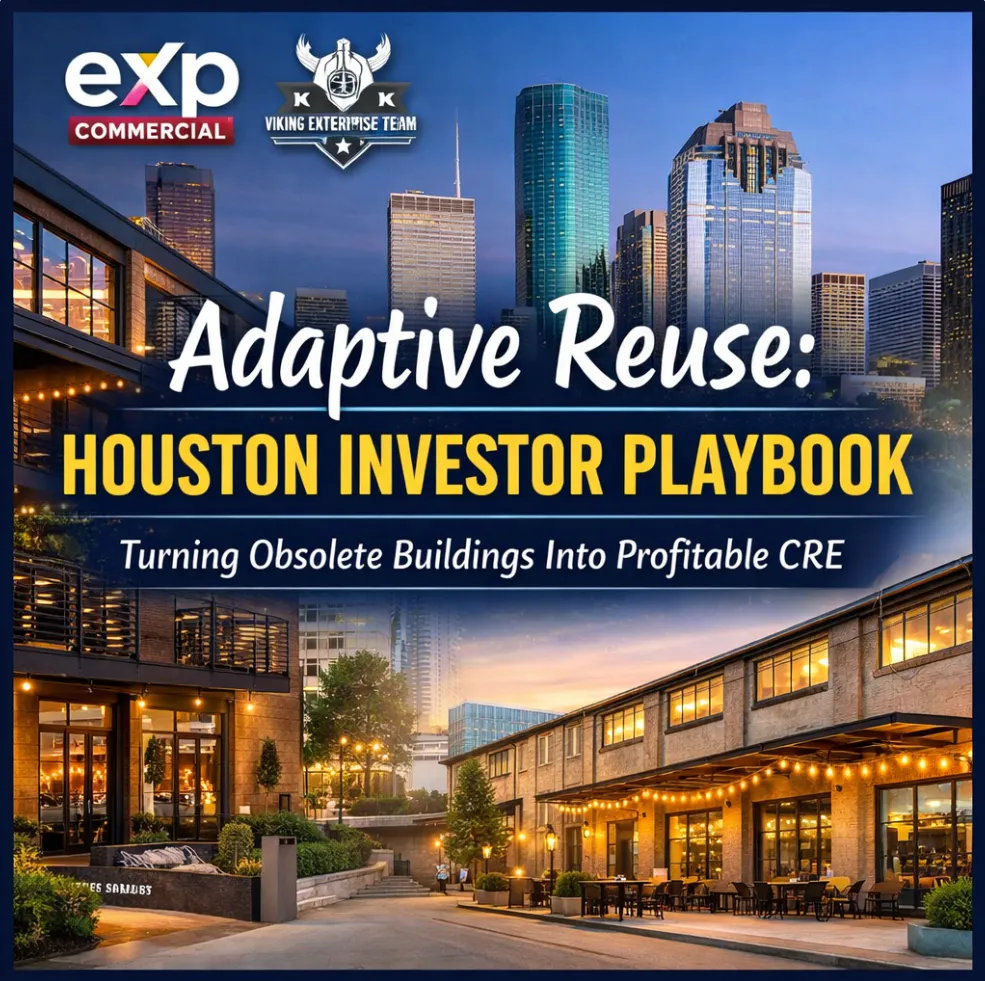
🏗️ The Investor’s Guide to Adaptive Reuse in Houston: Turning Obsolete Buildings Into Profitable Assets 💰
🏗️ The Investor’s Guide to Adaptive Reuse in Houston: Turning Obsolete Buildings Into Profitable Assets 💰
🏙️ Adaptive Reuse in Houston CRE: How Investors Unlock Value in Aging Properties 🔑
The Investor’s Guide to Adaptive Reuse in Houston
Adaptive reuse is no longer a niche strategy—it is becoming a core investment thesis for commercial real estate investors navigating Houston’s shifting demand patterns. As office vacancies rise, retail footprints evolve, and older properties struggle to compete, adaptive reuse offers a path to value creation rather than value erosion.
In markets like Houston, where land scarcity in core corridors intersects with strong population growth, adaptive reuse allows investors to reposition underperforming assets into income-producing properties aligned with modern demand.
What Is Adaptive Reuse in Commercial Real Estate?
Adaptive reuse involves repurposing an existing structure for a new commercial use rather than demolishing and rebuilding. Common Houston examples include:
·Office buildings converted into multifamily or mixed-use
·Warehouses transformed into creative retail or flex space
·Churches, schools, or industrial facilities repurposed into medical, office, or residential assets
For investors, adaptive reuse often means lower acquisition costs, faster entitlement timelines, and access to locations that would otherwise be cost-prohibitive.
Why Adaptive Reuse Is Gaining Traction in Houston
Houston’s commercial landscape is undergoing structural change:
·Office oversupply in certain submarkets
·Retail consolidation favoring experiential and service-oriented tenants
·Industrial and medical demand expanding beyond traditional zones
·Municipal pressure to revitalize aging corridors
Rather than waiting for rents to recover, investors are repositioning assets to meet today’s demand, not yesterday’s.
Key Financial Advantages for Investors
Adaptive reuse can significantly improve deal economics when executed correctly:
·Lower basis compared to ground-up construction
·Potential historic tax credits or local incentives
·Accelerated leasing by delivering differentiated space
·Improved exit cap rates due to modernized income streams
From a financing standpoint, lenders evaluate adaptive reuse projects based on stabilized NOI, tenant profile, and execution risk—not simply the original use of the property.
Zoning, Permits, and Feasibility Matter
Houston’s lack of traditional zoning offers flexibility—but not a free pass. Investors must still navigate:
·Deed restrictions
·Parking and access requirements
·Utility capacity and infrastructure
·ADA and code compliance
The most successful adaptive reuse projects start with a rigorous feasibility analysis, not a conceptual vision.
Financing Adaptive Reuse Projects
Capital stacks for adaptive reuse typically blend:
·Bridge or construction financing
·Value-add or transitional debt
·Potential tax credit equity
·Refinance into long-term permanent debt upon stabilization
Working with advisors who understand both commercial real estate and commercial lending is critical to avoid execution risk and capital shortfalls.
Risks to Watch
Adaptive reuse is not without challenges:
·Unexpected structural or environmental issues
·Higher upfront design and engineering costs
·Leasing risk if repositioning misses market demand
·Timeline overruns impacting carry costs
Disciplined underwriting and conservative assumptions separate profitable projects from stalled ones.
Bottom Line for Investors
Adaptive reuse in Houston is not about chasing trends—it is about aligning capital with reality. As demand shifts and obsolete properties increase, investors who understand how to reposition assets intelligently will outperform those waiting for old models to return.
If you are evaluating an underperforming property or exploring redevelopment opportunities, adaptive reuse deserves a place in your strategy.
https://www.houstonrealestatebrokerage.com/
https://www.houstonrealestatebrokerage.com/houston-cre-navigator
https://www.commercialexchange.com/agent/653bf5593e3a3e1dcec275a6
http://expressoffers.com/[email protected]
https://app.bullpenre.com/profile/1742476177701x437444415125976000
https://author.billrapponline.com/
https://www.amazon.com/dp/B0F32Z5BH2
https://veed.cello.so/FOmzTty6oi9
https://creplaybookseries.billrapponline.com
https://creplaybook.billrapponline.com/
© 2023-2024 Bill Rapp, Broker Associate, eXp Commercial Viking Enterprise Team

eXp Commercial - Viking Enterprise team real estate network provides unparalleled commercial real estate services to Tenants and Landlords around the greater Katy & Houston MSA area. Our knowledge, experience, and reputation sets us apart from many firms.
A commercial property owner might have various plans that would necessitate the services of a commercial real estate broker. Some of the common scenarios include:
1. Selling the Property: If the owner decides it’s time to sell the property, a commercial real estate broker can help determine the market value, market the property effectively, and negotiate with potential buyers to get the best possible price.
2. Leasing Space: For property owners looking to lease out part or all of their commercial space, a broker can help find suitable tenants, negotiate lease terms, and ensure the lease agreements meet all legal requirements and serve the owner’s best interests.
3. Acquiring More Properties: Owners looking to expand their portfolio would benefit from a broker's knowledge of the market, access to listings, and negotiation skills to secure additional properties at favorable terms.
4. Property Management: While not all brokers offer this service, some commercial real estate brokers or their affiliates offer property management services. This can be particularly appealing for owners who prefer a hands-off approach or are managing properties from a distance.
5. Market Analysis: Owners considering future developments, renovations, or rebranding of their property might engage a broker for a comprehensive market analysis. This helps in understanding current market trends, the demand for different types of spaces, and potential returns on investment for various strategies.
6. Refinancing: In situations where a property owner is looking to refinance their property, a commercial real estate broker can provide valuable insights into the property’s current market value, assist in gathering necessary documentation, and even help in finding the best financing options.
7. Partnership or Investment Opportunities: Owners interested in exploring partnerships, joint ventures, or seeking investors for expansion or development projects might use a broker to find and vet potential partners or investors.
8. Consulting on Zoning and Use Changes: When contemplating a change in the use of the property or dealing with zoning issues, a broker with experience in local regulations and the specific property type can provide guidance and strategic planning assistance.
9. Exit Strategy Planning: For owners looking to plan an exit strategy from their investment, whether it’s through a strategic sale or a gradual winding down of operations, brokers can provide market insights, timing advice, and valuation services to optimize the exit process.
In any of these scenarios, the expertise and services provided by a commercial real estate broker can save the property owner time and money, while also providing access to a wider network of potential buyers, tenants, and industry professionals. Give us a call today!

Find the perfect location for your business.
Let us help your business succeed.
🏗️ The Investor’s Guide to Adaptive Reuse in Houston: Turning Obsolete Buildings Into Profitable Assets 💰
🏗️ The Investor’s Guide to Adaptive Reuse in Houston: Turning Obsolete Buildings Into Profitable Assets 💰
🏙️ Adaptive Reuse in Houston CRE: How Investors Unlock Value in Aging Properties 🔑
The Investor’s Guide to Adaptive Reuse in Houston
Adaptive reuse is no longer a niche strategy—it is becoming a core investment thesis for commercial real estate investors navigating Houston’s shifting demand patterns. As office vacancies rise, retail footprints evolve, and older properties struggle to compete, adaptive reuse offers a path to value creation rather than value erosion.
In markets like Houston, where land scarcity in core corridors intersects with strong population growth, adaptive reuse allows investors to reposition underperforming assets into income-producing properties aligned with modern demand.
What Is Adaptive Reuse in Commercial Real Estate?
Adaptive reuse involves repurposing an existing structure for a new commercial use rather than demolishing and rebuilding. Common Houston examples include:
·Office buildings converted into multifamily or mixed-use
·Warehouses transformed into creative retail or flex space
·Churches, schools, or industrial facilities repurposed into medical, office, or residential assets
For investors, adaptive reuse often means lower acquisition costs, faster entitlement timelines, and access to locations that would otherwise be cost-prohibitive.
Why Adaptive Reuse Is Gaining Traction in Houston
Houston’s commercial landscape is undergoing structural change:
·Office oversupply in certain submarkets
·Retail consolidation favoring experiential and service-oriented tenants
·Industrial and medical demand expanding beyond traditional zones
·Municipal pressure to revitalize aging corridors
Rather than waiting for rents to recover, investors are repositioning assets to meet today’s demand, not yesterday’s.
Key Financial Advantages for Investors
Adaptive reuse can significantly improve deal economics when executed correctly:
·Lower basis compared to ground-up construction
·Potential historic tax credits or local incentives
·Accelerated leasing by delivering differentiated space
·Improved exit cap rates due to modernized income streams
From a financing standpoint, lenders evaluate adaptive reuse projects based on stabilized NOI, tenant profile, and execution risk—not simply the original use of the property.
Zoning, Permits, and Feasibility Matter
Houston’s lack of traditional zoning offers flexibility—but not a free pass. Investors must still navigate:
·Deed restrictions
·Parking and access requirements
·Utility capacity and infrastructure
·ADA and code compliance
The most successful adaptive reuse projects start with a rigorous feasibility analysis, not a conceptual vision.
Financing Adaptive Reuse Projects
Capital stacks for adaptive reuse typically blend:
·Bridge or construction financing
·Value-add or transitional debt
·Potential tax credit equity
·Refinance into long-term permanent debt upon stabilization
Working with advisors who understand both commercial real estate and commercial lending is critical to avoid execution risk and capital shortfalls.
Risks to Watch
Adaptive reuse is not without challenges:
·Unexpected structural or environmental issues
·Higher upfront design and engineering costs
·Leasing risk if repositioning misses market demand
·Timeline overruns impacting carry costs
Disciplined underwriting and conservative assumptions separate profitable projects from stalled ones.
Bottom Line for Investors
Adaptive reuse in Houston is not about chasing trends—it is about aligning capital with reality. As demand shifts and obsolete properties increase, investors who understand how to reposition assets intelligently will outperform those waiting for old models to return.
If you are evaluating an underperforming property or exploring redevelopment opportunities, adaptive reuse deserves a place in your strategy.
https://www.houstonrealestatebrokerage.com/
https://www.houstonrealestatebrokerage.com/houston-cre-navigator
https://www.commercialexchange.com/agent/653bf5593e3a3e1dcec275a6
http://expressoffers.com/[email protected]
https://app.bullpenre.com/profile/1742476177701x437444415125976000
https://author.billrapponline.com/
https://www.amazon.com/dp/B0F32Z5BH2
https://veed.cello.so/FOmzTty6oi9
https://creplaybookseries.billrapponline.com
https://creplaybook.billrapponline.com/
© 2023-2024 Bill Rapp, Broker Associate, eXp Commercial Viking Enterprise Team
Find the perfect location for your business.
Let us help your business succeed.
Sign up to receive the latest news on property investment and commercial real estate listings.
9600 Great Hills Trail, Suite 150w Austin, TX 78759 |
855.450.0324 xx255
Texas Real Estate Commission Consumer Protection Notice Texas Real Estate Commission
Information About Brokerage Services eXp Commercial LLC #9010212
Viking Enterprise LLC #9009614

Sign up to receive the latest news on property investment and commercial real estate listings.


Contact Us
901 S Mopac Expwy, Bldg 2, Suite 350 Austin, TX 78746 | 512.474.5557Texas Real Estate Commission
Consumer Protection Notice Texas Real Estate Commission Information About Brokerage Services Reliance Retail, LLC #603091
Texas RS, LLC #9003193 | RESOLUT RE Is Licensed In Louisiana #0995694083
Facebook
Instagram
X
LinkedIn
Youtube
TikTok