Your Trusted Houston Commercial Real Estate Brokerage
Viking Enterprise LLC is part of eXp Commercial, an agent-led, cloud-based commercial real estate brokerage with agents across the globe.
Email: [email protected]
Call: (281) 222-0433
Your Trusted Katy / Fulshear & Houston Commercial Real Estate Brokerage
Viking Enterprise LLC is part of eXp Commercial, an agent-led, cloud-based commercial real estate brokerage with agents across the globe.
Looking to invest, buy, sell or lease? We can help.
Looking to invest, buy, sell or lease? We can help.
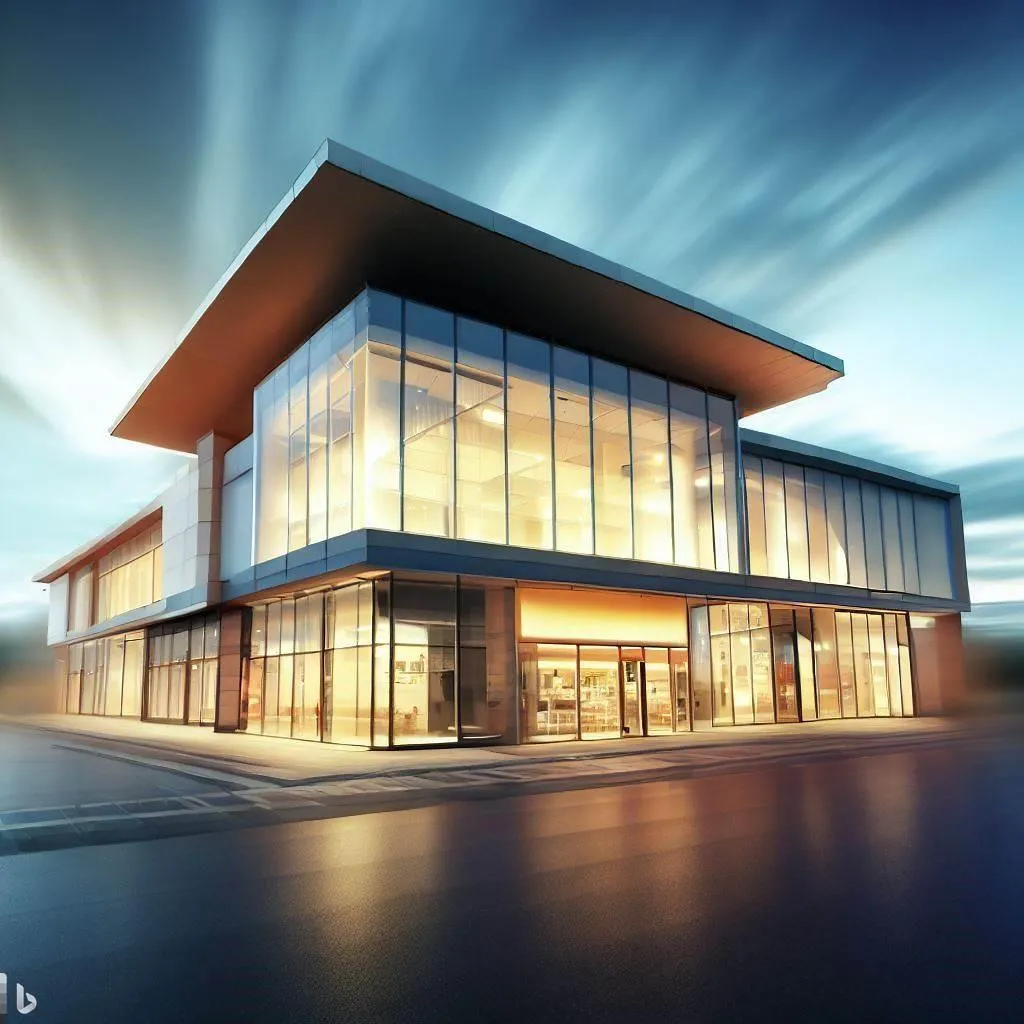
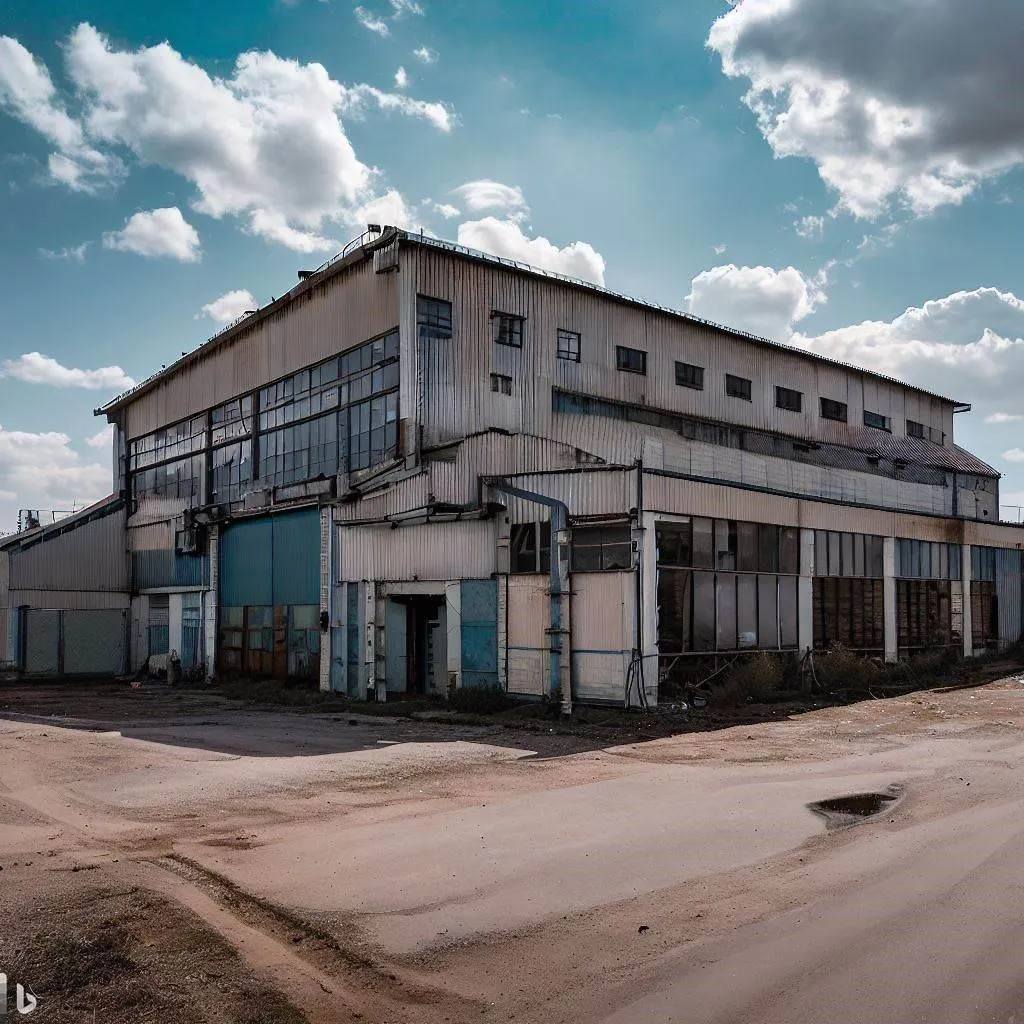
FEATURED PROPERTIES


OUR FEATURED TENANTS & CLIENTS
eXp Commercial - Viking Enterprise Team's real estate network provides unparalleled commercial real estate services to Tenants and Landlords around the Katy- Houston area. Our knowledge, experience, and reputation sets us apart from many firms.
A commercial property owner might have various plans that would necessitate the services of a commercial real estate broker. Some of the common scenarios include:
1. Selling the Property: If the owner decides it’s time to sell the property, a commercial real estate broker can help determine the market value, market the property effectively, and negotiate with potential buyers to get the best possible price.
2. Leasing Space: For property owners looking to lease out part or all of their commercial space, a broker can help find suitable tenants, negotiate lease terms, and ensure the lease agreements meet all legal requirements and serve the owner’s best interests.
3. Acquiring More Properties: Owners looking to expand their portfolio would benefit from a broker's knowledge of the market, access to listings, and negotiation skills to secure additional properties at favorable terms.
4. Property Management: While not all brokers offer this service, some commercial real estate brokers or their affiliates offer property management services. This can be particularly appealing for owners who prefer a hands-off approach or are managing properties from a distance.
5. Market Analysis: Owners considering future developments, renovations, or rebranding of their property might engage a broker for a comprehensive market analysis. This helps in understanding current market trends, the demand for different types of spaces, and potential returns on investment for various strategies.
6. Refinancing: In situations where a property owner is looking to refinance their property, a commercial real estate broker can provide valuable insights into the property’s current market value, assist in gathering necessary documentation, and even help in finding the best financing options.
7. Partnership or Investment Opportunities: Owners interested in exploring partnerships, joint ventures, or seeking investors for expansion or development projects might use a broker to find and vet potential partners or investors.
8. Consulting on Zoning and Use Changes: When contemplating a change in the use of the property or dealing with zoning issues, a broker with experience in local regulations and the specific property type can provide guidance and strategic planning assistance.
9. Exit Strategy Planning: For owners looking to plan an exit strategy from their investment, whether it’s through a strategic sale or a gradual winding down of operations, brokers can provide market insights, timing advice, and valuation services to optimize the exit process.
In any of these scenarios, the expertise and services provided by a commercial real estate broker can save the property owner time and money, while also providing access to a wider network of potential buyers, tenants, and industry professionals. Give us a call today!
Reviews
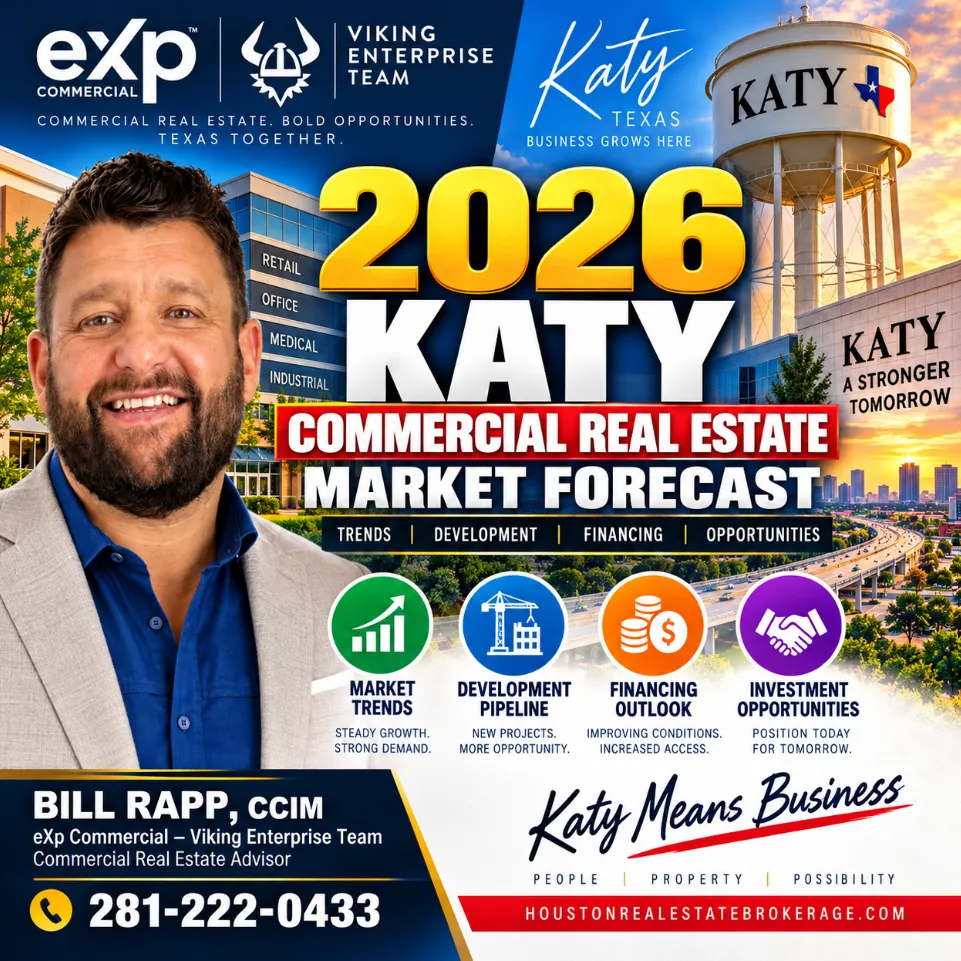
🏙️ 2026 Katy Commercial Real Estate Market Forecast: Growth, Development, Financing & Investment Opportunities 📈
🏙️ 2026 Katy Commercial Real Estate Market Forecast: Growth, Development, Financing & Investment Opportunities 📈
🚀 Katy Commercial Real Estate in 2026: Where Investors & Business Owners Should Be Looking 🏢
2026 Katy Commercial Real Estate Market Forecast
Katy, Texas continues to evolve from a Houston suburb into a significant commercial real estate market of its own.
Residential expansion, new retail anchors, industrial demand, expanding infrastructure and continued development west along the I-10 corridor are creating opportunities for commercial property investors, developers and business owners.
But 2026 is not simply a growth story.
Capital costs remain elevated, development pipelines need to be evaluated carefully, and investors must distinguish between a growing market and a good individual investment.
Here is my outlook for Katy commercial real estate in 2026, focusing on four areas: market trends, development, financing and investment opportunities.
Katy's Growth Continues to Push Commercial Development West
One of the most important themes I continue to watch is straightforward:
Follow the rooftops.
As residential development pushes farther west through Katy, Fulshear, Waller County and the surrounding communities, commercial development tends to follow.
More rooftops can create additional demand for restaurants, medical offices, retail, professional services, childcare, fitness, entertainment and other neighborhood-serving businesses.
A highly visible example is Texas Heritage Marketplace, the roughly $400 million mixed-use development near I-10 and Texas Heritage Parkway. A roughly 95,000-square-foot Lowe's has been preparing to open there, while a 148,000-square-foot Target is also part of the project's expansion.
For investors, the important question isn't simply:
"Where is Katy growing?"
It is:
"Where will population growth translate into sustainable commercial demand?"
That distinction matters.
Retail: Strong Fundamentals, but Be Selective
The broader Houston retail market provides useful context for Katy.
Houston retail vacancy was only 5.8% in Q2 2026, while average asking rents reached $21.43 per square foot, up 5.9% year over year. Approximately 3.6 million square feet remained under construction.
Interestingly, Houston also recorded negative retail absorption during the quarter.
That tells investors something important: low vacancy does not eliminate property-level risk.
Older centers, weak tenant mixes and poorly positioned big-box properties can behave very differently from newer retail projects located in high-growth corridors.
In Katy, I would pay particular attention to neighborhood retail positioned around expanding residential communities and major transportation corridors.
Medical, restaurant, service retail and daily-needs concepts may continue following household formation.
Development Pipeline: Watch West Katy
Texas Heritage Marketplace illustrates the larger trend.
Houston had roughly 3.8 million square feet of retail under construction across 161 developments at the end of Q2, according to Cushman & Wakefield, with the Far Northwest submarket leading construction activity. Texas Heritage Marketplace was among the notable developments cited in that pipeline.
Large anchors matter because they can change surrounding commercial economics.
A major retailer can increase traffic, visibility and consumer activity, potentially supporting nearby restaurants, service businesses, medical users and additional retail development.
But investors should avoid assuming that being close to a major development automatically creates a successful investment.
You still need to evaluate:
Traffic counts + demographics + access + visibility + competition + rents + basis.
Growth can compensate for some mistakes.
It cannot compensate for every mistake.
Industrial & Flex: Another Segment Worth Watching
Katy also benefits from its position along the I-10 industrial corridor connecting Houston with Brookshire and markets farther west.
The broader Houston industrial market remained active during the first half of 2026.
Colliers reported approximately 7.6 million square feet of Q2 net absorption, the strongest quarterly level in four years, with overall vacancy around 7.2%. Approximately 26.1 million square feet was under construction under its market methodology.
Different research firms use different geographic boundaries and methodologies—CBRE, for example, reported 6.7% vacancy and 17.7 million square feet under construction—but the broader message is similar: Houston continues to experience substantial industrial demand alongside a meaningful supply pipeline.
For Katy-area investors, that can create opportunities in:
·Small-bay industrial
·Flex space
·Owner-user warehouses
·Contractor facilities
·Distribution properties
·Industrial outdoor storage
·Service-oriented industrial properties
Smaller owner-user properties can be particularly interesting because the buyer pool includes both investors and businesses that want to control their real estate.
Office: Property Selection Matters More Than Ever
Office deserves a more nuanced approach.
Houston's office market continues to work through the structural changes created by hybrid work, aging inventory and tenant preference for higher-quality space.
Newmark reported 460,135 square feet of positive Houston office absorption in Q2 2026, although first-half leasing volume was the weakest of the post-pandemic period.
That doesn't mean investors should automatically avoid office.
It means the underwriting needs to become more specific.
In suburban markets such as Katy, medical offices, professional services, smaller owner-user buildings and well-located modern office properties can have completely different demand characteristics from older commodity office buildings.
Don't buy "office."
Buy the right office.
Financing Outlook: Cost of Capital Remains Critical
Financing may be the biggest variable influencing commercial real estate transactions during the remainder of 2026.
The Federal Reserve raised its benchmark target range to 3.75%–4.00% on September 16, and policymakers' projections indicated another increase could occur during 2026.
That means investors shouldn't build their acquisition strategy around an assumption that cheaper financing is immediately around the corner.
Instead, I would underwrite a transaction using today's financing environment.
Commercial lenders generally evaluate several constraints, including:
Loan-to-Value (LTV)
How much debt is being requested relative to property value?
Debt Service Coverage Ratio (DSCR)
Does the property's NOI adequately cover its proposed debt service?
Debt Yield
How much NOI does the lender receive relative to its loan exposure?
A property might appraise for $5 million and still fail to support the loan amount the buyer expects because the property's cash flow cannot support the debt.
That makes financing analysis increasingly important before signing a contract.
Where Could the Opportunities Be?
For Katy commercial real estate investors, I see several categories worth monitoring rather than treating any one property type as universally attractive.
1. Neighborhood Retail
Look for locations benefiting from residential expansion, strong demographics and limited competing supply.
2. Medical and Professional Office
Katy's growing population creates continuing demand for healthcare and professional services.
3. Small-Bay Industrial and Flex
These properties can serve contractors, service companies, distributors and owner-users while potentially providing investors with diversified tenant demand.
4. Owner-Occupied Commercial Real Estate
For established businesses, purchasing a building can convert occupancy expense into a long-term real estate asset, although the economics should always be compared with leasing.
5. Land in the Path of Growth
Land can provide significant upside—but timing is everything.
Utilities, detention, entitlement, access, frontage and development costs can determine whether apparently inexpensive acreage is actually developable at an attractive basis.
Don't Confuse Market Growth With Investment Performance
This may be the most important lesson for anyone investing in Katy commercial real estate.
A growing market doesn't automatically make a property a good investment.
You can buy the wrong building in the right market.
Investors should still underwrite:
Tenant quality, lease rollover, market rents, replacement reserves, property taxes, insurance, capital expenditures, environmental risks, financing costs, exit cap rates and competing supply.
I also recommend stress-testing the transaction.
What happens if vacancy increases?
What if rents don't grow?
What if refinancing costs remain elevated?
What if the exit cap rate expands?
A deal that only works under perfect assumptions isn't necessarily a strong deal.
2026 Katy Commercial Real Estate Outlook
Katy's long-term commercial real estate story continues to be driven by population growth, expanding rooftops, transportation access and westward development.
Major projects such as Texas Heritage Marketplace provide visible evidence of that expansion, while broader Houston industrial and retail fundamentals continue to support commercial activity.
At the same time, elevated financing costs make basis, cash flow and debt structure especially important.
For investors and business owners, the objective shouldn't be to chase growth.
It should be to identify where growth, property fundamentals and financing intersect.
I'm Bill Rapp, CCIM with eXp Commercial – Viking Enterprise Team. I help investors and business owners evaluate, acquire, sell and finance commercial real estate throughout Katy, Fulshear, West Houston and the Greater Houston market.
Connect With Viking Enterprise Team
📍 eXp Commercial & eXp Realty
📍 Houston | Katy | Fulshear | West Houston
📅 Calendly.com/VikingEnterprise
📞 281-222-0433
📞 Bill Rapp, CCIM
eXp Commercial | Viking Enterprise Team
Commercial Real Estate & Capital Advisory
🌐 https://houstonrealestatebrokerage.com
https://www.houstonrealestatebrokerage.com/
https://www.houstonrealestatebrokerage.com/houston-cre-navigator
https://www.commercialexchange.com/agent/653bf5593e3a3e1dcec275a6
http://expressoffers.com/[email protected]
https://app.bullpenre.com/profile/1742476177701x437444415125976000
https://author.billrapponline.com/
https://www.amazon.com/dp/B0F32Z5BH2
https://veed.cello.so/FOmzTty6oi9
https://buymeacoffee.com/vikingente3
https://creplaybookseries.billrapponline.com
https://creplaybook.billrapponline.com/
© Bill Rapp, Broker Associate, eXp Commercial Viking Enterprise Team

Commercial Real Estate Advisors Serving Katy, Fulshear & Greater Houston
Helping Property Owners, Investors & Businesses Make Smarter Commercial Real Estate Decisions
Whether you're buying, selling, leasing, investing, or financing commercial real estate, having the right advisor can make all the difference.
At eXp Commercial – Viking Enterprise Team, we provide comprehensive commercial real estate brokerage and advisory services for property owners, investors, developers, landlords, tenants, and business owners throughout Katy, Fulshear, Houston, and the surrounding Texas markets.
Our team combines local market expertise with commercial investment knowledge and capital markets experience to help clients maximize property value, identify new opportunities, reduce risk, and achieve long-term investment success.
From a single office building to a growing investment portfolio, we provide strategic guidance from acquisition through disposition.
Comprehensive Commercial Real Estate Services
Commercial Property Sales
Selling commercial real estate requires far more than placing a property on the market. We develop customized marketing strategies designed to maximize exposure while targeting qualified buyers locally, regionally, and nationally.
Our services include:
Property valuation and pricing strategy
Investment analysis
Professional marketing campaigns
Buyer qualification
Contract negotiation
Due diligence coordination
Transaction management through closing
Whether you're selling office, retail, industrial, multifamily, land, medical, mixed-use, or investment property, our objective is simple—maximize your property's value while creating a smooth transaction.
Commercial Leasing Services
Vacancies reduce cash flow and impact property performance.
We help landlords lease available space by creating effective marketing campaigns, identifying qualified tenants, negotiating favorable lease terms, and minimizing downtime.
Our leasing services include:
Office leasing
Retail leasing
Industrial leasing
Medical office leasing
Flex space leasing
Warehouse leasing
Landlord representation
Tenant representation
Lease renewals
Lease negotiations
Our goal is to keep your property occupied with quality tenants while protecting your long-term investment.
Commercial Property Acquisitions
Whether you're purchasing your first commercial property or expanding a large investment portfolio, we help identify opportunities that align with your investment objectives.
Our acquisition services include:
Market research
Property sourcing
Financial analysis
Cap rate evaluation
Cash flow analysis
Due diligence
Negotiation
Closing coordination
We help investors make informed decisions backed by market data and financial analysis—not emotion.
Investment Property Analysis
Every investment should begin with a thorough understanding of risk and return.
We assist investors by evaluating:
Net Operating Income (NOI)
Capitalization Rates
Cash-on-Cash Returns
Internal Rate of Return (IRR)
Market Rent Analysis
Occupancy Trends
Comparable Sales
Exit Strategies
Our investment analysis helps clients make data-driven decisions before committing capital.
Commercial Financing & Capital Advisory
One of the biggest advantages of working with Viking Enterprise Team is access to commercial financing expertise.
Through our capital markets relationships, we help clients evaluate financing options for acquisitions, refinancing, construction, bridge financing, SBA loans, investment properties, and owner-occupied commercial real estate.
We help clients:
Evaluate financing options
Analyze refinancing opportunities
Improve loan positioning
Understand lender requirements
Coordinate with commercial lenders
Structure financing strategies
Real estate and financing should work together—not independently.
Portfolio Growth & Investment Strategy
Building long-term wealth through commercial real estate requires strategic planning.
We work with investors to:
Expand investment portfolios
Identify off-market opportunities
Improve portfolio performance
Evaluate redevelopment opportunities
Reposition underperforming assets
Develop long-term acquisition strategies
Whether you're purchasing your second investment or your fiftieth, we help create a roadmap for continued growth.
Landlord Representation
Commercial property owners face constant challenges:
Tenant turnover
Lease negotiations
Rental rates
Market competition
Property positioning
We provide landlord representation focused on maximizing occupancy, improving lease terms, increasing property value, and strengthening long-term cash flow.
Tenant Representation
Businesses often outgrow their current space or need a location that better supports future growth.
We represent tenants throughout the site selection process, helping negotiate favorable lease terms while identifying properties that fit operational and financial objectives.
Our tenant services include:
Office space
Retail locations
Industrial facilities
Warehouse space
Medical offices
Flex properties
Build-to-suit opportunities
Market Analysis & Commercial Consulting
Successful commercial real estate decisions begin with accurate market intelligence.
Our advisory services include:
Market studies
Property positioning
Rent analysis
Development feasibility
Redevelopment analysis
Demographic research
Growth corridor identification
Competitive property analysis
Whether you're considering selling today or planning five years ahead, we help you understand where the market is headed.
Joint Ventures & Investment Partnerships
Many commercial opportunities require additional equity, strategic partners, or experienced investors.
We help facilitate introductions between qualified investors, developers, operators, and commercial property owners seeking partnership opportunities for acquisitions, development, redevelopment, or recapitalization.
Exit Planning & Wealth Preservation
Every commercial investment eventually reaches a transition point.
Whether you're considering:
Selling
Refinancing
Recapitalizing
Completing a 1031 Exchange
Passing assets to the next generation
Repositioning your portfolio
we help create an exit strategy that aligns with your financial goals while maximizing value and minimizing unnecessary risk.
Why Choose Viking Enterprise Team?
Commercial real estate is about more than buying and selling properties—it's about creating long-term value.
Our clients benefit from:
Local expertise throughout Katy, Fulshear, Houston, and surrounding markets
Experience representing investors, developers, business owners, landlords, and tenants
Comprehensive brokerage and advisory services
Commercial financing insight and capital markets knowledge
Investment-focused analysis
Strategic negotiation
Professional marketing
Personalized service from initial consultation through closing
We believe informed clients make better decisions, and our role is to provide the expertise, market intelligence, and guidance needed to help you succeed.
Let's Discuss Your Commercial Real Estate Goals
Whether you're buying, selling, leasing, investing, refinancing, or planning your next commercial real estate transaction, Viking Enterprise Team is ready to help.
Schedule a confidential consultation to discuss your objectives and discover how our experience, market knowledge, and strategic approach can help you maximize the value of your commercial real estate investments.
Contact eXp Commercial – Viking Enterprise Team today and let's build your commercial real estate strategy together.

Find the perfect location for your business.
Let us help your business succeed.
🏙️ 2026 Katy Commercial Real Estate Market Forecast: Growth, Development, Financing & Investment Opportunities 📈
🏙️ 2026 Katy Commercial Real Estate Market Forecast: Growth, Development, Financing & Investment Opportunities 📈
🚀 Katy Commercial Real Estate in 2026: Where Investors & Business Owners Should Be Looking 🏢
2026 Katy Commercial Real Estate Market Forecast
Katy, Texas continues to evolve from a Houston suburb into a significant commercial real estate market of its own.
Residential expansion, new retail anchors, industrial demand, expanding infrastructure and continued development west along the I-10 corridor are creating opportunities for commercial property investors, developers and business owners.
But 2026 is not simply a growth story.
Capital costs remain elevated, development pipelines need to be evaluated carefully, and investors must distinguish between a growing market and a good individual investment.
Here is my outlook for Katy commercial real estate in 2026, focusing on four areas: market trends, development, financing and investment opportunities.
Katy's Growth Continues to Push Commercial Development West
One of the most important themes I continue to watch is straightforward:
Follow the rooftops.
As residential development pushes farther west through Katy, Fulshear, Waller County and the surrounding communities, commercial development tends to follow.
More rooftops can create additional demand for restaurants, medical offices, retail, professional services, childcare, fitness, entertainment and other neighborhood-serving businesses.
A highly visible example is Texas Heritage Marketplace, the roughly $400 million mixed-use development near I-10 and Texas Heritage Parkway. A roughly 95,000-square-foot Lowe's has been preparing to open there, while a 148,000-square-foot Target is also part of the project's expansion.
For investors, the important question isn't simply:
"Where is Katy growing?"
It is:
"Where will population growth translate into sustainable commercial demand?"
That distinction matters.
Retail: Strong Fundamentals, but Be Selective
The broader Houston retail market provides useful context for Katy.
Houston retail vacancy was only 5.8% in Q2 2026, while average asking rents reached $21.43 per square foot, up 5.9% year over year. Approximately 3.6 million square feet remained under construction.
Interestingly, Houston also recorded negative retail absorption during the quarter.
That tells investors something important: low vacancy does not eliminate property-level risk.
Older centers, weak tenant mixes and poorly positioned big-box properties can behave very differently from newer retail projects located in high-growth corridors.
In Katy, I would pay particular attention to neighborhood retail positioned around expanding residential communities and major transportation corridors.
Medical, restaurant, service retail and daily-needs concepts may continue following household formation.
Development Pipeline: Watch West Katy
Texas Heritage Marketplace illustrates the larger trend.
Houston had roughly 3.8 million square feet of retail under construction across 161 developments at the end of Q2, according to Cushman & Wakefield, with the Far Northwest submarket leading construction activity. Texas Heritage Marketplace was among the notable developments cited in that pipeline.
Large anchors matter because they can change surrounding commercial economics.
A major retailer can increase traffic, visibility and consumer activity, potentially supporting nearby restaurants, service businesses, medical users and additional retail development.
But investors should avoid assuming that being close to a major development automatically creates a successful investment.
You still need to evaluate:
Traffic counts + demographics + access + visibility + competition + rents + basis.
Growth can compensate for some mistakes.
It cannot compensate for every mistake.
Industrial & Flex: Another Segment Worth Watching
Katy also benefits from its position along the I-10 industrial corridor connecting Houston with Brookshire and markets farther west.
The broader Houston industrial market remained active during the first half of 2026.
Colliers reported approximately 7.6 million square feet of Q2 net absorption, the strongest quarterly level in four years, with overall vacancy around 7.2%. Approximately 26.1 million square feet was under construction under its market methodology.
Different research firms use different geographic boundaries and methodologies—CBRE, for example, reported 6.7% vacancy and 17.7 million square feet under construction—but the broader message is similar: Houston continues to experience substantial industrial demand alongside a meaningful supply pipeline.
For Katy-area investors, that can create opportunities in:
·Small-bay industrial
·Flex space
·Owner-user warehouses
·Contractor facilities
·Distribution properties
·Industrial outdoor storage
·Service-oriented industrial properties
Smaller owner-user properties can be particularly interesting because the buyer pool includes both investors and businesses that want to control their real estate.
Office: Property Selection Matters More Than Ever
Office deserves a more nuanced approach.
Houston's office market continues to work through the structural changes created by hybrid work, aging inventory and tenant preference for higher-quality space.
Newmark reported 460,135 square feet of positive Houston office absorption in Q2 2026, although first-half leasing volume was the weakest of the post-pandemic period.
That doesn't mean investors should automatically avoid office.
It means the underwriting needs to become more specific.
In suburban markets such as Katy, medical offices, professional services, smaller owner-user buildings and well-located modern office properties can have completely different demand characteristics from older commodity office buildings.
Don't buy "office."
Buy the right office.
Financing Outlook: Cost of Capital Remains Critical
Financing may be the biggest variable influencing commercial real estate transactions during the remainder of 2026.
The Federal Reserve raised its benchmark target range to 3.75%–4.00% on September 16, and policymakers' projections indicated another increase could occur during 2026.
That means investors shouldn't build their acquisition strategy around an assumption that cheaper financing is immediately around the corner.
Instead, I would underwrite a transaction using today's financing environment.
Commercial lenders generally evaluate several constraints, including:
Loan-to-Value (LTV)
How much debt is being requested relative to property value?
Debt Service Coverage Ratio (DSCR)
Does the property's NOI adequately cover its proposed debt service?
Debt Yield
How much NOI does the lender receive relative to its loan exposure?
A property might appraise for $5 million and still fail to support the loan amount the buyer expects because the property's cash flow cannot support the debt.
That makes financing analysis increasingly important before signing a contract.
Where Could the Opportunities Be?
For Katy commercial real estate investors, I see several categories worth monitoring rather than treating any one property type as universally attractive.
1. Neighborhood Retail
Look for locations benefiting from residential expansion, strong demographics and limited competing supply.
2. Medical and Professional Office
Katy's growing population creates continuing demand for healthcare and professional services.
3. Small-Bay Industrial and Flex
These properties can serve contractors, service companies, distributors and owner-users while potentially providing investors with diversified tenant demand.
4. Owner-Occupied Commercial Real Estate
For established businesses, purchasing a building can convert occupancy expense into a long-term real estate asset, although the economics should always be compared with leasing.
5. Land in the Path of Growth
Land can provide significant upside—but timing is everything.
Utilities, detention, entitlement, access, frontage and development costs can determine whether apparently inexpensive acreage is actually developable at an attractive basis.
Don't Confuse Market Growth With Investment Performance
This may be the most important lesson for anyone investing in Katy commercial real estate.
A growing market doesn't automatically make a property a good investment.
You can buy the wrong building in the right market.
Investors should still underwrite:
Tenant quality, lease rollover, market rents, replacement reserves, property taxes, insurance, capital expenditures, environmental risks, financing costs, exit cap rates and competing supply.
I also recommend stress-testing the transaction.
What happens if vacancy increases?
What if rents don't grow?
What if refinancing costs remain elevated?
What if the exit cap rate expands?
A deal that only works under perfect assumptions isn't necessarily a strong deal.
2026 Katy Commercial Real Estate Outlook
Katy's long-term commercial real estate story continues to be driven by population growth, expanding rooftops, transportation access and westward development.
Major projects such as Texas Heritage Marketplace provide visible evidence of that expansion, while broader Houston industrial and retail fundamentals continue to support commercial activity.
At the same time, elevated financing costs make basis, cash flow and debt structure especially important.
For investors and business owners, the objective shouldn't be to chase growth.
It should be to identify where growth, property fundamentals and financing intersect.
I'm Bill Rapp, CCIM with eXp Commercial – Viking Enterprise Team. I help investors and business owners evaluate, acquire, sell and finance commercial real estate throughout Katy, Fulshear, West Houston and the Greater Houston market.
Connect With Viking Enterprise Team
📍 eXp Commercial & eXp Realty
📍 Houston | Katy | Fulshear | West Houston
📅 Calendly.com/VikingEnterprise
📞 281-222-0433
📞 Bill Rapp, CCIM
eXp Commercial | Viking Enterprise Team
Commercial Real Estate & Capital Advisory
🌐 https://houstonrealestatebrokerage.com
https://www.houstonrealestatebrokerage.com/
https://www.houstonrealestatebrokerage.com/houston-cre-navigator
https://www.commercialexchange.com/agent/653bf5593e3a3e1dcec275a6
http://expressoffers.com/[email protected]
https://app.bullpenre.com/profile/1742476177701x437444415125976000
https://author.billrapponline.com/
https://www.amazon.com/dp/B0F32Z5BH2
https://veed.cello.so/FOmzTty6oi9
https://buymeacoffee.com/vikingente3
https://creplaybookseries.billrapponline.com
https://creplaybook.billrapponline.com/
© Bill Rapp, Broker Associate, eXp Commercial Viking Enterprise Team
Find the perfect location for your business.
Let us help your business succeed.

Sign up to receive the latest news on property investment and commercial real estate listings.
9600 Great Hills Trail, Suite 150w Austin, TX 78759 |
855.450.0324 xx255
Texas Real Estate Commission Consumer Protection Notice Texas Real Estate Commission
Information About Brokerage Services eXp Commercial LLC #9010212
Viking Enterprise LLC #9009614

Sign up to receive the latest news on property investment and commercial real estate listings.


Contact Us
901 S Mopac Expwy, Bldg 2, Suite 350 Austin, TX 78746 | 512.474.5557Texas Real Estate Commission
Consumer Protection Notice Texas Real Estate Commission Information About Brokerage Services Reliance Retail, LLC #603091
Texas RS, LLC #9003193 | RESOLUT RE Is Licensed In Louisiana #0995694083
Facebook
Instagram
X
LinkedIn
Youtube
TikTok